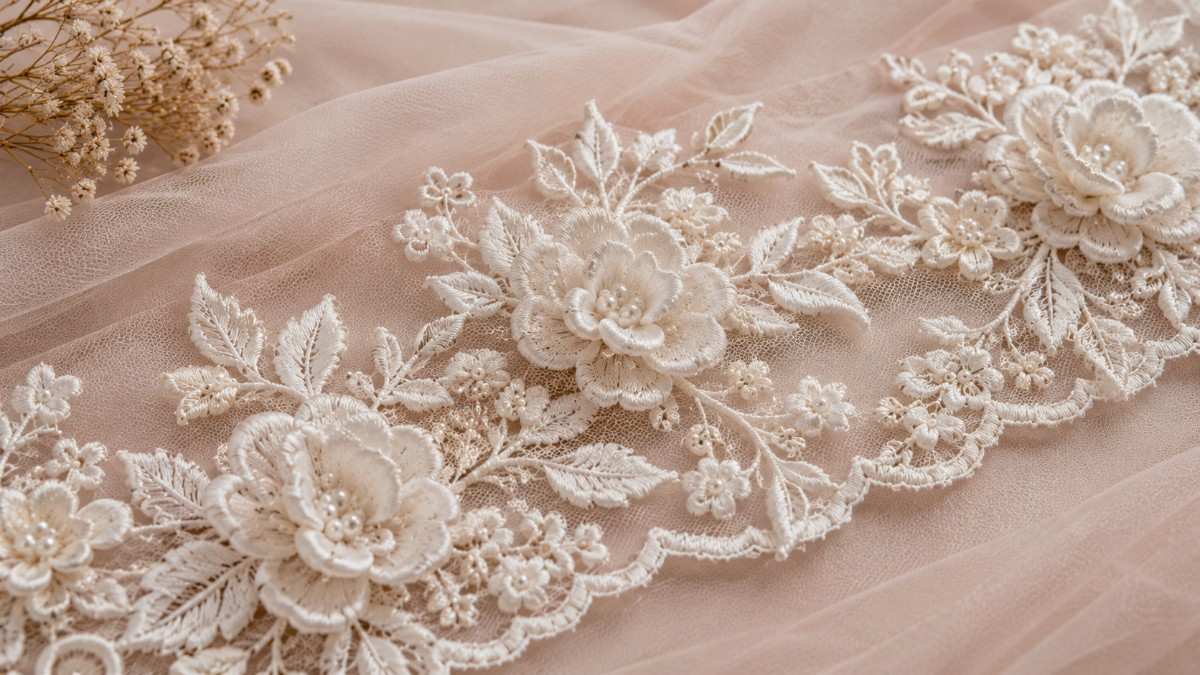
There is a particular kind of lace that stops a buyer mid-aisle. It is not just the pattern or the fineness of the thread. It is the depth. 3D embroidered lace combines the delicacy and design complexity of traditional Schiffli lace with a raised, dimensional quality that creates shadow, texture, and visual presence that flat lace simply cannot deliver.
At Shri Jagdamba Embroidery Pvt. Ltd., we manufacture 3D embroidered lace on Swiss-made Lasser AG MVD 75 Schiffli machines, producing foam-raised dimensional lace fabric for garment exporters, fashion designers, and apparel brands across India and global markets. If you are evaluating 3D lace suppliers for your bridal, fashion, ethnic, or premium casualwear collections, this page gives you the full technical and commercial picture you need to make a confident sourcing decision.
What Is 3D Embroidered Lace?
3D embroidered lace is a specialised Schiffli embroidery format that combines two techniques: chemical lace production, where embroidery is worked on a water-soluble or net base fabric, and dimensional foam embroidery, where foam underlay is placed beneath selected stitch areas to create a raised, sculptural surface.
The result is a lace fabric that has both the intricate, open-work character of traditional Schiffli lace and a three-dimensional depth that makes certain design elements stand proud of the fabric plane. Flowers rise from the lace background. Leaves curve. Borders have a tactile presence that communicates craftsmanship and premium positioning to anyone who touches or photographs the fabric.
This technique is more technically complex than either standard chemical lace or flat 3D embroidery because it requires precise coordination of foam placement, stitch density, thread tension, and dissolution chemistry. The machinery and expertise required to produce 3D embroidered lace consistently at industrial scale is not widely available. Our Lasser AG machines and in-house technical team are specifically configured for this work.
Types of 3D Embroidered Lace We Manufacture
Chemical Lace with 3D Raised Motifs
This is the most sought-after format. A fine chemical lace background is produced on a water-soluble base fabric. Within the lace design, selected motifs, typically floral centres, petal surfaces, or geometric focal points, are embroidered over foam underlay to create raised sections within the otherwise flat lace structure. The base is then dissolved, leaving a freestanding lace fabric where three-dimensional motifs emerge from the delicate lace background.
I have noticed that brands working in premium bridal and occasion wear consistently request this format because the dimensional elements catch light in ways that give garment photography a depth and luxury quality that flat lace cannot produce.
Net Base 3D Embroidered Lace
Here, the background is retained as a fine net or tulle fabric rather than being dissolved away. The Schiffli machine embroiders across the net base, with foam underlay placed beneath selected design elements to create the dimensional effect. The result is a lace fabric with a visible mesh background and raised embroidery sitting above it. This format is popular for overlays, lingerie, and contemporary fashion applications where the net structure contributes to the overall garment aesthetic.
3D Border Lace with Raised Detail
Border lace produced with dimensional elements along the design edge or within the border pattern. Scalloped edges with raised floral elements, raised ribbon motifs within a geometric border structure, or dimensional leaf patterns along a scroll border. These are applied to garment hemlines, necklines, and sleeve edges where the three-dimensional detail is most visible and impactful.
All-Over 3D Lace Fabric
All-over 3D embroidered lace distributed consistently across the full fabric width for use as a garment cloth in its own right. The dimensional elements are integrated into the repeat pattern so the fabric reads as a continuous surface with sculptural qualities throughout. This format is used for structured bodices, full-coverage lace garments, and premium fashion applications where the lace itself is the statement.
Fabric Base and Thread Options
The technical complexity of 3D embroidered lace means base fabric and thread selection are even more critical than in standard lace production.
Water-Soluble Base: The standard for chemical lace production. Dissolved post-embroidery to leave the freestanding lace structure with dimensional motifs intact. Thread selection is critical here because the thread is the sole structural element after dissolution. We use premium threads specifically selected for their post-dissolution integrity and drape behaviour.
Net and Tulle Base: Retained as the visible background for net-base 3D lace. Available in fine power net, hexagonal tulle, and diamond mesh depending on the design intent and garment application.
Organza Base: A semi-transparent, lightweight base that creates a sheer background behind the 3D embroidery. Popular for overlay garments and blouse fabrics where the organza surface adds structure and drape simultaneously.
Thread options for our 3D embroidered lace production include 100% cotton for a natural, matte surface quality; viscose rayon for a silk-like sheen that enhances the dimensional effect; polyester for wash durability; and metallic threads for occasion and bridal applications where the raised elements need maximum light reflection. Our R&D facility works with multi-colour and space-dyed yarns to develop 3D lace with tonal gradient effects that are increasingly popular with contemporary fashion buyers.
At Shri Jagdamba Embroidery Pvt. Ltd., all base options and thread combinations are available for custom 3D lace development. Our technical team will guide you through the selection process based on your design brief and garment end use.
Key Features and Benefits of Our 3D Embroidered Lace
Schiffli Precision at Full Width: Our Lasser AG MVD 75 machines work across 21.5 metres simultaneously. Every foam placement position, every stitch, every dissolved lace section across the full fabric width is controlled by the same digitised program. The consistency between your sample and your bulk production is a technical guarantee, not a production aspiration.
Dimensional Depth Control: Foam thickness is selected at the design development stage to calibrate the height of the raised elements. Fine foam creates a subtle, elegant raise. Heavier foam creates bold, architectural dimensionality. The choice depends on your garment application, photography requirements, and target buyer positioning.
Intricate Design at Industrial Scale: Schiffli technology is the only machine embroidery platform capable of producing the fine detail of chemical lace alongside the structural requirement of foam embroidery at bulk production volumes. Multi-head alternatives cannot achieve this combination at consistent quality and scale.
Structural Thread Quality: 3D lace that collapses, puckers, or loses its dimensional character after washing is a garment-level failure. We use only premium thread stock and run colorfastness and structural integrity tests as part of our standard quality process. The raised sections are specifically checked for foam adhesion and stitch security.
Full Integration Advantage: Design development, embroidery production, dissolution chemistry, and finishing are all managed within our facility and group. There is no handoff to an external dyeing unit or finishing contractor. You deal with one production partner from start to finish.
Applications Across Garment and Fashion Categories
3D embroidered lace from Shri Jagdamba Embroidery Pvt. Ltd. is produced for a wide range of high-value garment and fashion applications:
Bridal and Occasion Wear: Dimensional floral lace for wedding gown bodices, lehenga blouses, bridal overlays, and formal evening separates. The raised embroidery elements in bridal 3D lace translate powerfully in product photography and on the retail floor. Brides and occasion wear buyers actively seek this kind of textural differentiation.
Premium Ethnic Fashion: 3D lace borders and panels for kurtas, anarkalis, sarees, and dupattas in the premium ethnic segment. Raised motifs on ethnic garments communicate the same artisanal quality as hand embroidery but with the consistency and volume capability that export production requires.
Contemporary and Western Fashion: Dimensional lace panels in blouses, bodysuits, co-ord set tops, and overlay dresses for contemporary fashion collections. Brands positioning in premium casualwear and resort fashion use 3D lace to communicate design investment and differentiation within crowded market segments.
Lingerie and Intimate Wear: Net-base 3D embroidered lace for premium lingerie borders, bralette constructions, and sleepwear trim. The raised elements add a tactile quality to lingerie that is a meaningful differentiator at the retail level.
Accessories and Footwear: 3D lace panels for bags, clutches, and decorative footwear uppers. The dimensional surface adds luxury quality to accessories that flat fabric embellishments cannot replicate.
Couture and Custom Fashion: Individual designers and couture labels use 3D embroidered lace for bespoke garment construction where the lace itself is the primary design narrative. In my experience working with garment exporters serving couture-adjacent markets, 3D lace is one of the materials they return to season after season because it consistently elevates their product photography and buyer response.
Manufacturing Process for 3D Embroidered Lace
Understanding the production process helps you plan your sourcing timeline accurately and brief your design and production teams with realistic expectations.
Stage 1: Design Development and Digitisation Your design concept, reference lace, or artwork file is received by our in-house design team. The design is converted into a Schiffli punch file that specifies the lace pattern, the foam placement zones within the design, stitch type and density for both the lace areas and the 3D sections, thread colour assignments, and needle path sequences. When we develop embroidery samples at this stage, we review both the lace character and the dimensional quality of the raised sections before confirming the production file. Getting this right at sampling stage is what makes bulk production clean and efficient.
Stage 2: Material Preparation Thread is matched against your Pantone reference or our in-house shade library. Base fabric is prepared and verified. Foam is cut in the specified thickness and prepared for placement at the designated design positions.
Stage 3: Schiffli Machine Production Base fabric is loaded across the full working width of the Lasser AG machine. Foam is placed at the positions corresponding to the dimensional elements in the design repeat. The machine embroiders across the full width simultaneously, with the shuttle mechanism coordinating underside and surface thread to build the lace structure and the raised foam sections within the same continuous production run.
Stage 4: Chemical Dissolution (for Chemical Lace Base) The embroidered fabric moves into the dissolution process. The water-soluble base is removed in a controlled bath, leaving the freestanding 3D lace structure. This step requires careful temperature and chemistry management to ensure the foam underlay retains its dimensional integrity after the base is dissolved. Our in-house finishing capability means this process is fully controlled within our facility.
Stage 5: Finishing and Quality Control Shearing removes any thread irregularities on the lace surface. The dimensional elements are inspected for raised height consistency, foam security, and edge definition. Every metre of finished 3D embroidered lace is checked for pattern consistency, colorfastness, structural integrity, and dimensional stability. Our facility holds Inditex compliance clearances across social audit, health and safety, and metal detection.
Stage 6: Packing and Export Finished 3D lace fabric is packed with tissue interleaving in roll format to protect the raised embroidery surface during transit. Folded packing and cut-length formats are available on request. Export documentation is handled in-house for all international shipments.
Why Choose Shri Jagdamba Embroidery Pvt. Ltd. for 3D Embroidered Lace
Swiss-Made Machinery for Complex Technical Demands: 3D embroidered lace is one of the most technically demanding Schiffli formats to produce consistently. The combination of chemical lace dissolution chemistry and foam embroidery precision requires a machine platform and production expertise that most embroidery manufacturers in India do not have. Our six Lasser AG MVD 75 machines at 21.5 metres each are the right infrastructure for this work.
GOTS and GRS Certified: According to Textile Exchange, demand for certified sustainable textiles continues to grow among global fashion brands. Our active GOTS certification covers 3D lace production using organic cotton threads and compatible base fabrics. Our GRS certification supports recycled fibre input requirements. Both certifications come with full chain-of-custody documentation.
Inditex Compliance: Social, health and safety, and metal detection audits passed and maintained. This is a meaningful credential for buyers supplying global fashion retailers whose vendor compliance requirements extend through the entire supply chain.
In-House Dissolution and Finishing: Most Schiffli manufacturers outsource the chemical dissolution step for lace production. We handle it in-house within our integrated facility. This means the dissolution chemistry, foam preservation, and post-dissolution finishing are all controlled by the same production team that made the embroidery. Consistency and accountability at every step.
Design Confidentiality and Exclusivity: Every custom 3D lace design is treated as exclusively yours. Design files are not shared, replicated, or adapted for any other buyer. In my experience working with garment exporters, this commitment is particularly critical for bridal and luxury fashion clients whose seasonal lace designs are core commercial assets.
Expert Sampling Support: The development stage for 3D embroidered lace requires more technical iteration than standard embroidery because foam thickness, stitch density, and dissolution behaviour interact in ways that are difficult to predict without physical sampling. Our technical team works closely with you through this process to get the dimensional quality right before committing to bulk production.
Customization Options for 3D Embroidered Lace
Every 3D lace order at Shri Jagdamba Embroidery Pvt. Ltd. is a bespoke production project. Here is what you specify:
Design and Pattern: Completely original from your brief. Floral, botanical, geometric, abstract, or ornamental motifs. Scalloped or straight edges. All-over, border, placement, or panel format. The design language for your 3D lace can be as delicate or as bold as your collection requires.
Dimensional Elements: Which parts of the lace design are raised in 3D and which remain flat. The interplay between dimensional and flat sections within the same lace design is where much of the creative value lies.
Foam Thickness: Fine for subtle, understated dimensionality. Medium for clear visual depth. Heavy for bold, sculptural presence. Selected in consultation with your design intent and garment application.
Base Option: Water-soluble for freestanding chemical lace, net or tulle for mesh-background lace, or organza for sheer-background lace.
Thread: Cotton, viscose rayon, polyester, metallic, multi-colour, or space-dyed. Matched to Pantone, your supplied swatch, or our colour library.
Width and Repeat: Adjusted to your garment cutting layout and construction needs.
Finishing: Dissolution process, shearing, pressing, and dimensional stabilisation. Dyeing coordination available within our group for undyed thread or base options.
Packaging: Roll packing with tissue interleaving, folded, or cut-length with poly-bag and label.
Sustainability and Certifications
Sourcing 3D embroidered lace from a certified facility is increasingly a non-negotiable requirement for global fashion buyers. Our certifications support your compliance obligations at every documentation level.
GOTS (Global Organic Textile Standard): Active certification covering 3D lace production using organic cotton threads and compatible base materials. Full chain-of-custody documentation provided with certified orders.
GRS (Global Recycled Standard): Applicable to production incorporating recycled polyester or other recycled fibre inputs. Supports buyers with recycled content product specifications.
Inditex Compliance: Social audit, health and safety, and metal detection clearances are maintained across our facility. One of the most comprehensive vendor compliance frameworks operating in global fashion manufacturing.
Our R&D team continues to develop 3D lace using sustainable yarn combinations including dyed organic cotton, viscose with natural-dye compatibility, and multi-colour sustainable thread ranges. Our production capability and sustainability credentials are not separate tracks. They advance together.
Request Your 3D Embroidered Lace Sample Today
If you are a garment exporter, fashion brand, or sourcing manager looking for a technically capable, certified, and export-ready 3D embroidered lace manufacturer in India, Shri Jagdamba Embroidery Pvt. Ltd. is ready to support your development from first design brief through to shipped bulk fabric.
Request a sample and evaluate the dimensional quality, lace fineness, and thread character directly in your hands. Share your design concept and receive a structured quotation with realistic production timelines. Bring your specific customisation requirements to our technical team and get clear, expert answers.
We work with buyers who understand that 3D lace is a premium product that requires a premium production partner. If your sourcing standards match that expectation, let us start a conversation.
Contact us at sales@sjepl.in or call 0129-4324141. Visit us at Plot No. 55, Sector 68, Phase IMT, Faridabad, Haryana 121004.