At Shri Jagdamba Embroidery Pvt. Ltd., we work with garment exporters, fashion designers, and sourcing professionals to design and manufacture embroidered patches that meet the exacting standards of global buyers, using Swiss-engineered Lasser AG Schiffli machines and a fully integrated, compliance-ready production facility in Faridabad, India.
Why Designing an Embroidered Patch Requires More Than a Good Idea
Many buyers come to us with a beautiful reference image and expect the production to be straightforward. What surprises them is how much technical decision-making sits between a design reference and a finished embroidered patch ready for garment application.
The choice of base fabric affects how the patch sits on the garment and how it behaves through washing. The yarn type determines whether the finished patch reads as premium or mid-market. The stitch density affects both the visual richness of the design and the weight of the finished patch. The patch dimensions must align with the garment construction tolerances your cutting and stitching unit is working to.
When we develop embroidery samples for buyers who want to design an embroidered patch for the first time, the first conversation is always about end use. Where is the patch going on the garment? What garment category is it for? What market is the garment targeting? Those answers shape every technical decision that follows.
Getting these details right at the sampling stage prevents costly revisions in bulk. In my experience working with garment exporters across India and internationally, the buyers who invest time in the sampling conversation consistently achieve better outcomes and shorter overall development timelines than those who rush to bulk.
Step-by-Step: How to Design an Embroidered Patch With Us
Designing an embroidered patch with Shri Jagdamba Embroidery Pvt. Ltd. follows a structured, collaborative process. Here is how it works from your first contact through to finished patch delivery.
Step One: Share Your Design Brief
Start with whatever reference you have. This could be a vector file, a high-resolution photograph, a scanned sketch, a physical sample from another manufacturer, a mood board, or even a verbal description of the motif, style, and color story you are targeting.
There is no minimum level of design completion required to begin the conversation. Some buyers come with fully finalised artwork. Others come with a seasonal trend direction and ask our design team to develop concepts from scratch. Both approaches work and we handle the full design development and Schiffli punching process in-house.
Step Two: Define the Technical Parameters
Once the design direction is clear, we work through the technical specifications. These include the base fabric type, the yarn type and color palette, the finished patch dimensions, the stitch type and density, any special technique requirements such as 3D foam embroidery or CORD yarn application, and the finishing format, whether the patch is to be supplied as a cut piece, a roll with repeat spacing, or in another configuration suited to your production setup.
Step Three: Sampling
With the brief and technical parameters confirmed, our design team creates the Schiffli punching file and schedules the sample run on our dedicated 5-meter Lasser AG MVD 57 sampling machine. This machine operates at full production scale, so the sample you receive is a genuine representation of what bulk production will deliver. There are no quality gaps between sample and production.
Sampling lead time is approximately one to two weeks from brief confirmation, depending on design complexity and material availability.
Step Four: Review and Refine
You review the physical sample and provide feedback. Adjustments to color, stitch density, dimensions, or design elements are incorporated and a revised sample is produced if required. Most designs are confirmed within one to two sample rounds.
Step Five: Bulk Production
With the sample approved, bulk production is scheduled on our six Lasser AG MVD 75 production machines. ERP-based tracking gives full visibility from production entry through dispatch. Every order goes through in-house mending and shearing for surface finishing and quality inspection before packing.
Patch Types You Can Design and Order
When you design an embroidered patch with us, the format and technique are fully open to your brief. Here are the main patch types we produce.
Neck Patches
Neck patches are precision-dimensioned embroidered elements designed for placement at the neckline of kurtas, kaftans, shirts, and tops. They are one of the most commercially important patch formats in the Indian ethnic wear and export markets.
A neck patch must be dimensionally accurate to within tight tolerances because even a small size variation causes alignment problems during garment stitching. Our ERP-tracked production and in-house quality inspection ensure dimensional consistency across every unit in a bulk order.
Panel and Yoke Patches
Panel patches are larger embroidered sections intended for use as front panels, back yoke panels, sleeve panels, or border strips on garments. They allow a manufacturer to add highly detailed embroidery to a specific garment zone without embroidering the entire fabric length.
Panel patches are widely used in women's ethnic and fusion wear, where a richly embroidered front panel elevates an otherwise simple garment into a premium product.
Badge and Logo Patches
Badge patches are structured, often border-defined embroidered elements used for branding, institutional identification, or decorative purposes on jackets, uniforms, caps, tote bags, and casual wear. Logo patches require precise stitch registration and clean edge definition, both of which are strengths of Schiffli production.
Applique Patches
Applique patches combine an applied fabric element with surrounding embroidery. The contrast between fabric textures creates a layered, dimensional aesthetic. These are widely used in ethnic wear, bridal collections, occasion wear, and kidswear.
3D Embroidered Patches
3D patches use a foam or CORD base beneath the stitching to create a raised, dimensional surface. This technique is popular in streetwear, casual fashion, kidswear, and sportswear-influenced collections. Two of our Lasser AG machines carry CORD attachments specifically for this category of work.
Floral and Motif Patches
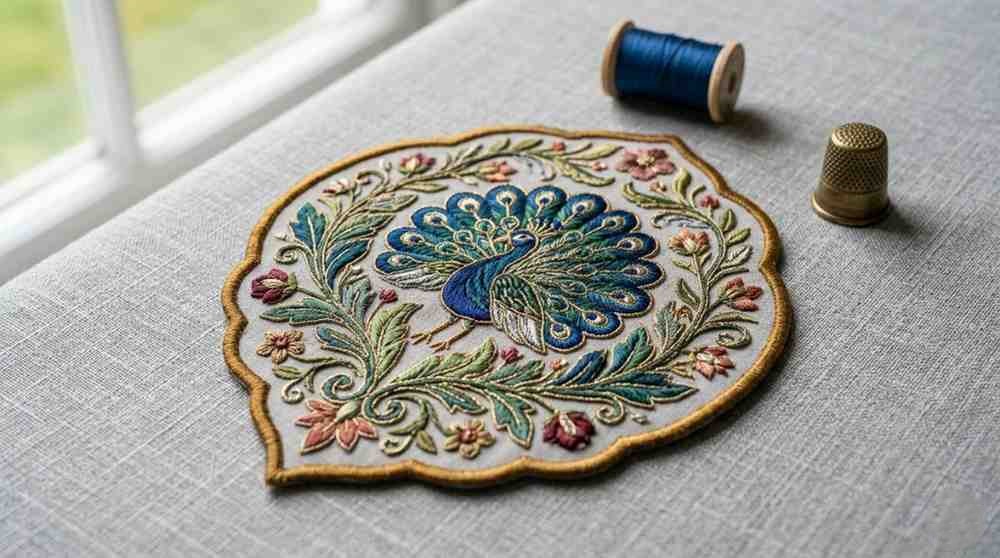
Standalone floral motifs, paisley forms, buti designs, and geometric shapes produced as individual embroidered patches are used across a wide range of garment applications. These can be designed as single motifs, grouped compositions, or repeat-format panels.
Design Options: Motifs, Aesthetics, and Styles
The design language of your embroidered patch is entirely open. Here is a reference for the styles and motifs we most commonly develop, which may help when framing your brief.
Traditional Indian motifs including paisleys, mangoes, lotus forms, jali-inspired geometric fills, and heritage floral compositions are consistent bestsellers in export markets, particularly for buyers supplying South Asian diaspora communities in the UK, US, Canada, Gulf countries, and Australia.
Contemporary and minimalist designs including clean geometric shapes, abstract line work, and tonal stitch-on-stitch textures work well for fusion wear, co-ord sets, and modern ethnic collections targeting younger consumers.
Bridal and occasion wear designs typically involve dense floral compositions, multi-layer motifs, and rich stitch coverage that creates a jewel-like surface effect. These are among the most technically demanding patch designs we produce and also the most commercially rewarding for buyers who get them right.
Kidswear and novelty designs include animals, characters, seasonal motifs, sport references, and bold graphic shapes in bright colorways. Felt applique is commonly combined with embroidery in this category.
Logo and text-based patches require precise stitch registration to reproduce letterforms and brand marks cleanly. These are produced for uniform, promotional, and branded apparel programs.
Base Fabric Options for Embroidered Patch Design
The fabric you choose as the patch base significantly shapes the final aesthetic and performance of the finished product. We work across the following options.
Cotton in its various forms including lawn, cambric, voile, and poplin is the most widely used base for embroidered patches. Stable, breathable, and compatible with natural fiber certifications, cotton suits every garment category and price point.
Viscose and Boski deliver a flowing drape and a premium visual quality that positions patches at a higher market level. These are popular for export collections targeting premium and mid-premium segments.
Net and Organza are used for bridal, occasion wear, and sheer garment constructions. Embroidered patches on net have an open, delicate aesthetic where the design appears to float against the garment. These require exceptional machine precision to avoid fabric distortion.
Polyester and Poly-Cotton offer durability and cost efficiency. These are well-suited to casual wear, uniform, sportswear, and mass-market applications where patch longevity through repeated washing is a priority.
Denim and Twill are used for patch applications in jacket and denim collections. The heavier fabric base handles dense stitch counts well and gives a structured, defined edge to badge-style patches.
Felt is used as a base for bold, graphic patch designs particularly in kidswear and novelty fashion. Its non-woven structure eliminates fraying and allows very clean shape edges.
Yarn Choices That Define the Quality of Your Patch Design
At Shri Jagdamba Embroidery Pvt. Ltd., our investment in R&D means your patch design is not limited to standard poly-spun yarn. The yarn you choose shapes the entire commercial positioning of your finished patch.
Viscose Yarn delivers a silk-like shine that lifts patches into the premium category. Designs stitched with viscose yarn have a luminous finish that reads clearly in product photography and at retail point of sale.
Cotton Dyed Yarn provides a natural, matte finish that aligns beautifully with natural fiber collections and sustainable range positioning. It coordinates well with cotton base fabrics and prints naturally in catalog photography.
Organic Cotton Dyed Yarn is available for GOTS-certified production runs. If your buyer or retail partner requires certified organic input materials, this yarn option supports full supply chain compliance.
Multi-Color Yarn allows gradient shading, color transitions, and complex color effects within a single design pass. This is particularly effective in floral patch designs where petal shading or leaf veining adds realism and design depth.
CORD Yarns of various counts add a raised, sculptural quality to stitch work. Combined with 3D foam techniques, CORD yarn produces the most visually dramatic patch designs we offer.
Applications Across Garment and Product Categories
Embroidered patches designed with us are used across a wide range of garment and product categories.
Women's ethnic wear is the primary application, covering neck patches, front panels, border strips, sleeve details, and standalone motifs on kurtas, kaftans, anarkalis, lehengas, sarees, and dupattas. Fusion and contemporary wear uses patches as design statements in co-ord sets, blouses, and jacket-style tops. Bridal and occasion collections use high-density, multi-technique patches as centrepiece design elements. Kidswear uses felt, applique, and novelty embroidery patches extensively. Casual fashion and streetwear use 3D badge patches and graphic embroidered elements. Uniforms and institutional wear use badge and logo patches. Home textiles and accessories use motif patches on cushion covers, tote bags, and decorative items.
What Sourcing Managers Need to Know
Sampling Lead Time: One to two weeks from brief confirmation to sample dispatch. Complex designs with multi-layer techniques or specialty yarn requirements may take slightly longer and will be confirmed at the start of the project.
Bulk Production Lead Time: Three to five weeks from sample approval to dispatch depending on order volume, design complexity, and production queue.
MOQ: Minimum order quantities vary by patch type, fabric base, design complexity, and technique. We work with buyers to identify commercially practical minimums, particularly for first development orders with a new design. Contact our sales team with your brief for a specific MOQ guideline.
Production Capacity: Our facility produces over two lakh meters of embroidered fabric per month. Patch and panel formats are accommodated within this capacity and scaled based on order volume commitment.
Quality Assurance: All patches go through in-house mending, shearing, and visual quality inspection before dispatch. Dimensional accuracy is monitored at every production stage. ERP tracking provides full order visibility from production entry through dispatch.
Design Confidentiality: All designs developed for or by buyers are kept strictly internal. Non-disclosure agreements are available before development begins on request.
Export Readiness: We handle export documentation, commercial invoicing, packing standards, and freight coordination for international orders.
Certifications Supporting Your Compliance Requirements
According to Textile Exchange, certified sustainable textile inputs have become a sourcing baseline for a growing number of global fashion brands, with European and North American retailers increasingly embedding certification requirements into their vendor compliance programs.
Shri Jagdamba Embroidery Pvt. Ltd. holds GOTS certification for embroidery produced on certified organic cotton base fabric using organic cotton dyed yarn, and GRS 4.0 certification for production involving recycled fiber content. Both certifications come with full transaction certificate documentation available upon request to support your compliance chain.
Our facility has cleared Inditex social, health and safety, and metal detection audits, supporting fast-track vendor approval for buyers supplying to Inditex-group brands. We are also preparing for a transition to solar energy at our Faridabad facility, further strengthening our environmental responsibility credentials.
Customization Available When You Design an Embroidered Patch
Every technical and aesthetic parameter of your embroidered patch can be specified and customized at Shri Jagdamba Embroidery Pvt. Ltd.
You define the base fabric type and color, the applied fabric if applique is involved, the yarn type and color palette, the patch dimensions and shape, the design motif and composition, the stitch type and density, any 3D or CORD technique requirements, and the supply format whether cut piece, roll, or repeat-spaced panel. Multiple colorways of the same design can be developed once the base design is punched and approved, allowing efficient range building across a full seasonal collection.
Ready to Design an Embroidered Patch for Your Collection?
If you are developing a new garment range, fulfilling an export program, or looking for a manufacturing partner who can take your patch design from concept to production-ready quality, Shri Jagdamba Embroidery Pvt. Ltd. is ready to work with you.
You can request a physical sample to evaluate our stitch quality and material finish. You can share your design brief or reference and receive a development plan with a clear timeline. You can speak with our technical team about fabric selection, yarn choice, technique options, and production scheduling for your specific order.
Reach us at sales@sjepl.in or call 0129-4324141. We are available Monday through Saturday and will respond with everything you need to move your project forward with confidence.