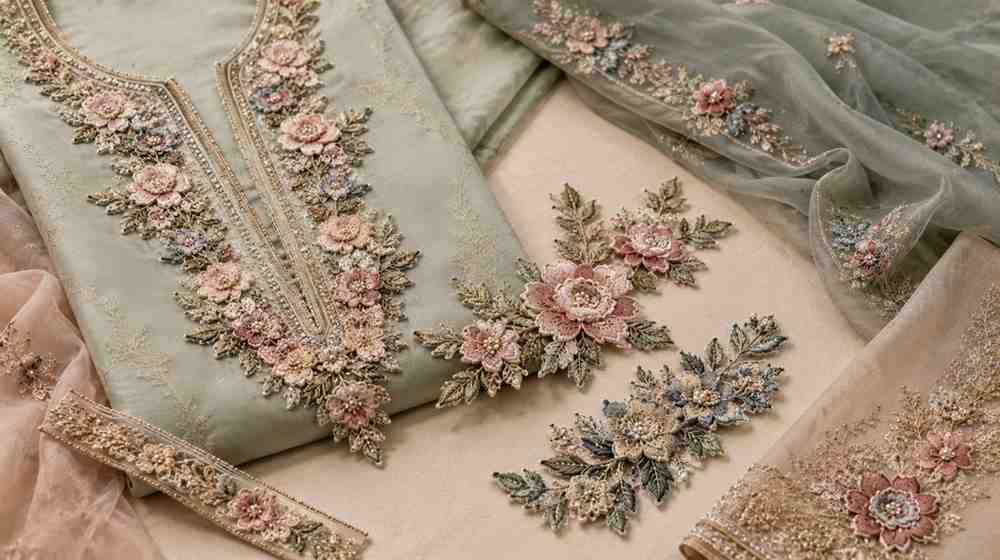
At Shri Jagdamba Embroidery Pvt. Ltd., we manufacture embroidery patches for suits across a wide range of categories, from ethnic salwar suits and sherwanis to contemporary fusion co-ords and formal occasion wear. We work with garment exporters, fashion designers, and sourcing managers who need a manufacturer that understands both the aesthetic demands and the production realities of suit embroidery at scale.
Why Embroidery Patches for Suits Require a Different Level of Precision
A patch on a suit is not a decorative afterthought. It is a placement decision that affects the entire visual architecture of the garment. Proportions matter enormously. A neck patch that is 2 mm too wide reads as heavy. A border panel that is not perfectly symmetrical disrupts the entire silhouette.
Embroidery patches for suits also have to meet a higher standard of consistency than most other garment trims. Ethnic wear buyers in particular are highly sensitive to any variation between pieces in a set. If the neck patch on one suit piece differs in stitch density or color shade from the next, the entire batch becomes a quality issue.
In my experience working with garment exporters who supply ethnic wear and formal occasion collections, suit patches are the most intensely scrutinized trim category at inspection. Getting the sampling right, locking the stitch program, and running tight in-line quality checks are non-negotiable steps in this product category. That discipline is built into our production process at every stage.
The Product: Embroidery Patches for Suits in Full Detail
Fabric Base Options
Selecting the right base fabric for a suit embroidery patch starts with understanding the garment fabric it will be applied to and the visual weight of the embroidery design.
Net and organza bases are the most widely used for ethnic suit patches, particularly neck patches and border panels on salwar suits, churidars, and dupattas. The sheer quality of these bases allows the embroidery to sit lightly on the garment without adding bulk at the neckline or hem. Georgette and chiffon compatible bases are used for patches applied to flowing, lightweight suit fabrics where the patch must not stiffen or disrupt the drape. Cotton and organic cotton bases are preferred for structured patches on casual and semi-formal suits, cotton kurtas, and linen suits where a firmer patch hand feel is appropriate. Viscose bases deliver exceptional thread color vibrancy and a soft, flowing quality that works well on fashion-forward suit designs targeting contemporary women's wear markets. Boski and satin bases are used for premium ethnic suit patches where a rich, lustrous ground beneath the embroidery adds to the perceived luxury of the finished garment. Polyester bases offer durability and wash stability for suit patches used in export programs targeting markets where repeated laundering is a standard consumer behavior.
Embroidery Techniques Best Suited to Suit Patches
Our Swiss-made Lasser AG MVD 75 Schiffli machines, each running at 21.5 meters in length, give us the technical range to produce suit embroidery patches across every major technique category.
Flat Schiffli embroidery is the foundation of most ethnic suit neck patches and border panels. The satin stitch fills, precise outline stitching, and thread color layering achievable on our machines produce a clean, jewel-like patch surface that reads well both in close-up product photography and at retail display distance. Chemical lace suit patches are among the most requested products in our ethnic wear category. The embroidery is worked onto a dissolvable base that is washed away after production, leaving a standalone lace patch with delicate open work and fine botanical or geometric motifs. These patches are applied to necklines, cuffs, and hem borders of salwar suits and kaftans, and they consistently create the premium visual that high-value ethnic wear brands demand.
Applique suit patches combine cut fabric pieces with layered Schiffli stitching to create a textured, dimensional embroidery quality that is distinctive and highly photogenic. This technique is used frequently on contemporary fusion suits and Indo-Western occasion wear. 3D puff embroidery patches for suits create a raised, sculptural quality in select design elements, typically used to lift logo marks, central motifs, or accent flowers within a larger flat embroidery composition.
I've noticed that brands often choose chemical lace patches for their hero suit styles and flat Schiffli patches for mid-range and volume lines within the same collection. The technique decision is as much about commercial positioning as it is about aesthetic preference, and our team helps you navigate that during the development consultation.
Design Aesthetics for Suit Embroidery
The vocabulary of suit patch design is rooted in heritage motifs but constantly evolving toward contemporary interpretations. Paisley and boteh arrangements, geometric lattice borders, floral sprays, mughal-inspired arch motifs, symmetrical yoke compositions, and minimalist linear borders are all categories we produce regularly.
For export programs targeting European and Middle Eastern buyers, suit embroidery patches tend toward restrained, refined compositions with high thread quality and precise stitch definition. For domestic and South Asian diaspora markets, denser embroidery with richer color palettes and layered motif complexity is the norm.
When we develop embroidery samples for suit patches at Shri Jagdamba Embroidery Pvt. Ltd., we always prototype the patch on the actual suit base fabric before approving the stitch program. The way embroidery sits and behaves on a sheer georgette is fundamentally different from how it reads on a structured cotton, and that context must be built into the sample development process.
Sizing, Placement, and Repeat Options
Neck patches for suits typically range from 25 cm to 50 cm in width and 15 cm to 35 cm in length, depending on the neckline style, garment proportion, and design weight. Border panels are produced as continuous yardage with the repeat size calibrated to the garment's hem or sleeve length.
For co-ord suit sets, we produce coordinated patch programs where the neck patch, sleeve patch, and border panel share a common motif language but are scaled appropriately for each placement. This requires careful design planning at the digitizing stage and is something our in-house team manages end to end.
Key Features and Benefits
Precise multi-color stitch control on Swiss Lasser AG Schiffli machines for fine suit patch detail. Full in-house digitizing ensuring suit-specific proportions and placement are built into the stitch program from the start. Multiple strike-off rounds to confirm patch weight, color accuracy, and garment compatibility before bulk production. Thread options covering dyed organic cotton, viscose, metallic, zari-style, and multicolor yarns suited to ethnic and formal wear aesthetics. Colorfastness tested to international wash, light, and rub standards. Consistent production quality maintained across full bulk runs. Coordinated patch programs for co-ord suit sets managed under a single development process.
Applications and End Uses
Ethnic Salwar Suits and Kurtas
Neck patches, yoke patches, front placket embroideries, sleeve patches, and border panels on salwar suits and kurtas represent the largest application volume for suit embroidery patches in the Indian market and in export programs serving South Asian diaspora communities worldwide.
Sherwanis and Men's Ethnic Formal Wear
Embroidery patches for sherwanis tend toward structured geometric and heritage motifs applied to the chest panel, collar, and cuff. The embroidery weight for sherwani patches is typically higher than for women's suits, and the color palette leans toward gold, silver, ivory, and jewel tones.
Contemporary Fusion and Co-Ord Sets
The growing market for Indo-Western fusion suits and matching co-ord sets has created strong demand for coordinated embroidery patch programs where neck, sleeve, and border elements share a unified design language. This is one of the fastest-growing segments in our suit patch production.
Occasion and Bridal Wear
For bridal lehengas, anarkalis, and heavy occasion suits, embroidery patches carry the full design weight of the garment. These are typically our most complex and most technically demanding programs, involving dense multi-color compositions, zari-style metallic threads, and large format patch sizes.
Export Garment Programs
Garment exporters supplying ethnic wear and occasion collections to the United Kingdom, United States, Canada, the Middle East, and Southeast Asia are consistent buyers of our suit embroidery patches. Our export documentation, packing capability, and buyer compliance familiarity make the sourcing process efficient for international programs.
The Manufacturing Process
Design Intake and Review: You share your suit patch design as a vector file, high-resolution image, or physical reference embroidery. Our digitizing team reviews the design for stitch-ability, proportion on the suit base fabric, and thread color requirements before programming begins.
Digitizing: The confirmed design is converted into a stitch program. Motif placement, stitch direction, color sequencing, and density are programmed to produce the intended visual result on the specified suit base fabric.
Strike-Off Sampling: The first machine run produces a strike-off sample on the actual or representative base fabric. Color, proportion, stitch quality, and patch weight relative to the suit fabric are reviewed. Adjustments are made and additional strike-offs are produced until the sample meets your standard.
Bulk Production: Approved designs move to full production runs on our Lasser AG machines with in-line thread tension and registration monitoring throughout.
Finishing: Loose threads are sheared. Irregularities are mended. Chemical lace patches go through a dissolution wash. All patches are dimensionally inspected against the approved sample.
Backing and Cutting: Patches are cut to the specified shape and fitted with the required backing type for your application method.
Quality Check and Packing: Final visual and dimensional inspection is conducted against the approved sample. Approved batches are packed to your specification and prepared for dispatch.
Why Choose Shri Jagdamba Embroidery Pvt. Ltd.
Swiss-Made Lasser AG Machines: The stitch precision, repeat accuracy, and multi-color capability of our six MVD 75 Schiffli machines make them the right tool for the fine detail work that quality suit embroidery patches demand. There is no substitute for machine quality at the production stage.
In-House Digitizing with Garment Context Awareness: Our digitizing team works with an understanding of how suit patches sit on garments, not just how designs look on screen. Proportions, stitch weight, and base fabric compatibility are built into the stitch program from the start.
Integrated Dyeing for Custom Thread Shades: Suit embroidery often requires thread colors, particularly in metallic and zari-style options, that are not available off the shelf. Our group dyeing facility develops custom shades to match your design brief precisely.
Inditex Audit Compliance: Our facility has cleared Inditex social, health and safety, and metal detection audits. For brands supplying global fashion retail formats, this compliance status is a direct advantage in vendor qualification processes.
Coordinated Co-Ord Patch Programs: We manage the full design and production coordination for suit co-ord patch sets under a single development process, giving you consistency across every embroidered element in the set.
Export-Ready Operations: We are experienced in export documentation, freight coordination, and buyer-specific packing for international garment programs. Suit embroidery patches from our facility ship regularly to buyers across Europe, the Middle East, and North America.
Customization Options
Thread Type and Color: Dyed organic cotton, viscose, multicolor blends, metallic threads, zari-style yarns, and glow threads. All colors matched to your Pantone reference or physical swatch with custom shade development available through our in-house dyeing facility.
Patch Shape and Edge Finish: Neckline cutout shapes, rectangular border panels, yoke shapes, sleeve placket formats, and fully custom die-cut shapes. Edge finishes include straight cut, merrow border stitch, laser cut, and heat-sealed options.
Design Scale and Motif Density: Adjusted during the strike-off sampling stage to calibrate the visual weight of the embroidery relative to the suit garment proportions and fabric type.
Backing Type: Plain woven backing, heat-activated adhesive backing, paper backing for sew-on application, and peel-and-stick self-adhesive backing based on your production workflow.
Coordinated Patch Sets: Full design and production coordination for neck, sleeve, and border patch sets within a single suit program.
Packaging: Individual poly-bagged patches, set packing for co-ord programs, roll packing for border yardage, and retail-ready card-mounted packaging depending on your distribution requirements.
Sustainability and Certifications
Shri Jagdamba Embroidery Pvt. Ltd. holds active GOTS (Global Organic Textile Standard) and GRS (Global Recycled Standard) certifications, audited annually by independent accredited bodies. According to Textile Exchange, demand for certified sustainable textiles continues to grow among global fashion brands, with major retailers increasingly building supplier certification requirements into their sourcing frameworks.
For brands whose buyers require sustainability documentation, sourcing suit embroidery patches from a GOTS and GRS certified manufacturer provides valid scope certificates that support retailer compliance scorecards and ESG reporting requirements directly.
Our facility operates with responsible water usage, ethical labor standards, and chemical management practices aligned with REACH and OEKO-TEX norms. These are not aspirational statements. They are audited, documented, and available for buyer review.
Conclusion
If you are sourcing embroidery patches for suits for your next ethnic wear collection, occasion wear program, or export garment range, the right next step is a direct conversation with our team.
Shri Jagdamba Embroidery Pvt. Ltd. brings Swiss machine precision, in-house digitizing expertise, certified sustainable production, and a deep understanding of suit embroidery requirements to every development program we work on.
Request a sample and evaluate our suit patch quality against your current standard. Share your design brief for a development feasibility review. Get a tailored quotation based on your patch type, base fabric, and order volume. Connect with our technical team to discuss technique, thread options, and coordinated patch set requirements.
Reach us at sales@sjepl.in or call 0129-4324141. Our team responds within one business day.