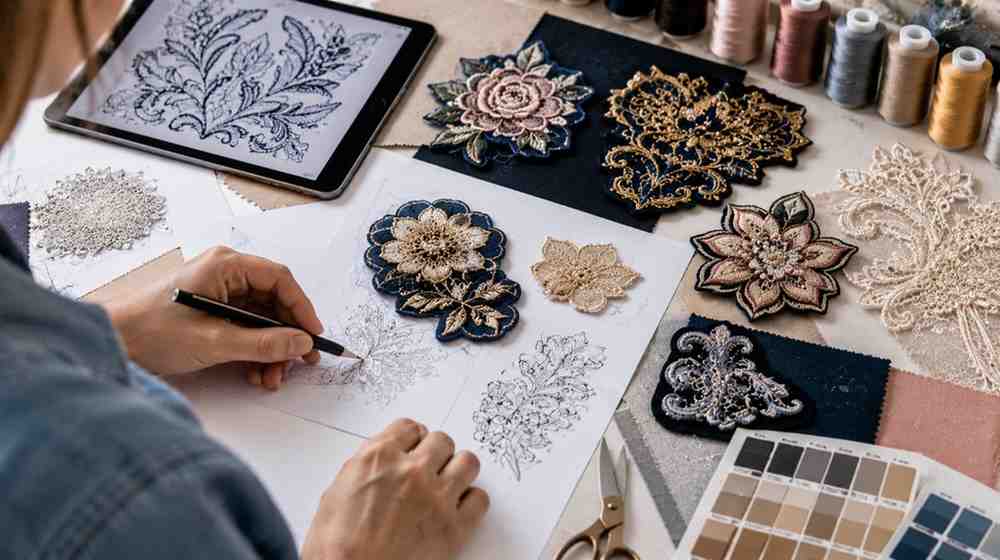
At Shri Jagdamba Embroidery Pvt. Ltd., designing embroidered patches is something we approach with both technical discipline and creative sensitivity. We work with garment exporters, fashion designers, and sourcing managers who know what they want but need a manufacturing partner capable of executing it with consistency across development samples, pre-production runs, and full-scale bulk orders.
What Designing Embroidered Patches Actually Involves
Many brands treat patch design as a simple art file submission. In practice, it is a multi-step technical process where design decisions directly affect production output, cost efficiency, and the final visual quality of the embroidered element.
Designing embroidered patches begins with understanding the end-use context. A woven badge patch for a denim jacket behaves very differently from a delicate net-base neck patch on a formal blouse. The stitch type, thread weight, backing material, and edge finish all need to be calibrated to the specific garment application before any machine is programmed.
This is why working with a manufacturer who has genuine in-house design and digitizing capability matters. At Shri Jagdamba Embroidery Pvt. Ltd., every design goes through a structured development process that bridges your creative concept and the mechanical reality of Schiffli embroidery production.
The Product: Designing Embroidered Patches in Full Detail
Starting With the Right Fabric Base
The base fabric is the canvas, and choosing the wrong one will undermine even the most beautifully designed patch. Our facility works with a comprehensive range of base fabrics, each chosen based on the garment category, design weight, and end-use requirement.
Cotton and organic cotton bases are ideal for structured patches that need a firm hand feel. Viscose bases deliver a softer drape and carry thread colors with exceptional vibrancy, making them popular for fashion-forward collections. Net and organza bases are used for translucent, delicate patch applications in occasion wear, bridal collections, and premium ethnic garments. Polyester bases offer durability and are commonly used in sportswear, workwear, and outerwear patches where wash performance is critical. Linen and linen blends bring a textured, artisanal quality that suits heritage and lifestyle brands well. Satin and Boski bases are reserved for high-end fashion applications where a luxurious surface finish is non-negotiable.
In my experience working with garment exporters, fabric base selection is where the most costly mistakes happen at the development stage. Getting this right in the first sample saves you both time and budget across the season.
Embroidery Techniques Used in Patch Design
Our Swiss-made Lasser AG MVD 75 Schiffli machines, each 21.5 meters in length, allow us to produce a wide spectrum of patch types with outstanding stitch definition and repeat accuracy.
Flat Schiffli embroidery is the foundation. It delivers clean satin-stitch fills, precise outline stitching, and smooth gradient fills that reproduce fine design details faithfully. For brands that want a three-dimensional quality to their patch, 3D puff embroidery creates a raised profile by stitching over a foam underlayer. This technique works especially well on logo patches for caps, jackets, and workwear.
Applique patch design involves placing a cut piece of fabric onto a base and securing it with embroidery stitching around the perimeter and across the design. This creates a layered visual texture that is distinctive and highly durable. Chemical lace patch design takes a different approach entirely. The embroidery is worked onto a dissolvable base fabric, which is then washed away to leave a standalone lace patch with open, breathable negative space.
I've noticed that brands often choose chemical lace patches for ethnic wear neck applications and allover lace panels, while applique patches tend to dominate casualwear and denim collections. Understanding which technique best serves your design intent is something our team discusses with you during the initial development consultation.
Design Aesthetics, Motifs, and Patterns
The visual language of embroidered patches is extraordinarily broad. Geometric blocks, floral motifs, brand typographies, abstract fills, crest and badge designs, heritage-inspired borders, and photorealistic digitized illustrations are all achievable on our machines.
The key constraint to understand is that embroidery works in stitches, not pixels. Every curve, gradient, and color boundary in your design needs to be interpreted by a digitizer who understands how thread behaves at scale. A well-digitized file makes the difference between a patch that looks exactly like your artwork and one that looks like an approximation of it.
When we develop embroidery samples at Shri Jagdamba Embroidery Pvt. Ltd., our digitizing team reviews your design for stitch-ability before anything is loaded onto a machine. Elements that will not translate cleanly are flagged and discussed with you. Small adjustments at the digitizing stage save significant time and material during sampling.
Sizing, Repeat, and Scale Flexibility
Individual patch sizes range from small 3 cm badge patches to large back panels of 40 cm or more. For allover fabric yardage with repeated patch patterns, our machines produce standard-width fabric with your specified repeat size, calibrated to your cutting layout for minimal fabric wastage.
Customization at the sizing level includes the patch shape, the border width, the placement of individual design elements within the patch boundary, and the density of stitch coverage.
Key Features and Benefits of Our Embroidered Patch Design Service
Precision stitch repeatability across bulk runs on Swiss Lasser AG machinery. Full in-house digitizing so your design is never interpreted by a third-party operator. Strike-off sampling at multiple stages to confirm color, stitch density, and scale before bulk production. Thread palette covering dyed organic cotton, viscose, multicolor, metallic, and glow options. Colorfastness tested to international standards for wash, light, and rub. Design confidentiality maintained throughout development and production.
Applications and End Uses
Apparel and Garments
Designing embroidered patches for apparel covers an enormous range of applications. Womenswear brands use them as focal points on blouses, kurtas, dresses, and sarees. Menswear collections apply them to shirt yokes, jacket breasts, and collar bands. Denim brands use signature badge patches on pockets, waistbands, and hem tabs. Childrenswear uses character and motif patches to add playfulness to everyday garments. Ethnic and bridal collections rely on intricate neck patches, border panels, and allover lace patches as primary design elements.
Fashion Accessories
Embroidered patches are frequently applied to bags, caps, footwear uppers, belts, and scarves. A well-designed patch on an accessory can carry as much brand recognition as a logo print, with the added dimension of tactile richness.
Export Garment Programs
For garment exporters supplying international retailers, embroidered patches are a recurring trim requirement across private label programs in Europe, the United States, and the Middle East. Our facility is fully equipped to handle export documentation, buyer-specified packing formats, and third-party quality audit requirements.
The Manufacturing Process Behind Every Patch
Design Intake and Review: Your artwork is submitted in a vector or high-resolution raster format. Our team reviews it for stitch-ability and flags any elements requiring adjustment before digitizing begins.
Digitizing: The confirmed design is converted into a stitch program. Thread colors are mapped to your specified palette. Stitch type, angle, density, and sequence are programmed to produce the intended visual result.
Strike-Off Sampling: The first machine run produces a strike-off sample for your approval. Color, proportion, stitch quality, and overall appearance are reviewed at this stage. Adjustments are made based on your feedback before further samples are produced.
Fabric Preparation and Production: Approved fabric is loaded onto the Lasser AG machine frames. The embroidery run is monitored throughout for thread tension, registration, and continuity.
Finishing: Loose threads are sheared. Irregularities are mended. Chemical lace patches go through a dissolution wash. All patches are inspected dimensionally against the approved sample.
Backing Application and Cutting: Patches are cut to shape and fitted with the backing type specified during order confirmation, whether plain woven, heat-activated adhesive, or sew-on.
Quality Check and Packing: Final inspection covers visual quality, dimensional accuracy, and colorfastness. Approved batches are packed to your specification and prepared for dispatch.
Why Choose Shri Jagdamba Embroidery Pvt. Ltd.
The combination of Swiss machinery, integrated dyeing and finishing, sustainability certifications, and genuine export capability is not common in the Indian embroidery industry. Most manufacturers offer one or two of these. We offer all of them within a single group facility.
Swiss-Made Lasser AG Machines: Six MVD 75 Schiffli machines running at 21.5 meters each deliver the stitch precision and repeat accuracy that export-quality programs require. There is no workaround for poor machinery at the production stage.
In-House Design and Digitizing: We do not outsource your design file to a third-party digitizer. Our in-house team handles the complete journey from your artwork to a machine-ready stitch program. This protects your design and speeds up the development cycle.
Integrated Dyeing and Printing: Our group facility handles dyeing, printing, embroidery, shearing, and mending under coordinated management. You deal with one point of contact, not five vendors.
Inditex Audit Compliance: Our facility has passed Inditex social, health and safety, and metal detection audits. For brands supplying to Zara, Massimo Dutti, and other Inditex retail formats, this compliance status directly supports your vendor approval process.
Experienced Export Team: We are accustomed to working with international buying offices, freight forwarders, and third-party inspection agencies. Export documentation, packing specifications, and shipment coordination are handled efficiently.
Customization Options
Thread Colors and Fiber Types: Select from dyed organic cotton, viscose, multicolor blends, metallic threads, and glow threads. Colors are matched to Pantone references or physical swatches provided by you.
Patch Shape and Edge Finish: Rectangular, circular, shield-shaped, irregular, and fully custom die-cut shapes are available. Edge finishing options include straight cut, merrow border stitch, laser cut, and heat-sealed edges.
Backing Type: Plain woven backing, heat-activated adhesive backing, paper backing for sew-on patches, and peel-and-stick self-adhesive backing are all available.
Packaging Format: Individual poly-bagged patches, assorted packing by size or color, roll packing for yardage, and retail-ready card-mounted packaging can all be arranged depending on your distribution requirement.
Design Repeat and Placement: Single-placement patch programs and repeating allover pattern programs are both supported. Repeat size and placement coordinates are confirmed against your cutting layout before bulk production begins.
Sustainability and Certifications
Shri Jagdamba Embroidery Pvt. Ltd. holds active GOTS (Global Organic Textile Standard) and GRS (Global Recycled Standard) certifications, both audited annually by accredited certification bodies. According to Textile Exchange, demand for certified sustainable textiles continues to grow among global fashion brands, with more retailers requiring supplier-level certification as part of their sourcing criteria.
For buyers responding to retailer ESG scorecards or sustainability reporting requirements, our certifications directly support your compliance documentation. Valid scope certificates are provided with each order.
Beyond certifications, our facility operates with responsible water usage, ethical labor practices, and chemical management aligned with REACH and OEKO-TEX norms. Sustainable production is embedded in how we operate, not added as an afterthought.
Conclusion
If you are ready to move forward with designing embroidered patches for your next collection, development season, or ongoing trim program, we are ready to support you from the first design review through to final shipment.
Shri Jagdamba Embroidery Pvt. Ltd. offers a complete design-to-delivery service with GOTS and GRS certified production, Swiss Schiffli machinery, and a team that understands what serious garment exporters and fashion brands require.
Request a sample and experience our quality directly. Share your artwork for a design feasibility review at no obligation. Get a tailored quotation based on your patch specifications. Speak with our technical team about technique, fabric base, and customization options.
Reach us at sales@sjepl.in or call 0129-4324141. Our team responds within one business day.