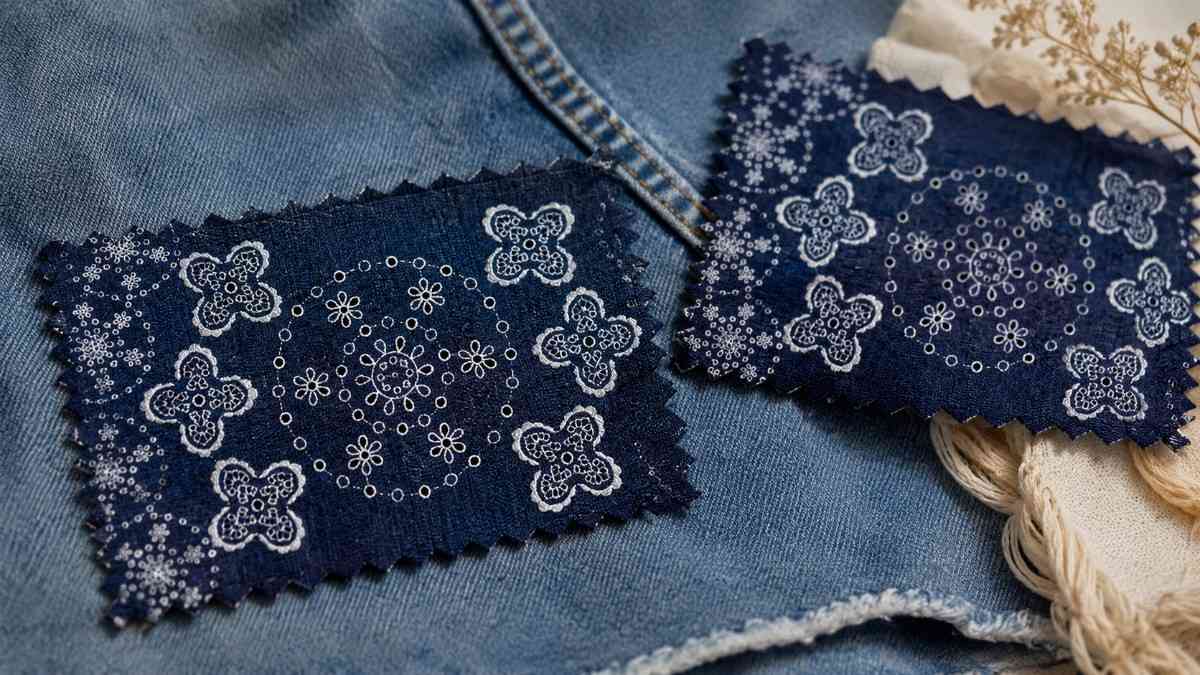
This page is for garment brands, exporters and manufacturers who need patches that arrive ready to attach. It covers what ready-made patches are, which format and attachment method to choose, and what we need from you to quote.
What Are Ready-Made Embroidered Patches?
A ready-made (or pre-made) patch is a finished, cut embroidery piece supplied ready to attach. It differs from embroidery done directly on the garment or on a fabric roll: the patch is embroidered separately, on a base you choose. You may also hear them called cloth patches or fabric patches. In garment manufacturing they all mean the same thing, an embroidered element made off the garment.
Working this way gives you four practical advantages:
- A stable base. The stitch quality does not depend on the garment fabric, so stretch knits, lightweight weaves and denim can all carry the same detail.
- One design, many styles. The same patch can be used across silhouettes and colourways without re-running embroidery each time.
- Approval before production. You check a sample patch before committing to bulk.
- Less waste. If a patch is wrong, you replace the patch, not the garment.
Which Patch Format Do You Need?
The format decides where the patch goes and how it is made. Each has its own page if you want more detail.
| Format | What it is | Typical placement | More detail |
|---|---|---|---|
| Motif or badge patch | Small self-contained motif or logo | Chest, pocket, sleeve, back | custom embroidered patches |
| Neck patch | Shaped to a neckline | Neckline | embroidered clothing patches |
| Panel | Larger embroidered section | Front, back yoke, sleeve, hem | patch or panel embroidery |
| Applique patch | Second fabric layered and stitched down | Chest, yoke, kidswear motifs | applique embroidery |
| 3D patch | Raised on foam or padding | Logos, casualwear, sportswear | 3D embroidery |
Looking for something specific?
See embroidery patches for suits, floral embroidery patches or custom embroidered badge patches. If you are starting from a sketch or reference image, read how we design an embroidered patch.
How Patches Are Attached: Sew-On, Iron-On or Self-Adhesive
The attachment method is set by the backing on the patch, so decide it before sampling. Here is how the three options compare.
| Method | How it works | Strengths | Watch out for |
|---|---|---|---|
| Sew-on (plain back) | The patch is stitched around its edge onto the garment | Most permanent; works on almost any fabric; can be removed and reused | Slower on a production line unless a sewing step is already planned |
| Iron-on / heat-seal | A heat-activated adhesive backing is pressed onto the garment | Fast; no sewing needed | Not suitable for heat-sensitive, coated or waterproof fabrics such as nylon, vinyl or leather; adhesion depends on temperature, pressure and time |
| Self-adhesive | A peel-and-stick backing | Handy for positioning and sampling | Generally not permanent for garments that will be laundered often |
For garments that will be washed frequently, stitching around the edge as well as heat-sealing gives extra security. Edge finishing options include a raw edge or a merrow-stitched border. Whichever method you choose, run a wash and peel test on your actual garment fabric before bulk, and follow the adhesive supplier's specification for heat, pressure and time.
Base Fabrics and Threads
The base sets the patch's hand feel, weight and how it behaves in the wash. We work with:
- Cotton and organic cotton: natural hand feel, accepts dyeing well; GOTS-certified organic cotton on request.
- Viscose: silk-like shine and fluid drape for premium casualwear and occasion wear.
- Polyester and blends: durability and colourfastness for sportswear and workwear where wash performance matters.
- Organza and net: lightweight, semi-sheer bases for delicate patches.
- Linen and cotton-linen blends: natural fibres for lifestyle and heritage ranges.
Thread options include cotton, viscose rayon, polyester, metallic and space-dyed yarns. Each behaves differently on each base, so we recommend a combination during sampling. For help choosing a base, see how to choose the best fabric to embroider.
Where Ready-Made Patches Are Used
- Casualwear and denim: chest patches, back panels and pocket motifs
- Kidswear: playful applique and 3D motifs on tops, dungarees and uniforms
- Workwear and uniforms: logo, team and ID patches
- Ethnic and occasion wear: neck, yoke and border patches
- Accessories: caps, bags and footwear details
How We Make Your Patches
- Design development and digitising. We convert your artwork, sketch or sample into a Schiffli-ready digital file. Two to three design reviews are typical before a file is production-ready.
- Sampling. We make strike-off samples on your chosen base with your thread colours. Sampling usually takes 7 to 10 working days from design approval.
- Bulk production. After approval, production runs on our six Swiss-made Lasser AG MVD 75 machines, each with a 21.5-metre working width. Not sure what that means? Read what schiffli embroidery is and how the machine works.
- Finishing and quality control. Shearing, mending and inspection for stitch uniformity, colourfastness and dimensional accuracy.
- Packing and shipment. Rolled, folded, poly-bagged or individually tagged to your specification, with export documentation handled in-house.
What to Send Us for a Quote
To price and sample quickly, please share:
- Artwork: vector file, high-resolution image, sketch or a physical sample
- Finished size and shape
- Base fabric and thread preference
- Attachment method (sew-on, heat-seal or self-adhesive) and the garment fabric it will go on
- Quantity and colourways
- Packing, labelling and destination
Email sales@sjepl.in or call 0129-4324141, or download our brochure to see the range first. Our facility is at Plot No. 55, Sector 68, IMT, Faridabad, Haryana 121004.
Certifications and Compliance
We hold GOTS certification for organic cotton production and GRS certification for recycled content. Our facility has also cleared Inditex social, health and safety, and metal detection audits. Certificates are available on request for your compliance pack.