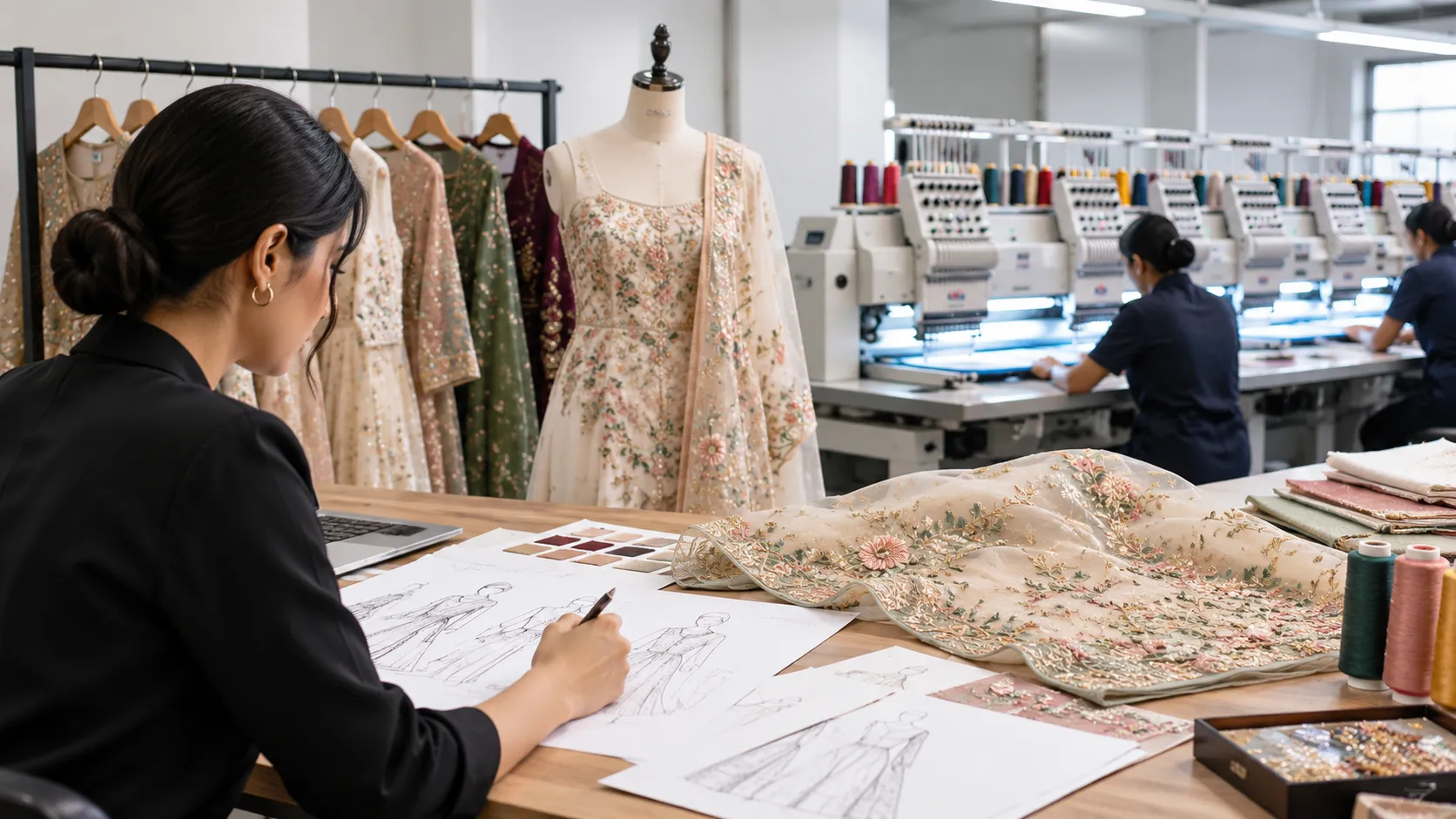
If you design clothing, you already know embroidery can make or break a collection. A beautifully placed motif on a jacket lapel or a hand-worked panel on a bridal lehenga adds a level of craft that printing simply cannot match. But finding embroidery services for fashion designers that actually understand fashion, not just corporate logo work, is harder than it sounds. Most embroidery shops are built for polos and caps. Fashion needs something different: precision on delicate fabrics, small batches, fast sampling, and a partner who won't treat your design like just another order.
This guide walks through what embroidery services for fashion designers should include, how to evaluate a potential partner, and what actually affects cost and quality, so you can make a confident decision for your next collection.
Need embroidery for an upcoming collection?
Get in touch with our team and we'll walk you through samples, timelines, and pricing.
What "Embroidery Services for Fashion Designers" Actually Means
There's a real difference between generic custom embroidery and embroidery built for fashion work. Corporate embroidery shops are optimized for logos on shirts and caps at high volume with low design complexity. Fashion designers usually need the opposite: intricate, often one-of-a-kind designs on smaller quantities, worked onto fabrics like silk, chiffon, velvet, or leather that don't behave the same way cotton does.
A fashion-focused embroidery partner should be comfortable with:
- Small batches and sample runs, not just bulk minimums
- Delicate or unusual fabrics that need special hooping and stabilizer
- A mix of hand and machine techniques within the same garment
- Working directly from a sketch, mood board, or reference image, not just a finished vector file
- Fast turnaround for sampling before a full production run is committed to
This is essentially what falls under embroidery job work: a designer or brand sends fabric or garments to a specialized unit that handles just the embroidery stage, rather than managing an in-house embroidery setup themselves.
Why More Fashion Designers Are Outsourcing Embroidery
Setting up an in-house embroidery unit is expensive. A single multi-head embroidery machine can cost several lakhs, and that's before accounting for digitizing software, skilled operators, thread inventory, and maintenance. For most independent designers and even mid-sized labels, that capital is better spent elsewhere.
Outsourcing also gives designers access to techniques they may not have in-house, like zardozi, aari work, sequin embellishment, or 3D thread work, without hiring specialists for every technique. A good embroidery partner has already invested in the machines, the digitizing expertise, and the skilled hands needed for hand embroidery, so designers can focus on design and merchandising instead of production logistics.
Types of Embroidery Used in Fashion
Not every embroidery technique suits every garment. Here's a quick breakdown of what's commonly used across fashion collections.
Machine Embroidery
Machine embroidery uses computerized, digitized files to stitch consistent, repeatable designs at speed. It's the right choice for structured patterns, allover motifs, brand logos, and anything that needs to be replicated identically across multiple pieces. If you're producing a run of jackets or shirts with the same design on each, this is usually the most cost-effective route. Learn more about our machine embroidery services if this fits your production plan.
Hand Embroidery
Hand embroidery covers techniques like zardozi, aari, mirror work, and thread painting. It's slower and more expensive per piece, but it produces a texture and depth machines can't replicate. This is the natural choice for bridal wear, couture pieces, and statement garments where the embroidery itself is the centerpiece of the design.
Combination Work
Many fashion pieces actually use both. A designer might have the base outline machine-stitched for consistency, then finished by hand with beadwork, sequins, or French knots for detail. A partner who offers both under one roof saves you from coordinating two separate vendors and matching quality between them.
Specialty Techniques
Appliqué, cutwork, chikankari, and 3D puff embroidery each require different equipment or skill sets. If a specific technique is central to your collection's identity, ask upfront whether the partner has direct experience with it, not just general embroidery capability.
What to Look For in an Embroidery Partner
Most articles on this topic stop at "get quotes and compare pricing." That's not enough for fashion work, where the stakes are higher than a logo on a t-shirt. Here's what actually matters.
Sampling Process
Ask how samples are handled before committing to a bulk order. A reliable partner will digitize your design, produce a sample on your actual fabric (or something very close to it), and let you approve stitch density, thread color, and placement before production starts. Skipping this step is one of the most common reasons designers end up with embroidery that doesn't match their vision.
Fabric Compatibility
Silk, net, georgette, and leather all require different stabilizers, needle types, and hooping tension. Ask directly whether the partner has experience embroidering on your specific fabric. A shop that only works with cotton twill for corporate polos may not know how to prevent puckering on chiffon.
Minimum Order Quantities
Fashion designers, especially independent or emerging ones, often need to test a design on 5 or 10 pieces before scaling up. Some embroidery units enforce high MOQs built around bulk corporate orders. Look for partners who are set up for smaller, flexible batches without penalizing you on price per piece.
Digitizing Capability
If your design exists only as a sketch or a photo, the embroidery unit needs an in-house digitizer who can convert it into a stitch file (usually DST, PES, or EMB format) that the embroidery machine reads. Outsourcing digitizing separately adds time and another point of miscommunication, so an in-house team is usually preferable.
Turnaround Time
Fashion moves on tight calendars, especially around fashion weeks and seasonal drops. Ask for realistic turnaround times for both sampling and full production, and confirm what happens if your order needs rush handling.
Custom Design Flexibility
Some brands need embroidery designed entirely from scratch based on a concept, not just executed from a ready file. If that's your situation, look specifically for custom embroidery services that include design development, not just execution.
The Embroidery Digitizing Process, Explained Simply
Digitizing confuses a lot of designers who are new to outsourcing embroidery, so here's the short version.
- You provide the design. This can be a vector file, a raster image, or even a hand sketch.
- A digitizer converts it into a stitch file. This file tells the embroidery machine exactly where to stitch, in what direction, with what density, and in what thread colors.
- A test stitch-out is produced. This is usually done on scrap fabric similar to your actual material, to check how the design translates from screen to fabric.
- Adjustments are made. Stitch density, pull compensation, and underlay are fine-tuned based on the test.
- The final file is approved and used for production.
The quality of digitizing has a bigger impact on the final look than most designers expect. Poor digitizing causes puckering, thread breaks, and designs that look flat or uneven, even if the machine itself is high quality.
Cost Factors in Custom Embroidery for Fashion Brands
Pricing varies a lot depending on a few key factors, and understanding them helps you budget realistically and evaluate quotes.
- Stitch count: More stitches mean more machine time and thread, which raises the cost per piece.
- Design complexity: Multiple thread colors, fine detail, and small lettering all take longer to digitize and stitch cleanly.
- Technique: Hand embroidery costs significantly more per piece than machine embroidery due to labor time.
- Fabric handling: Delicate or slippery fabrics need extra stabilizing steps, which adds time.
- Order volume: As with most manufacturing, cost per piece drops as quantity increases, though a good fashion-focused partner should still offer fair small-batch pricing.
- Placement and garment construction: Embroidering on a flat panel before stitching is cheaper than embroidering on a fully constructed garment with seams and curves in the way.
Rather than comparing a single flat rate across vendors, ask for a breakdown based on your specific design and fabric. Generic quotes rarely reflect what fashion embroidery actually costs.
Embroidery for Different Segments of the Fashion Industry
Embroidery needs shift depending on who you're designing for.
Independent and emerging designers typically need small batches, flexible MOQs, and strong sampling support since they're often testing new designs before a full launch.
Clothing brands scaling production need consistency across larger runs, along with quality control that ensures the 500th piece looks identical to the first. Dedicated embroidery services for clothing brands are built around this kind of repeatable, high-volume execution.
Apparel companies managing multiple product lines often need a partner who can handle varied techniques across categories, from casualwear to formalwear, without quality dropping on any single line. This is where broader embroidery services for apparel companies come in.
Exporters have an added layer of requirements around international quality standards, packaging, and documentation. If you're producing for overseas buyers, it's worth working with a partner experienced in embroidery services for exporters, since export orders often face stricter inspection and compliance checks than domestic ones.
Common Mistakes Designers Make When Outsourcing Embroidery
A few recurring issues come up when designers outsource embroidery for the first time:
- Skipping the sample stage to save time, then discovering the final batch doesn't match expectations.
- Not specifying thread type (rayon, polyester, metallic, cotton) which affects both look and durability.
- Sending low-resolution reference images that make accurate digitizing difficult.
- Underestimating lead time for hand embroidery, which can take days per piece for detailed work.
- Not confirming wash and care compatibility, especially for metallic threads or delicate stitching, before finalizing.
Most of these are avoidable with clear upfront communication and a partner who asks the right questions before starting production.
Conclusion
Good embroidery can elevate a collection, and rushed or mismatched embroidery can just as easily undermine one. The difference usually comes down to the partner you choose. Look for a team that treats sampling seriously, understands your fabric, and can move between machine precision and hand craftsmanship depending on what your design calls for.