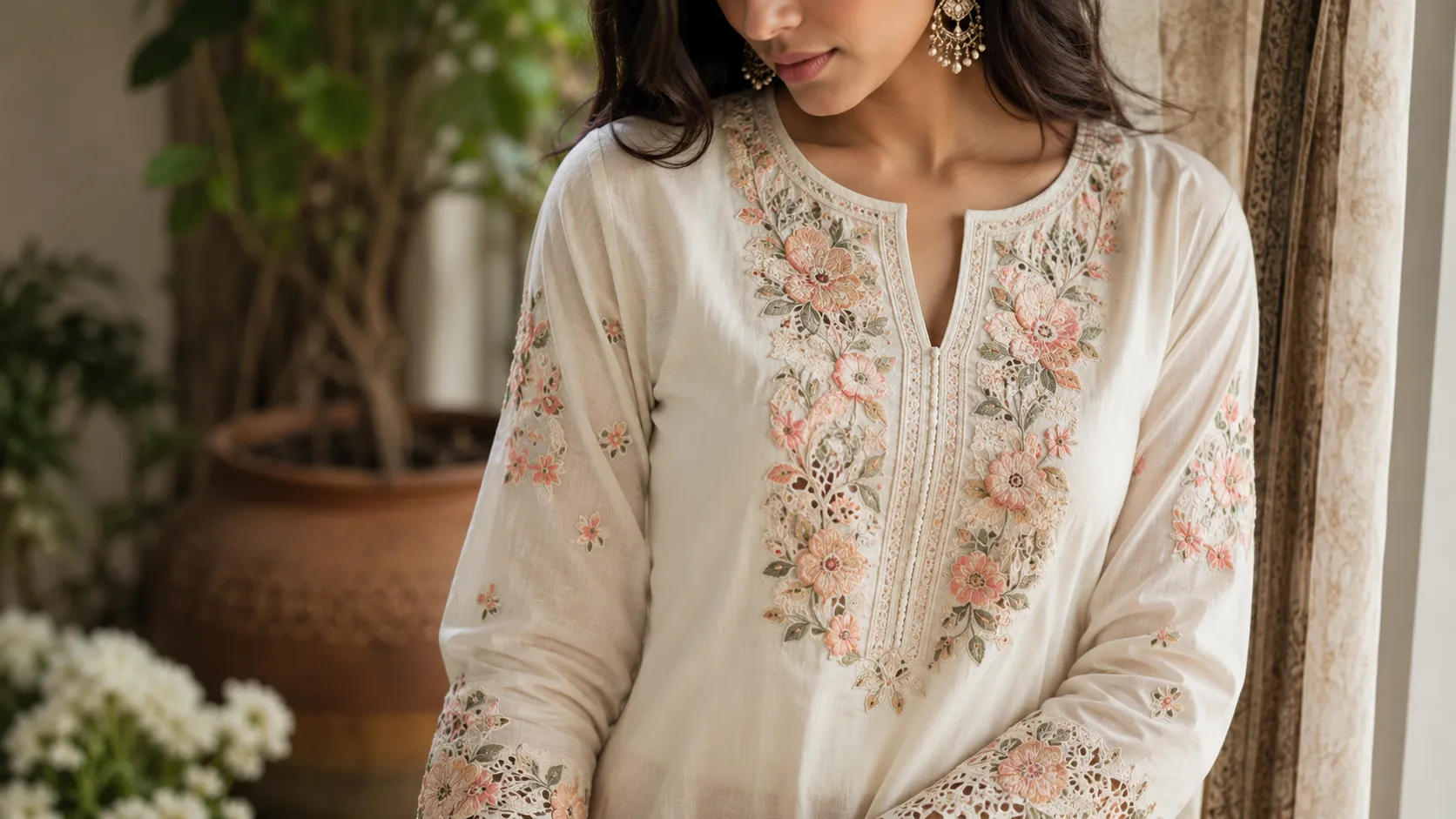
This page is written for two kinds of readers. If you are a designer or brand owner trying to understand what actually goes into a good machine embroidered kurti design, you will find the technical grounding here. If you are a sourcing manager or garment exporter evaluating a Schiffli embroidery partner for a kurti line, you will find the production detail that usually only comes up after three rounds of email back and forth with a vendor. For a broader look at how we approach embroidery on kurtis as a category, that page covers the full range of styles we produce beyond what is detailed below.
What Search Intent Looks Like in this Case
Searches for machine embroidery designs on kurti emanate from two types of audiences. One is the home tailors or small boutique owners looking for inspiration and ideas for their work. The more significant part of the search is performed by apparel brands, private label buyers, and export houses searching for manufacturers of kurti embroidery capable of delivering a consistent design across thousands of garments.
The actual intent behind the search is rarely "what does a nice kurti design look like." The underlying question is “which technique will retain its shape through commercial washing and will the supplier provide identical designs across the whole order”. And this is the question this page is intended to answer.
Why the Differences in Kurti Embroidery
A kurti is worn close to the body, often washed, and worn with nothing over it, so embroidery flaws show more than they would on a garment that is worn more distantly. Three factors contribute to embroidery being a different category than general garment embroidery.
The weight of fabric falls into a tighter band. Kurti tends to use light to medium fabrics, around 100 to 180 GSM in cotton and rayon, and sometimes even lighter in chikankari-style embroidery on voile or muslin. Heavy stitch density on a light base fabric causes puckering, which shows up immediately when a seated position, or movement of the upper arms, causes the kurti to hang.
Higher wash frequency than almost any other garment category. A jacket might see a wash every few weeks. A kurti can be washed every week, in the everyday-wear and office-wear segments. Thread type, backing choice and stitch density must be chosen with this wash frequency in mind, not just appearance on a finished piece.
Placement of neckline and yoke carries disproportionate design weight. A t-shirt's design focus is on the chest, in a logo, but kurti embroidery is done on the more flexible parts of the garment: neckline, yoke, sleeve border and hemline. Design choices that ignore this lead to stiff-looking or cracking embroidery on these areas.
The Main Categories of Machine Embroidery Designs Used on Kurtis
Customers frequently ask us to add "embroidery" to their design brief, without appreciating the range of techniques that fall under this heading, each producing markedly different visual effects, production costs, and wearing characteristics.
Schiffli Thread Embroidery
A dense, high precision thread embroidery, using industrial multi-head Schiffli machines, typically used for floral all-over designs, paisleys, and border patterns that require a repeatable motif across a large yardage of fabric (before cutting into individual kurti panels). Since embroidery is applied to the fabric before being cut into kurti panels, this approach is best suited to achieving a consistent all-over pattern on every garment, rather than individual placement embroidery.
Applique Embroidery
Applique techniques add a second layer of fabric, usually a cotton, netting, or organza, to the fabric surface which is then trimmed to create a decorative stitch border. On kurtis this is often used on the yoke panel and hem borders, to provide a sense of depth and interest, while avoiding the visual weight of a heavily worked thread coverage across a large surface area. If you'd like to explore this method further, our page on applique embroidery covers the technique in more detail.
Chemical Lace and Cutwork
Chemical lace or Schiffli cutwork embroidery techniques use a chemical process to erode the base fabric, within the motif, to create a desirable sheer, lacy effect. This is frequently seen in ethnic wear kurtis on yoke inserts and sleeve panels where a light coverage is desirable.
3D or Puff Embroidery
Puff embroidery uses a raised foam core to create a design that is lifted from the surface of the garment. This technique is rarely used on kurtis in comparison to streetwear, being typically confined to small motif accents, however it is a useful design option to note if the design brief calls for it.
Border and all over chemical lace patterns
Kurtis made using a fabric incorporating a lace panel running down the front placket (or along the hem) will typically have a border pattern that is worked along the length of the fabric, before being cut into the relevant pattern pieces. All-over variations will cover a greater width of fabric and will be appropriate for pieces requiring a lace effect across the yoke or sleeves.
White Kurti Embroidery: A Category With Its Own Rules Essay
White kurti embroidery has certain criteria that need to be considered separately due to several factors that may show on white fabric. When compared to a printed or black base fabric, thread tension, backing shadow, and even the shadow of oil on the fabric are much more noticeable on white or light background materials.
Some factors that need to be considered more closely when it comes to white kurti embroidery include
- The necessity to choose the right kind of backing material that will not be visible through the top fabric after the embroidery process, thread colors’ resistance to light, and increased attention to the condition of the machine.
- The first thing that needs to be paid more attention when working with white kurti embroidery includes the choice of the backing material. One should realize that dark or colored material will be visible through white or light-colored fabric after the embroidery process, which makes such an option a bad choice. As for the second point, one should be extremely careful about the quality of threads since the chikankari embroidery technique traditionally uses white threads to match white fabric. The latter may not always appear white on the fabric; thus, the thread color should ideally be matched to the white textile’s actual color rather than its standard white.
- Finally, the third factor includes the need for extra machine maintenance. Any oil spot or lint that may be present on the fabric would be much more noticeable on a white or light-colored background, meaning that such items will need to undergo an additional visual inspection before being sent to another stage.
From Design Brief to Completed Fabric: An Overview of the Process
Much of buyer confusion around the sourcing process for kurti embroidery arises from the lack of information on what happens between receipt of a design file and delivery of completed fabric. The same sequence of production steps is applied to all of our machine embroidery services here at Textile Universe, simply tailored to the fabric weights and neckline positioning required in production kurtis. Below is an overview of the production sequence.
- Receipt of design file or reference. This may take the form of a vector file, a physical sample garment, a photograph of a design liked by the buyer, or a sketch. Even an incomplete design brief is sufficient for our design team to begin compiling a punch file, at which point our custom embroidery services may come into play if you wish to commission an embroidery design rather than follow a reference closely.
- Digitizing and punching. The selected design is converted into a stitch file which directs the Schiffli machine as to needle path, stitch density, and thread sequencing for the embroidery. This stage determines much of the appearance and performance characteristics of the embroidery, and is therefore not treated as a rapid formality.
- Strike-off and lab dip approval. Before beginning a bulk embroidery production run, a strike-off sample is produced on the base fabric intended for use and compared to a Pantone reference if applicable. This is the point at which thread colours, stitch densities, and repeat sizes are locked in for a given embroidery design in accordance with your approval, and should not be altered during bulk production.
- Sample garment or panel approval. Following strike-off approval, a sample panel or garment piece must be produced for assessment of drape, feel, and performance of the embroidery on the fabric weight and construction to be used in the production pieces.
- In-process checks during bulk production. Bulk production is not a continuous process from first stitch to final piece, but is broken up by in-process inspection points to identify tensioning issues, broken threads, and stitch density problems which may arise throughout the course of production.
- Post-production finishing and inspection. Shearing, mending, and trimming of threads takes place before final inspection and testing for colourfastness and dimensional accuracy against your approved sample.
- Packaging and dispatch. Completed embroidery fabric or garment panels are packed for despatch with appropriate moisture protection in accordance with your requirements, whether for domestic or overseas distribution.
Fabric Compatibility: What Works, and What Needs Adjustment
Not every fabric base takes machine embroidery the same way, and this is where a lot of first-time kurti brands run into avoidable problems.
| Fabric Base | Embroidery Behaviour | Typical Adjustment Needed |
|---|---|---|
| Cotton (100-140 GSM) | Takes stitch cleanly, moderate stretch risk | Lighter stitch density to avoid puckering |
| Rayon / Viscose | Soft drape, prone to puckering under dense work | Stabilizer backing recommended |
| Voile / Muslin | Lightweight, ideal for chikankari-style work | Lower stitch density, careful hoop tension |
| Cotton-linen blends | Slight texture variation affects thread sheen | Thread type matched to fabric texture |
| Chanderi / Silk blends | Delicate, shows needle marks if mishandled | Finer needle gauge, slower machine speed |
If your kurti line moves across multiple fabric bases within one collection, which is common for brands running both everyday cotton kurtis and festive silk-blend pieces, it is worth flagging that upfront during the design brief stage rather than after the strike-off, since backing and needle selection often need to change between bases.
Mistakes We See Buyers Do Most Often
Approved a design on a different weight of fabric to the bulk sample. Motif that looked amazing on a heavier cotton sample can pucker like crazy on a lighter voile base. Always make sure to request your strike-off on the actual fabric GSM you are going to be producing in.
Not considering how much the repeat size will impact fabric wastage. A bigger embroidery repeat might look fabulous on your swatch, but it can significantly add up once you start applying cutting patterns to the whole repeat across your fabric width
This is a discussion best had with your embroidery partner before approving any design for production rather than after.
Skipping the wash test on your approved embroidery sample. Embroidery that looked great coming off the machine can often act up when washed (thread shrinkage) and bleed, especially with darker threads on light fabric. A wash test on your approved sample will usually highlight most issues.
Forgetting to confirm your MOQ and lead time against your overall order schedule. MOQ's can vary significantly depending on design and fabric base, and lead times will change depending on if you require digitizing for a new design or you are re-producing in a different colour. Confirming this well ahead of your ship date will save you from any production rush later.
Why Brands Choose Shri Jagdamba Embroidery for Kurti Development
Our in-house Schiffli embroidery machines produce the delicate precision required to execute yoke and neckline finishes on fine kurti fabrics. As part of a larger production chain that also carries out dyeing and printing, we provide counsel on textile- and colour-specific preparations that other standalone embroidery units may not be able to advise on.
In practical terms, this means that a kurti brand or export house can work with a single contact on both design development and execution, sampling, full-production orders and quality control, without having to juggle multiple suppliers throughout the process.
Talk to Our Design Team
A kurti design concept, or even a rough sketch alongside an idea for a particular fabric, is enough for our design team to advise on digitization, strike-off and sampling processes prior to larger-scale production. Contact us to request a sample, discuss design development ideas, or ask for a technical assessment of textiles and techniques for your next kurti collection.
Contact Shri Jagdamba Embroidery to share a design brief, or request a quotation for kurti production.