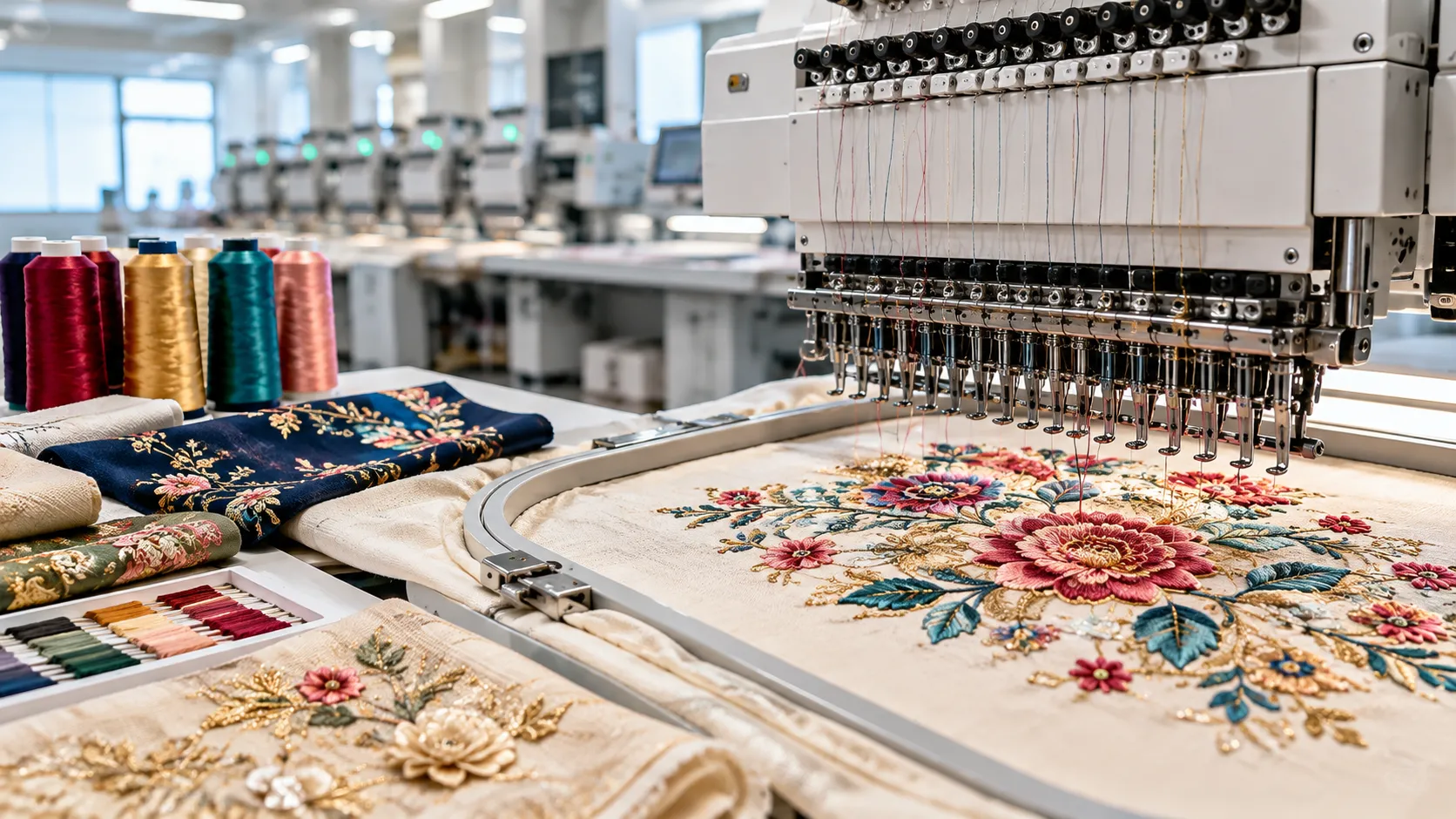
We offer custom embroidery services as an export-oriented Schiffli embroidery manufacturer based in Faridabad, Haryana. We are Shri Jagdamba Embroidery Pvt. Ltd., and this article aims to describe our production process for custom embroidery pieces, outlining what a brand or another embroidery manufacturer should expect when working with us.
Who Needs Custom Embroidery Services?
Not every embroidery requirement is custom. If you just need an existing floral all over pattern for a kurti collection, that's more like sourcing from a design library than developing something new. We have different services for different needs.
You are likely to need our services for a custom embroidery development if any of the following applies to your brief:
- You have a logo or brand mark that has not been digitized for embroidery before
- You are replicating a sample from a competitor or inspiration garment, rather than an in-house order
- Your design incorporates multiple techniques, such as Schiffli thread work in conjunction with applique or chemical lace
- You require replication across several fabric bases or garment category in same season
- Your existing embroidery has quality issues you cannot fix at source, requiring a new punch file rather than patching
If none of the above applies to your request and you just need a design executed consistently across production, that most likely falls under machine embroidery services rather than a fresh custom development cycle. Knowing the difference saves a round of back and forth before a project has even started.
Design Development: Where Custom Embroidery Actually Begins
I have noticed that many fashion brands perceive digitizing as something mechanical- a clerical activity. It is not. It is the point where a 2 D image is converted to needle paths, stitch types and sequencing which will dictate how the embroidered design will look on the garment. I can see why it matters
A digitizer working on a bespoke brief has to make judgements that software cannot. Will a running stitch or a narrow satin stitch be used to render a fine text logo so that it remains legible even at smaller sizes? Will fill stitches be worked in directional angle to catch the light, or would tatami fill offer a more consistent and flat finish? Would the density of stitches be reduced towards the periphery of a motif to avoid a hard edging? This is not the time to go by a template. These decisions are informed by someone who has punched in enough files to know how each stitch type will appear when transferred to media.
Fabric choices also come into play here; even before strike offs. A voile kurti panel would not take the same density as a twill jacket back panel, even if the computer renderings were the same.
From Punch File to Approved Sample: The Development Sequence
When we develop embroidery samples for a new custom brief, here is the development sequence, generally.
Brief and reference collection. A design brief can arrive as a vector file, a physical garment, a photograph, or a hand sketch. We have taken briefs that were nothing more than a verbal description over a phone call. The more important thing is a clarity on end use, since a chest logo for a t-shirt and a full yoke motif for a formal shirt will need entirely different stitch strategies from the start.
Digitizing and punch file creation. The design is converted into a machine readable stitch file which defines the needle path, stitch type, density and thread sequence. For designs involving multiple thread colours or mixed techniques, such as combining embroidery with applique this stage also maps out the layering order.
Strike off on actual fabric. A strike off sample is run on the base fabric you will be using for bulk production not a substitute fabric. If a Pantone reference is provided thread colours are matched against it here. This is the point where density, repeat size and colour is locked before anything moves to bulk yardage.
Sample garment or panel review. Once the strike off is approved we produce a sample panel or full garment piece so that the drape, hand feel and embroidery performance can be assessed under real wearing conditions not just visual approval on a flat swatch.
Revision, if needed. Custom development sometimes needs a second pass. A stitch density that looked right on the strike off can feel too stiff once it is on a moving garment. We treat this as a normal part of custom work not a failure of the first attempt.
Bulk production release. Once the sample is signed off the approved punch file and strike off become the fixed reference for every subsequent production batch protecting consistency over the full order.
One production challenge we regularly solve at this stage is buyers approving a sample on one fabric weight and sourcing bulk fabric from a different mill with a slightly different GSM. Even a small shift in fabric weight can change how a locked stitch density performs. We flag this actively rather than waiting for a bulk batch to come back with visible puckering.
Fabric, Thread, and Backing Decisions Behind Every Custom Job
The thread count in a fabric GSM determines your stitch density ceiling. Lighter weight fabrics in the 60 to 120 GSM range need looser density and careful tensioning in the hoop to prevent puckering. Heavier weight fabrics like twill or denim can take a denser and more intricate custom motif without puckering risk.
Rayon threads offer a lustrous appearance desired in premium and bridal custom work, but wear out faster with repeated abrasion compared to polyester. Cotton and organic cotton threads offer closer to a natural hand feel and align with GOTS aligned sustainable development goals. Our own R&D has developed capability using dyed organic cotton yarn, viscose yarn for silk like sheen, multi coloured yarns, and CORD yarns of various counts, going beyond the default greige cotton or poly spun yarns most Schiffli units default to.
Backing choice is dictated more by end use than fabric type. Cutaway backing is recommended for logo embroidery on shirts and logo embroidery on t-shirts applications where the garment will require repeated washing and stitch site stability. Tearaway or water soluble backing is better for all over custom lace work where visible backing residue would detract from the finished appearance.
Needle gauge and machine speed should be dialed back on delicate custom bases. Chanderi, silk blends and fine voile reveal needle marks when using a standard gauge needle at standard speed. Using a finer needle and slower run protects the fabric but comes at the cost of a lengthened production window, something to be aware of when setting delivery dates.
Fabric Compatibility Reference
| Fabric Base | Suitability for Custom Embroidery | Adjustment Typically Needed |
|---|---|---|
| Cotton, 100 to 180 GSM | Reliable base for most custom motifs | Standard density, cutaway or tearaway backing |
| Rayon or Viscose | Soft drape, needs care with dense custom work | Stabiliser backing, reduced density |
| Voile or Muslin | Suited to fine detail, chikankari style custom motifs | Lower density, careful hoop tension |
| Knit fabric for t-shirts | Common for embroidery on tshirt logo work | Cutaway backing, placement testing for stretch |
| Twill or Denim | Handles dense, elaborate custom designs well | Standard gauge needle, higher speed possible |
| Chanderi or Silk blends | Delicate, ideal for premium custom detailing | Finer needle, slower machine speed |
If your collection spans more than one of these fabric types, raise it during the brief stage. Backing and needle selection often need separate settings per fabric base, and adjusting for this after the strike off costs more time than planning for it upfront.
Common Mistakes Buyers Make With Custom Development
Locking a design on a sample fabric different to the bulk fabric. If a custom motif is approved on a heavier cotton sample, it can behave completely different on the lighter voile bulk base. Always request your strike off on the same GSM you plan to use in production.
Not considering the impact of repeat size. If you have a large custom repeat that looks great on your swatch, it may waste a significant amount of fabric when mapped across a cutting layout. This is worth addressing before a design is finalized, and not after cutting has commenced.
Not requesting a wash test prior to bulk release. Custom embroidery that looks perfect of the machine can shrink down or bleed after washing, especially if using dark threads over a light base. A wash test on the approved sample would identify most of these issues.
Considering MOQ and lead time as fixed, regardless of design complexity. A custom design that requires fresh digitizing will take longer to plan around, than a repeat design in a new colourway. Confirming this against your ship date will avoid a rushed final stage.
Where Custom Embroidery Appear Across Garment Categories
Custom logo work most often appears on shirts and t-shirts, with placement accuracy and wash durability determining whether high quality t shirt embroidery actually reads as high quality after the fifth wash, not just in the first sample photograph. Our approach to this category is detailed further on our embroidery on shirts page.
Corporate and uniform programs typically require a single custom logo repeated with zero variance across hundreds or thousands of garments, closer to computerized embroidery services requiring just a single punch file once the initial custom punch file is locked.
Ethnic wear and dress collections often employ custom Schiffli thread work combined with applique or chemical lace within a single garment, which is where design layering decisions made during digitizing carry the most weight.
Export collections often require a specialized design, developed across a range of garment styles and fabric bases within one season, which is where our ability to offer integrated dyeing, printing, and embroidery options under one roof can significantly reduce lead time as compared to working with different suppliers on separate processes. On the other hand, for export houses that bring in their own fabric and request embroidery runs on a specific design as opposed to bespoke development, our embroidery job work for export houses page describes the specifications in detail.
Why Brands Bring Custom Development to Shri Jagdamba Embroidery Pvt. Ltd.
Our production floor operates Swiss Lasser AG Schiffli machines, including six MVD 75 units running at 21.5 metres with CORD attachment capability on two machines, plus a dedicated MVD 57 sampling machine; that sampling machine is critical for custom work in that it enables proving a new punch file at a reduced scale ahead of larger-scale fabric development for a design not produced previously.
We are based in Faridabad, Haryana, in a group that includes in house dyeing and rotary and digital printing, enabling custom colour and fabric preparation decisions to be discussed as part of a custom embroidery brief, rather than with a third party; our GOTS and GRS certifications cater to brands seeking documented sustainability credentials for a custom program aimed at an export market, and our ERP based order processing records each punch file, strike off, and approval on file, such that a custom design developed today can be replicated accurately a year later without repeat development. For buyers evaluating our capabilities for standard job work rather than new development, our embroidery job work page details how that arrangement differs from a custom design.
Talk to Our Design Team
If your embroidery requirement starts from a sketch, a reference garment or even a verbal description over a call, our design team will guide you through the process of digitization, strike off and sampling before any bulk orders are made. Get in touch to request for samples, discuss design development, seek a technical assistance on fabric and thread selection, ask for MOQ details or an export quotation on your next custom order.
Contact Shri Jagdamba Embroidery Pvt. Ltd. to share your design brief and start development on your custom embroidery project.