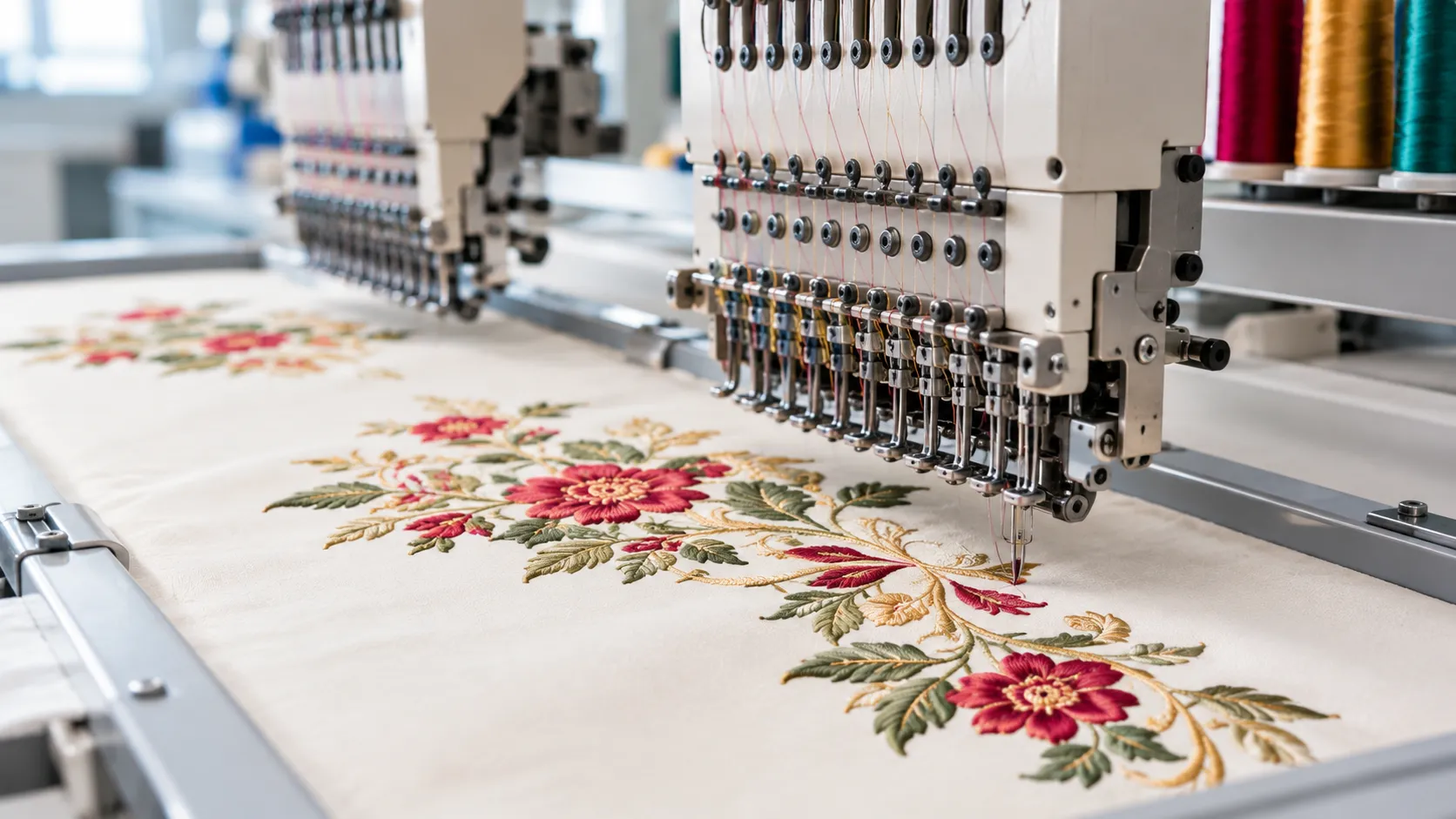
The question this page attempts to answer is that of a buyer’s doubt about what goes into a machine embroidery service. We, Shri Jagdamba Embroidery Pvt. Ltd., Schiffli embroidery manufacturer based out of Faridabad, Haryana, believe this page answers that question comprehensively. It details our embroidery services, the process of embroidery design from your computer to your warehouse, and the questions to ask an embroidery manufacturer before you take them on as a supplier.
What “Machine Embroidery Services” Really Means
The phrase can be misleading since in practice, machine embroidery work is actually segmented into a number of categories based on the production process.
Placement embroidery refers to embroidery done on a specific placement on a cut garment or panel, typically a logo, monogram or badge. This covers logo embroidery on t-shirts and other garments where the logo appears on a separate panel that needs to be stitched at a specific placement every time.
All-over or repeat embroidery is embroidery on a fabric length in a continuous manner prior to cutting. This is the work that Schiffli embroidery machines specialize in, allowing motifs to be repeated seamlessly over lengths of fabric without any discernible join. This is important for creating lace or patterned fabric required for yokes, borders, and similar dressmaking elements.
Job work embroidery is when a brand or exporter supplies their own fabric and asks us to run the embroidery to a fixed specification, returning either finished yardage or cut panels. A large part of our export volume moves this way, and we have written a separate breakdown of how that arrangement is structured on our embroidery job work page.
Therefore, identifying which category your request falls under is an important first step, since the choice of machinery, the kind of backing fabric used, and the timing all depend on it.
Computerized Embroidery vs Manual or Single Head Work
Here is a distinction that matters more to most buyers than they realize before they are burned by it once. Machine work embroidery designs produced on computerized, multi head Schiffli equipment run from a single digitized stitch file. Head one and head twenty are stitching from the same instructions, at the same tension setting, with the same needle path. Manual or low end single head machines depend on an operator repeating a setup by hand, and that repetition is where consistency quietly erodes.
For a gift order of a dozen pieces, this distinction barely registers. For an export order of five thousand units moving in multiple container loads, it is often the entire difference between a shipment that clears buyer inspection on the first pass and one that comes back with a partial rejection. This is part of why we describe our offering as computerized embroidery services rather than simply embroidery. The word computerized is doing real work in that sentence. It is a claim about consistency, not just about technology for its own sake.
Our production floor runs on Swiss Lasser AG Schiffli machines, including six MVD 75 units at 21.5 metres in length, two of which carry CORD attachment capability for raised cord and outline effects, plus a dedicated MVD 57 sampling machine at 5 metres. That sampling machine is not a minor detail. It lets us prove a stitch file at a smaller scale before committing bulk fabric to a design that has not yet been approved, which shortens your approval cycle and protects your yardage.
The Technical Layer Buyers Often Skip Past
A design brief tends to describe the embroidery in great detail, but often misses out on the specifics about the fabric it will be applied on, leaving room for many avoidable missteps.
Embellishment weight considerations define stitch density capabilities. A sheer voile in a 60-80 GSM will not accept the same level of stitch density as a 200 GSM twill without developing unattractive puckering along the stitch lines. The expectation of a design calling for high stitch density all over the garment may require a higher GSM base fabric or a conversation about lower stitch density to meet the mechanical limits of the fabric. This should be established at the design brief stage and not a strike-off surprise
Rayon threads have a natural sheen, making them ideal for bridal and designer embroidery, but lack the durability of polyester threads, while cotton and organic cotton threads offer a great versatility for the GOTS approved embroidery development. Our in-house R&D has been experimenting with various embroidery yarns, including dyed organic cotton, viscose yarn for a silk-like effect, and multi-coloured yarns, moving away from the staple greige cotton or polyester yarns traditionally used in Schiffli embroidery.
Meanwhile, the choice of the cutaway, tear-away or water-soluble backing also depends on the design’s stitch density and visibility. Heavier overall stitch densities and logo embroidery on shirts or t-shirts require a more stable cutaway backing to prevent distortion during the washing process; more delicate lace-like patterns benefit from a tear-away or water-soluble backing to avoid a tell-tale backing roughness on the garment’s surface
A smaller needle gauge and reduced machine speed are often required when working with delicate fabrics such as Chanderi, silk mixes, or sheer voiles to prevent leaving marks on the surface. The embroidery machine will run slower, which may increase the production time per garment, but save on precious fabric in the long-term.
Repeat size, meanwhile, can add up to significant wastage if not planned correctly. While a large repeat size looks impressive on a sample, it may require a narrower fabric width than is available, leaving unusable fabric along the selvedge. This is another consideration that should be worked out with the buyer prior to sample production.
From Design File to Finished Fabric: Our Production Process
In my time working with garment exporters, much of the anxiety over choosing an embroidery partner stems from uncertainty as to what happens between delivering a file and receiving the fabric. Here is the sequence we follow.
Design receipt. This can be the vector file, a reference garment, a photograph, or a rough sketch. Even an incomplete brief is sufficient for our design team to begin building a punch file, and if you wish to have a design developed rather than replicated, this falls under our custom embroidery services.
Digitizing and punching. The design is converted to a stitch file which dictates the needle path, stitch density, and thread sequencing. It is this single stage which dictates most of how the finished embroidery will turn out, so we do not see it as a mere formality.
Strike off and lab dip approval. Before committing to bulk fabric, a strike off sample is produced on the actual base fabric and compared to your Pantone reference if colour matching is required. Threads, stitches and repeat sizes are all fixed at this point.
Sample panel or garment approval. Once the strike off is approved, a sample panel or garment piece is produced so that you can see how the drape, hand feel, and embroidery will perform on the actual fabric construction to be used for bulk production.
In process checks during bulk production. Bulk runs are not left unattended from first stitch to last, but regular inspection points are scheduled to catch tensioning drift, thread breaks, and stitch density inconsistencies before they are compounded across the entire order.
Post production finishing. Mending, shearing, and thread trimming take place before final inspection and colourfastness and dimensional checks against your approved sample.
Packaging and export dispatch. Finished fabric or garment panels are packed with appropriate moisture protection for domestic transit or container loading, as required for whether the order is to move within India or overseas.
Every ERP order record we maintain ties back to this sequence, so that if a buyer asks us to reproduce a design six months later, we are not guessing, but pulling the original punch file and approved strike off from record.
Fabric Compatibility at a Glance
| Fabric Base | Embroidery Behaviour | Adjustment Usually Needed |
|---|---|---|
| Cotton, 100 to 180 GSM | Takes stitch cleanly, moderate puckering risk | Moderate stitch density, standard backing |
| Rayon or Viscose | Soft drape, prone to puckering under dense work | Stabiliser backing, reduced density |
| Voile or Muslin | Lightweight, suited to fine detail work | Lower stitch density, careful hoop tension |
| Twill or Denim | Heavy, holds dense stitching well | Standard gauge needle, higher speed possible |
| Chanderi or Silk blends | Delicate, shows needle marks if mishandled | Finer needle, slower machine speed |
| Knit fabrics for t-shirt embroidery | Stretch risk under dense coverage | Cutaway backing, tested placement |
If a single collection uses more than one of these fabric bases, flag that during the brief stage. Backing and needle selection often need to change between bases, and it is far easier to plan for that before the strike off than to discover it afterward.
Where This Applies To Real Garments
Embroidery on tshirt work is one of the more difficult categories precisely because knit fabric moves. High quality t shirt embroidery depends on the correct backing and placement testing so that the design does not distort when the garment stretches during wear or washing. Chest logos, sleeve motifs, and back panel work all fall under this, and our approach mirrors what is detailed on our logo embroidery on t-shirts page.
Uniform and corporate wear typically involves small, repeated logo work across a large piece count, where consistency across every single garment matters more than design complexity.
Dress and ethnic wear embroidery leans on all over and border Schiffli work, where machine embroidery dress designs need to account for yoke placement, sleeve borders, and hemlines rather than a single fixed logo position.
Export apparel brings the widest range of requirements into one order, since a single shipment might carry placement logos, all over lace panels, and applique detail across different garment styles within the same production run.
What Sourcing Managers Ask
What a buyer won’t tell you in the first email, but is asking implicitly with every embroidery enquiry we get:
Can you replicate my approval sample, consistently, across the whole order? It’s less about the machine and more about the process – that’s why we have in-process checks, to spot deviations before they turn into hundreds or thousands of inconsistent embroideries.
Will my design be safe with you? Yes – design files, sketches, and references are treated as confidential information and never shared with another buyer.
Can you do both a small development order and a big export order on the same design? Once a file is approved, it can be run on both a development order and then bulk production without re-punching, so the embroidery will be identical, at any order size.
Can you offer a range of embroideries on different fabric bases? Yes – as long as it’s specified at the brief stage, so that stitchers can be instructed to adjust the backing and/or needle size for each fabric, before strike-off.
How do you handle compliance for export orders? We’re GOTS and GRS certified, and have had our factory audited by Inditex for social, health and safety, and metal detection protocols – required by many leading international retailers for first-time supplier approvals.
Common Mistakes We See Buyers Make
Approving a design on a different fabric weight to the bulk order will use. Motifs that look great on a heftier sample can pucker on a lighter weight. Always ask for your strike off on the actual GSM you are going to produce in.
Overlooking the impact of repeat size on fabric wastage. A larger repeat may look great on a swatch, but when it is tiled across the width of fabric in a cutting layout it can waste far more fabric than a smaller more efficiently laid out repeat.
Not requesting a wash test on the approved sample. Embroidery that looks beautiful straight from the machine can shrink, pucker or bleed threads when washed, particularly if dark threads have been used on a light fabric. A wash test will highlight most issues before bulk production commences.
Not confirming the MOQ and lead time against the production schedule. Both MOQ and lead time will be impacted depending on whether a design requires fresh digitizing or is a repeat in a new colourway. Confirming this information early can prevent a last minute rush to finish production close to your ship date.
Why Exporters and Brands Work With Shri Jagdamba Embroidery Pvt. Ltd.
Our facility is part of an integrated group which also offers in house dyeing and rotary and digital printing, meaning you can discuss colour and design options for an embroidery project with people aware of the entire fabric preparation process, not just the stitching segment, for those cases when a single point of contact is a must for your design development, sampling, bulk production and quality control stages.
Based out of Faridabad, Haryana with pan India sourcing capabilities and a proven track record of exports to garment exporters and international buying houses, our GOTS and GRS certifications ensure that your brand's sustainability goals are properly documented and our ERP based order processing ensures every file, approval and production step is traceable well after the invoice has cleared.
If you found this page looking for an embroidery machine service near me, it is worth noting that India's export focused embroidery sector consists mostly of a few established Schiffli manufacturers who handle most larger orders due to the consistency multi head computerized embroidery machines offer over single machine operations. For a more general overview of our capabilities beyond what is detailed above, you may want to consult our embroidery services page.
Talk to Our Team
If you have a design file, a reference garment, or even a rough idea for a collection, our team can walk you through digitizing, strike off, and sampling before you commit to bulk production. Reach out to request samples, discuss design development, ask about MOQ details, or get a technical consultation on fabric and thread selection for your next order.
Contact Shri Jagdamba Embroidery Pvt. Ltd. to share your design brief or request an export quotation for machine embroidery services.