If you run an apparel company, you already know the annoying truth about embroidery vendors. Half the websites out there are built for someone ordering 12 polo shirts for a golf tournament, not for a brand placing a 2,000-piece production order with a launch date breathing down its neck. The pricing pages talk about "no minimums" and clip art libraries. Nobody tells you how stitch density actually affects your fabric, why your last vendor's logo puckered on the fleece hoodies, or how to figure out if a factory can actually hit your deadline before you sign the PO.
We've been doing embroidery job work for apparel brands, exporters, and private labels for a long time, and honestly, most of the confusion buyers have isn't about design. It's about production reality. So let's actually get into it.
Got a design and a deadline?
Say hi to our team and let's talk about your order, no pressure, just a real conversation about what you need.
Why "embroidery services for apparel companies" is a different search than "custom embroidery"
Here's the thing most blog posts miss. A person searching for a t-shirt with their dog's name on it and a sourcing manager at a clothing brand placing a 5,000-unit order are not looking for the same thing, even though they type similar words into Google.
An apparel company needs:
- Consistency across a few thousand pieces, not just one nice sample
- A vendor who can quote based on real production capacity, not a website calculator
- Someone who understands fabric behavior across knits, wovens, fleece, and technical fabric
- Turnaround times tied to actual machine output, not vague promises
- Quality control that catches problems on piece 40 instead of piece 4,000
Most of the top ranking pages for embroidery searches right now are built for the first buyer. They're retail decorator sites with online design tools and small-batch pricing. That's fine for what it is, but if you're sourcing for a brand, you need a partner set up for volume, and the content out there just doesn't go deep enough on that side of things. So we're going to.
What actually happens on the machine (and why it matters to your timeline)
Most guides skip straight to "we digitize your logo and stitch it." That's technically true but it hides the part that actually determines your delivery date.
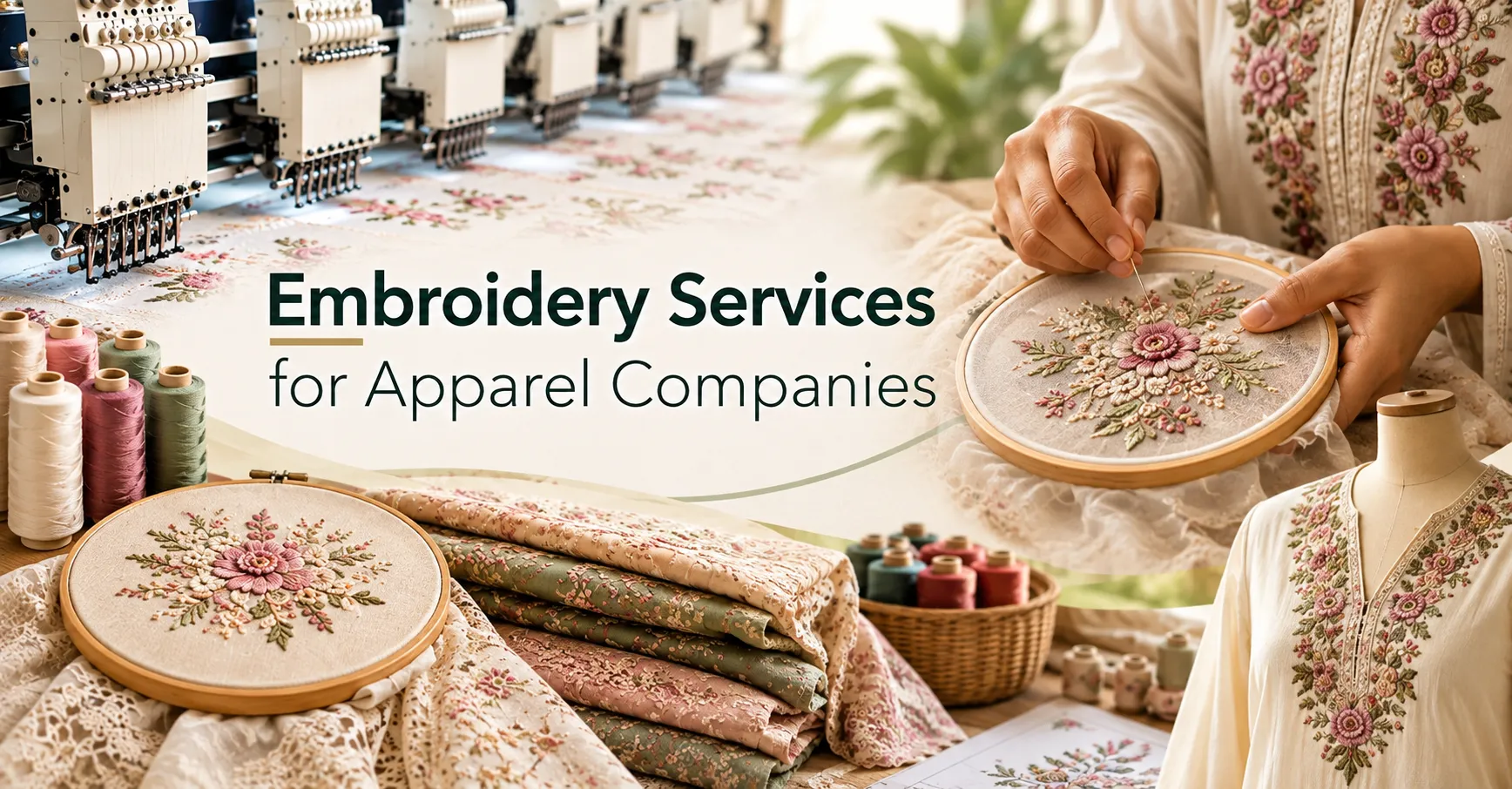
Commercial embroidery runs on multi-head machines, usually anywhere from 6 heads to 20 heads per machine, meaning that many identical pieces get stitched at once in a single run. A single-head machine embroiders one item at a time. A 12-head machine embroiders 12 identical items simultaneously. This is the single biggest factor in how fast an order of, say, 3,000 units can actually move, and it's also why a shop with three single-head machines will quote you a very different timeline than a factory running multi-head production lines. If a vendor won't tell you their head count when you ask, that's a small red flag worth noticing.
Then there's digitizing. Before a single stitch happens, your logo has to be converted into a stitch file (usually DST or a similar machine-readable format) that tells the needle exactly where to go, how dense the fill should be, and where the thread should jump. A poorly digitized file is the number one reason logos look "off" on fabric even when the artwork looked perfect on screen. Fine text under 5mm, thin outlines, and gradients are the usual troublemakers here. A good digitizer will actually flag these problems before production, not after you've got 2,000 pieces with blurry small print.
We handle this as part of our machine embroidery services, and honestly, the digitizing conversation is where a lot of quality issues get solved or created before the machine even starts.
The stitch count and pricing math nobody explains clearly
This part genuinely confuses a lot of first-time bulk buyers, so let's walk through real numbers.
Embroidery is priced mainly by stitch count, not by "size" the way people assume. A small left-chest logo usually runs somewhere between 3,000 and 8,000 stitches depending on detail. A larger design, like a jacket back or a bold text logo, can run 10,000 to 20,000 stitches or more. Industry pricing across the market generally lands in the range of $1 to $4 per 1,000 stitches for smaller runs, dropping noticeably as order volume increases, because setup and machine time get spread across more pieces.
Here's a simple worked example. Say your logo digitizes to 7,000 stitches, and you're ordering 1,000 units.
- 7,000 stitches ÷ 1,000 = 7 (stitch units)
- At a bulk rate, say $0.80 per 1,000 stitches for that volume, that's 7 × $0.80 = $5.60 per piece just for the embroidery
- Multiply by 1,000 units = $5,600 for the embroidery portion of the order
That's before garment cost, before setup or digitizing fees (usually a one-time charge for a new design), and before any multi-location stitching if you want a logo on both the chest and the sleeve. Once you understand this math, quotes stop feeling like a black box, and you can actually compare vendors apples to apples instead of just picking the lowest number on a page. This is exactly the kind of transparency we try to bring to our custom embroidery services, because a vague quote almost always means a surprise later.
Fabric matters more than most people expect
This is honestly where a lot of embroidery orders go wrong, and it rarely gets covered in guides written for the golf-shirt crowd.
Knits stretch. If you embroider a logo directly onto a stretchy jersey or a rib-knit collar without the right backing, you'll get puckering, that annoying rippled texture around the stitching that shows up the moment the shirt moves. The fix is usually a cutaway or tearaway stabilizer matched to the fabric weight, and honestly, this decision should come from the vendor, not be an afterthought.
Fleece and terry fabrics have loft, meaning the surface has some height and softness to it, which can swallow fine detail in a design. Small text or thin lines that look crisp on a cotton twill can look muddy on a hoodie unless the digitizing accounts for it.
Denim and heavier canvas need a stronger needle and sometimes a different thread tension entirely, or you risk skipped stitches and thread breaks mid-run, which slows production and can create inconsistency across a batch.
Leather and vinyl trims are their own category. You generally can't hoop them the normal way, and the needle type and stitch density both need adjusting to avoid tearing the material.
None of this is meant to scare you off embroidery, it's just meant to show why "we can embroider anything" without asking about your fabric is a claim worth being a little skeptical of. A vendor who asks good questions about your fabric before quoting is usually the one who'll give you fewer headaches later.
Different apparel businesses need slightly different things
Not every apparel company is buying embroidery for the same reason, and it's worth being honest about that.
Exporters are usually working against tight shipping windows and strict buyer specification sheets, often with exact Pantone thread matches and placement tolerances written into the order. Consistency across a huge volume matters more than almost anything else, because a buyer audit can reject an entire container over a stitching inconsistency. Our embroidery services for exporters page goes deeper into how we handle that kind of compliance-heavy production.
Fashion designers, especially smaller or emerging labels, are often more focused on getting the exact texture and finish right for a limited run or a sample collection, sometimes with unusual placements or mixed materials that a mass-market embroiderer might not want to bother with. If that's you, our embroidery services for fashion designers page talks about how we work on smaller, detail-heavy runs.
Clothing brands scaling up a product line usually care most about repeatability, getting the same clean result on unit 1 and unit 10,000 of an ongoing collection. This is where our embroidery services for clothing brands work comes in, built around long-term, repeat production relationships rather than one-off jobs.
And more broadly, our embroidery services for apparel companies work covers the full range of this, uniforms, workwear, seasonal collections, private label programs, the whole spectrum.
Job work, custom embroidery, and machine embroidery: these terms actually mean different things
People use these phrases interchangeably, but if you're sourcing for a business, it helps to know the difference.
Embroidery job work usually means you're sending garments or fabric to be embroidered as a contract manufacturing arrangement, often ongoing, often at scale. It's less about a one-time custom design and more about a production relationship. If you're a brand that needs a reliable embroidery partner for regular runs, our embroidery job work page is worth a look.
Custom embroidery services generally refers to the design-to-finish process for a specific logo or artwork, from digitizing through stitching, whether it's a single design or a full catalog of them.
Machine embroidery services is more about the production method itself, multi-head commercial machines running at scale, as opposed to single-needle or hand embroidery work. If you're comparing vendors, it's a fair question to ask which of these they're actually set up for, because a shop built for custom one-offs isn't always the right fit for repeat bulk job work, and vice versa.
How to actually vet a vendor before you commit
A few things worth asking before you sign a PO, based on what tends to separate a smooth order from a stressful one:
- Ask for their machine head count and average daily output. This tells you if their quoted timeline is realistic for your volume.
- Ask how they handle color matching, specifically whether they can match Pantone or thread manufacturer codes exactly, which matters a lot if you have brand guidelines.
- Ask what happens if there's a defect rate above a certain percentage. A good vendor has a clear answer here, not a shrug.
- Request a pre-production sample, always, even if you've worked with them before on a different design. Fabric and design combinations behave differently every time.
- Ask about their stabilizer and backing process for your specific fabric. If they don't ask you what fabric you're using before quoting, that's worth noting.
Trust us on this one, the vendors who ask a lot of questions upfront are almost always the ones who cause you the fewest problems down the line. The ones who just send a price sheet and a "sure, we can do that" without asking anything about your fabric or your timeline tend to be the ones you end up emailing anxiously three days before your ship date.