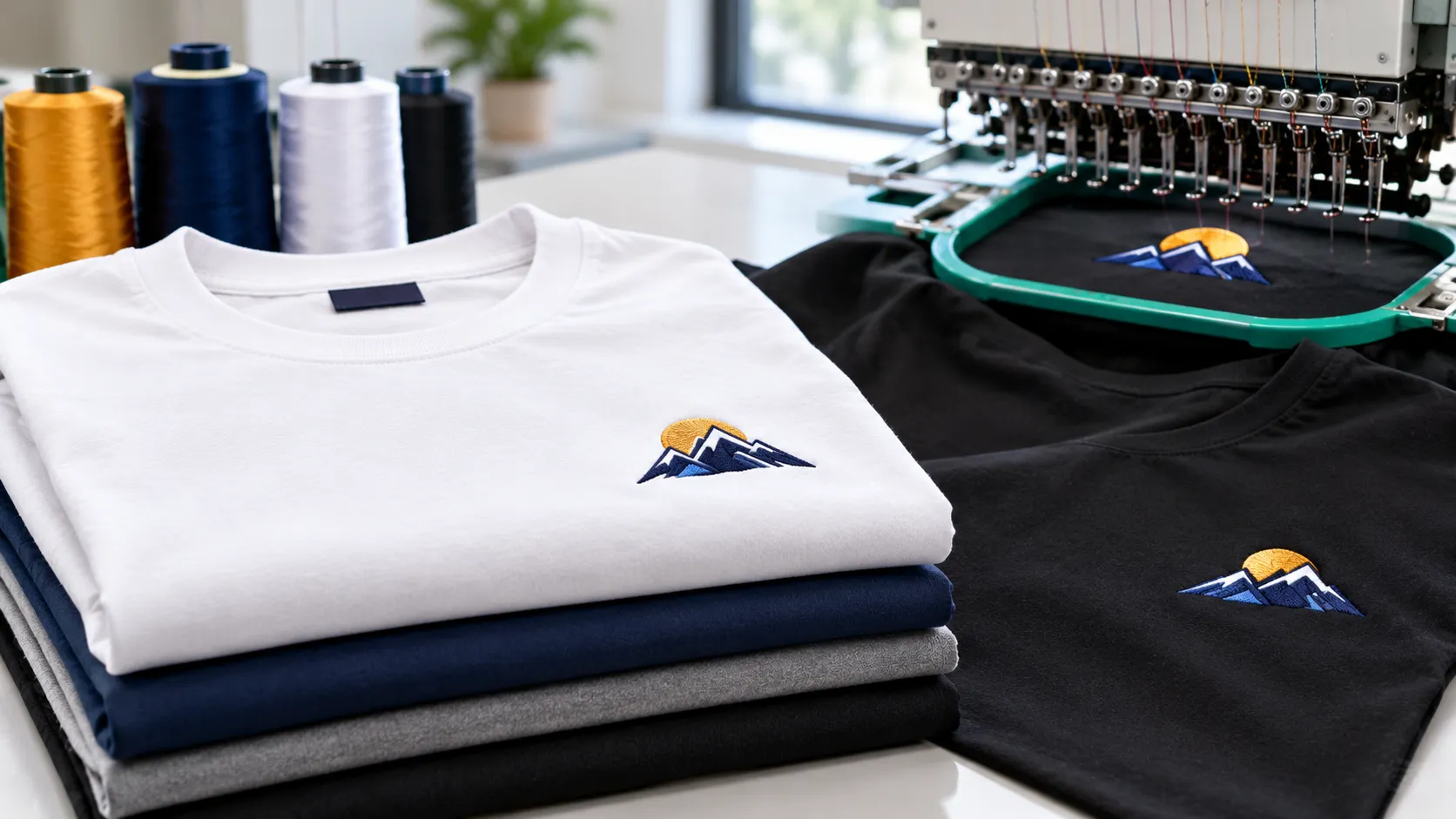
That's why logo embroidery on t shirts is such a special topic, deserving of its own article separate from embroidery on shirts and jackets. Knit fabric stretches while embroidery stitches resist stretching. The combination of these two factors is what makes logo embroidery such a challenging process and this article aims to explain the technical aspects of the process from the manufacturer's end.
The stretch problem nobody mentions until it is too late
A woven shirt panel remains largely the same shape whether it is on a hanger or on a body. A t-shirt knit does not. Cotton jersey, the most common t-shirt base, typically stretches 20 to 40 percent in the crosswise direction depending on knit construction, and an embroidered logo sitting rigidly on top of that movement has to either flex with the fabric or fight it.
When it fights the fabric, you get a few predictable failures. The area directly under the logo puckers when the shirt is worn, because the embroidery has effectively created a stiff, non-stretch patch on a garment designed to stretch everywhere. Over repeated washing, that tension differential can eventually cause the stitches to pull loose at the edges, or worse, tear the surrounding knit fabric.
I've noticed that fashion brands often approve a logo sample on a flat table, where it looks perfect, without ever testing it on a body or through a stretch cycle. That is one production challenge we regularly solve by insisting on a worn sample check, not just a flat approval, before a design moves to bulk.
What Makes T-Shirt Logo Embroidery Different To Shirt Embroidery
Fabric reaction to tension. The give in a knit means that decisions on backing and hoop tension are often more critical in order to prevent distortion in the finished design once the garment is worn, in comparison to a stable woven shirt panel. Incorrect tension decisions and an incorrectly digitized motif can cause puckering.
Lighter weight fabrics on average. Most t-shirt knits tend to fall in the 140-200 GSM range compared to shirting twills which are generally heavier, limiting the density of stitch pattern that can be used without puckering becoming apparent.
Different placement areas. A chest logo t-shirt placement area is on a dynamic surface, rather than a stable panel held in place by a placket and buttons, requiring hoop stabilisation to compensate for a lack of in-built rigidity.
More frequent washing. T-shirts, particularly corporate and promotional t-shirts tend to be washed more frequently and with less care than a standard dress shirt, often in domestic washing machines rather than commercial laundry, affecting the thread/backing combination choices available.
Choosing a Technique for Your T Shirt Logo
Not every embroidered t shirt logo requires the same production method and this is where many buyers default to whatever their last vendor happened to offer them, rather than what suits the requirements of their own design.
Standard flat embroidery is the correct choice for most wordmarks, simple icons and monogram style logos. It is close to the fabric in height and has moderate flexibility with slight stretch, making it the most cost efficient option for straightforward brand marks.
3D or puff embroidery raises the design with a foam core underneath the stitching, making it ideal for streetwear branding or a logo that is meant to stand out on a plain t-shirt. Because it can add stiffness at the logo site, 3D embroidery needs to be applied more carefully for stretch fabric than flat embroidery would need to be. Our 3D embroidery page goes into more depth on how we produce this raised effect.
Patch embroidery, where the logo is separately embroidered and then attached to the t-shirt, is worth considering for intricate multi colour designs or for programmes that need the same logo across many different fabric weights and colours. Because the patch is embroidered on a stable backing before attachment, it avoids the stretch distortion risk that comes with direct embroider onto knit. Our patch embroidery page covers why this approach would make more sense than direct embroidery in certain circumstances.
Deciding between them is a matter of logo complexity, the extent of the fabric stretch and how the t-shirt will be worn and washed, rather than a default choice.
Considerations for Backing, Thread, and Needle in Knit Fabrics
Use of cutaway backing is the norm for t shirt logo projects, and for good reason. Unlike tearaway backing which is removed when the embroidery is complete, cutaway backing remains on the garment after the stitch site has been finished, providing ongoing stability to the area during repeated stretching and washing that a knit fabric undergoes.
Densities must be decreased when working on a knit compared to a woven shirt fabric of similar GSM. A density that looks great on shirting twill can cause puckering on t-shirt jersey of a comparable GSM, due to the relative lack of structure in the knit face fabric.
Hoop tension must take into account the natural stretch of the garment fabric, and should not be greater than required to hoop the fabric itself. Tightening a knit too much during the embroidery process can cause distortion of the logo site once the hoop is removed and the knit returns to its natural relaxed length, resulting in costly reworks.
Polyester thread generally performs better than rayon in t-shirt applications due to the increased washing and often less careful handling of promotional and corporate t-shirts as compared to dress shirts.
Fabric Compatibility for T Shirt Logo Embroidery
| Knit Fabric Type | Typical GSM Range | Embroidery Consideration |
|---|---|---|
| Cotton jersey | 140 to 180 | Moderate stretch, needs cutaway backing and lower density |
| Cotton-polyester blend jersey | 160 to 200 | More dimensionally stable than pure cotton, slightly more density tolerance |
| Ringspun combed cotton | 150 to 190 | Smooth surface, good stitch definition, standard backing |
| Polyester performance knit | 130 to 170 | High stretch, needs careful hoop tension and lighter density |
| Fleece or French terry | 220 to 280 | Heavier base, can carry denser logos including 3D puff work |
If your programme runs the same logo across several of these fabric types, worth flagging at the brief stage, since density and backing settings typically need separate tuning per fabric rather than one universal setup for the whole range.
How We Take a T Shirt Logo From File to Finished Garment
Logo file and end use review. Most corporate and brand clients arrive with a vector logo file ready, while adapting an existing mark for embroidery or developing something new falls under the purview of our custom embroidery services. We also ask early what fabric and garment styles the logo will run across as this informs all decisions made downstream.
Digitizing with knit fabric in mind. This is not the same digitizing approach used for a stable woven shirt panel. Stitch paths and density are set with fabric stretch and movement factored in from inception, and not adjusted after a problem has already manifested.
Strike off on the actual t shirt fabric and colour. A strike off run on a substitute fabric tells you very little on how the logo will behave on your actual knit base. We run strike offs on the exact fabric and colourway intended for bulk.
Worn sample check, not just a flat approval. A finished sample t-shirt is reviewed under actual wearing tension and not just on the table, since this is the only way to catch stretch related distortion before it manifests across a full order.
In process monitoring through bulk production. Placement and tension consistency are spot checked at intervals through the run, so that drift is caught early rather than waiting until the finished batch is being presented for inspection.
Final inspection, packaging, and export readiness. Finished garments are checked against the approved sample prior to packaging, with moisture protection applied for shipments moving through container loading to export markets.
Mistakes That Show up Most Frequently in T-Shirt Logo Briefs
Approval of a sample without stretch or wear. A flat approval fails to identify the issue that is most often a concern on knit fabrics. Always insist upon a worn sample check, not just on a table.
Using the same density for a range of weights. A setting that works on a heavy fleece will almost certainly pucker on a lighter jersey knit. Each fabric base in a family usually takes a different density.
No wash test before bulk release. T-shirts get washed more frequently and more casually than most other embroidered garments, and skipping this step is one of the more common causes of post delivery complaints on t-shirt logo orders.
Failure to agree on placement measurements, in writing, to the approved sample. Descriptions of the chest location leave too much room for interpretation. Always agree on measurements to avoid disagreements at final inspection on a large bulk order.
Where this fits within our broader shirt and t shirt embroidery work
Logo embroidery on t-shirts is one part of a wider capability which extends into dress shirt and formal shirting embroidery where fabric behaviour and placement tolerances work differently again. Our embroidery in shirts page covers that broader shirting range if your brand sources both categories. If your programme requires a design developed from scratch rather than adapted from an existing file then that development work falls under custom t shirt embroidery as its own process. And for brands running an ongoing logo programme across multiple seasons and fabric bases rather than a one off order our Logo Embroidery Services page details how we structure that as a continuing production relationship.
Why Brands and Buying Houses Choose Shri Jagdamba Embroidery Pvt Ltd for T Shirt Embroidery Logo Services
Our production machines are Swiss Lasser AG Schiffli embroidery machines ranging from MVD 75 series (21.5 meters long with CORD attachment possibility on two machines) and a single MVD 57 sampling machine that can test how the logo will behave when stretched on a smaller scale, thus reducing the risk that the knitting fabric for the t-shirt embroidery design at larger scales will prove unsuitable.
Being based in Faridabad, Haryana, and having an in-house dyeing and printing, colour-matching and fabric preparation capacity means that questions that may arise when a buying house is considering a t-shirt embroidery logo can be resolved at the level of the embroiador rather than another supplier. Certifications such as GOTS and GRS are available for brands and buying houses seeking to enter into contracts with third parties that require proof of sustainability, and the ability to manage accounts through the ERP-based order management system means that a logo produced for one customer can be replicated for others in subsequent seasons without going through the entire design process again.
Talk to Our Team About Your T Shirt Logo Programme
If you have a logo ready to adapt for t-shirt embroidery or you require a new design to be developed for your new collection our team can guide you through the process of digitizing, strike off and worn sample testing before any bulk goes into production. Contact us to request samples, discuss design development, request a technical consultation on knit fabric and stitch density, request MOQ information, or request an export quotation on your next t-shirt logo order.
Contact Shri Jagdamba Embroidery Pvt. Ltd. to send us your logo file to develop your t shirt embroidery programme.