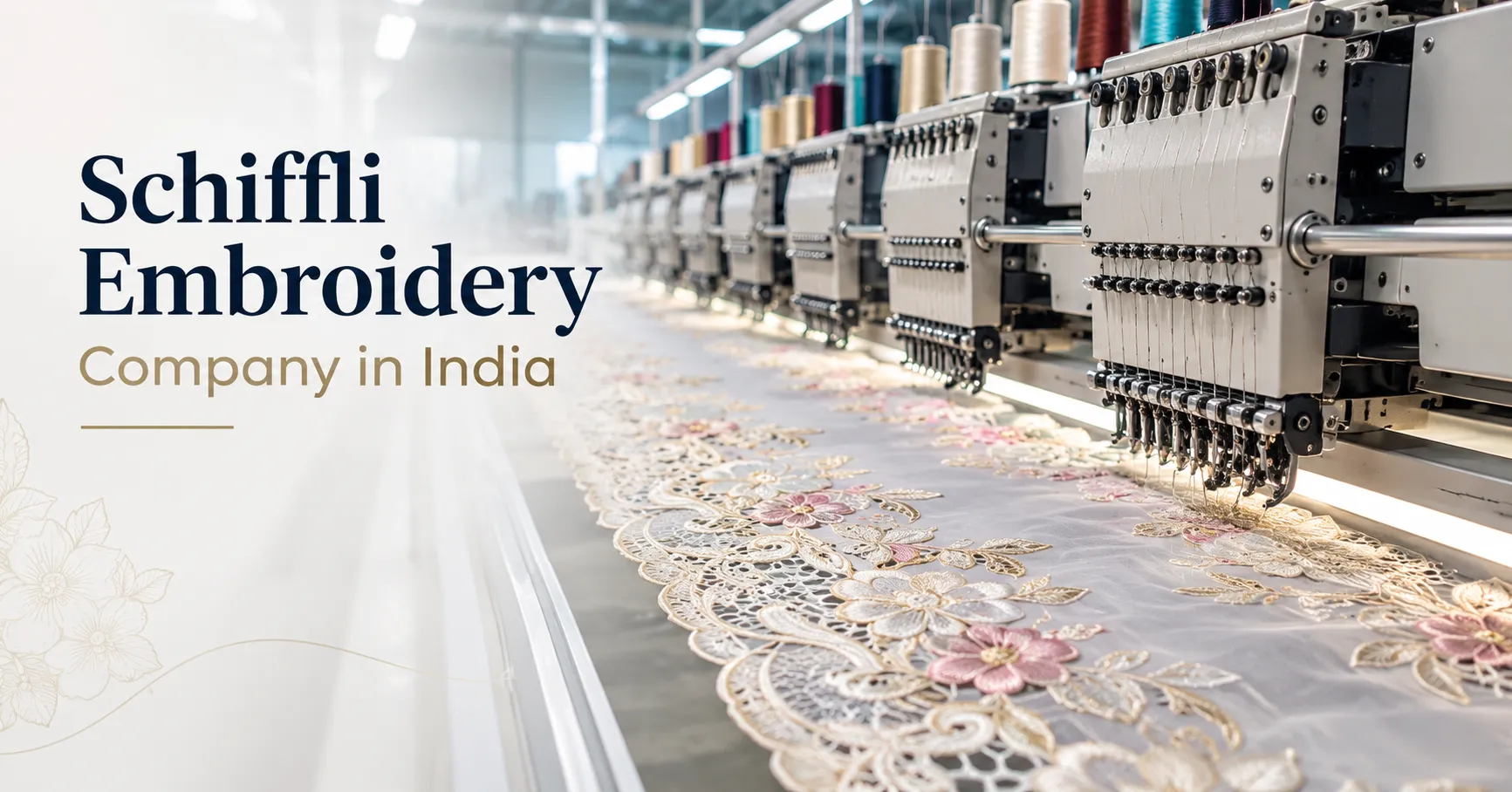
Schiffli embroidery has a distinct look. Fine, lace-like patterns worked directly into cotton, poly, or silk fabric, often used for kurtas, sarees, sherwanis, and delicate borders. If you've ever wondered how that intricate allover embroidery on a fabric roll is made so consistently across hundreds of meters, it's almost certainly Schiffli work. Finding the right Schiffli embroidery company in India matters because this isn't a technique every embroidery unit offers. It needs specific machines, a different production process, and usually a different order structure than regular garment embroidery.
This guide explains what Schiffli embroidery actually is, how the process works, and what to check before placing an order with a Schiffli embroidery company.
If you're sourcing Schiffli embroidered fabric or want to place a job work order, reach out to our team and we'll walk you through fabric options, minimum quantities, and turnaround time.
What Is Schiffli Embroidery
Schiffli embroidery is a machine embroidery technique that uses a lock stitch, similar to a sewing machine stitch, to create detailed, lace-like patterns across wide rolls of fabric. It gets its name from the shuttle used in the original machines, which resembled a small boat, "schiffli" in Swiss German. The technique originated in Switzerland in the 1800s and later became widely adopted in India's textile hubs for large-scale fabric embroidery.
Unlike a standard multi-head embroidery machine that stitches individual garments or panels one at a time, a Schiffli machine embroiders an entire width of fabric in a single continuous run, often several meters long, using hundreds of needles working in sync across the fabric.
How Schiffli Embroidery Differs From Regular Machine Embroidery
This is where a lot of confusion comes in, since both are technically "machine embroidery" but they serve very different purposes.
Scale of production. A regular multi-head embroidery machine stitches a limited number of garments or panels at once, typically ranging from a few pieces to a few dozen per run. A Schiffli machine works across an entire fabric roll at once, producing embroidered yardage rather than individual finished pieces.
Design style. Schiffli embroidery tends to focus on fine, repetitive, lace-like patterns, cutwork, and jaali (net-like) designs spread evenly across the fabric. Regular machine embroidery is more commonly used for placement designs like logos, motifs, or specific panel embellishment.
Output form. Schiffli embroidery is usually sold or supplied as embroidered fabric by the meter, which is then cut and stitched into garments later. Standard machine embroidery is often done directly on cut panels or finished garments.
Order structure. Because Schiffli machines are set up for large fabric rolls, minimum order quantities tend to be higher, often starting from a few hundred meters or a set weight in kilograms, compared to the smaller, piece-based orders common with regular embroidery.
If your need is smaller batches or placement designs on finished garments rather than fabric yardage, machine embroidery services built around multi-head production may be a better fit than Schiffli work.
The Schiffli Embroidery Process
Fabric Preparation
The base fabric, whether cotton, polyester, silk, or a blend, is mounted onto the Schiffli machine's frame in wide rolls. The fabric needs to be even in tension and free of major defects, since the embroidery covers large continuous stretches at once.
Design Punching and Programming
The design is translated into a punch card or digital program that controls the movement of the pantograph, the mechanism that guides hundreds of needles simultaneously across the fabric width. Modern Schiffli units typically use computerized systems rather than the original mechanical punch cards, allowing for faster design changes and more precise repeats.
Embroidery Production
Once programmed, the machine stitches the design across the entire fabric roll in a continuous, repeating pattern. This is what makes Schiffli embroidery efficient for large volumes, since a single production run can cover hundreds of meters without needing to reposition the fabric for each repeat.
Finishing
After embroidery, the fabric often goes through additional finishing steps depending on the design. This can include cutting away background fabric for a lace-like or cutwork effect, washing to remove the water-soluble backing used during stitching, and final quality inspection for consistency across the roll.
Common Applications of Schiffli Embroidery
Schiffli work shows up across a wide range of textile categories, including:
- Kurta and kurti fabric, where allover or border embroidery is worked directly into the yardage before cutting
- Saree and dupatta fabric, particularly for fine border and pallu embellishment
- Sherwani and Indo-western fabric, where dense, detailed patterns add a formal, textured finish
- Laces and trims, produced as standalone embroidered strips used as embellishment on other garments
- Baby and children's wear fabric, where delicate cutwork and eyelet-style embroidery are common
- Home textiles, including curtains, table linens, and decorative fabric panels
What to Look for in a Schiffli Embroidery Company
Machine Type and Condition
Schiffli machines vary in age, needle count, and precision. Well-maintained, modern machines produce cleaner stitch definition and fewer thread breaks across long runs. It's reasonable to ask what type of machines a company runs and how they're maintained, since this directly affects consistency across a large fabric order.
Fabric Range and Compatibility
Confirm the company has direct experience working with your specific fabric type. Cotton, polyester, silk, and blended fabrics all behave differently under tension, and a company experienced mainly with one fabric type may not deliver the same quality on another.
Design Library and Custom Digitizing
Some Schiffli companies maintain large libraries of existing designs you can choose from, which is useful if you don't need something entirely custom. Others offer full custom digitizing based on your own design concepts. If you need a specific pattern for your collection, confirm the company can handle custom programming rather than only offering pre-existing designs.
Minimum Order Quantity
Because Schiffli production runs across full fabric rolls, MOQs are typically higher than piece-based embroidery, often starting from a couple hundred meters or a set weight in kilograms. Confirm this upfront, since it affects both your budget and how much fabric you commit to before seeing the final result.
Sample Availability
Ask whether the company can provide a sample cut of the design on your actual fabric before you commit to the full roll. This is especially important for custom designs, where seeing the pattern repeat and stitch density in person makes a real difference compared to viewing it on screen.
Consistency Across the Roll
Since Schiffli embroidery covers long continuous lengths of fabric, ask how the company checks for consistency from the start of the roll to the end. Tension can shift over a long production run if machines aren't properly maintained, leading to visible variation in stitch density.
Schiffli Embroidery Job Work vs Buying Ready Embroidered Fabric
There are generally two ways businesses source Schiffli embroidery.
Job work means you supply your own fabric, and the company embroiders it based on your chosen or custom design. This is the right approach if you already have a specific fabric sourced, or if your fabric composition and design need to be closely matched for a particular collection. If this fits your need, look into Schiffli embroidery job work, where the company handles the embroidery stage on material you provide.
Buying ready embroidered fabric means purchasing fabric that's already been embroidered with an existing design, often sold by the meter from a company's own stock or design catalog. This works well if you're not tied to a specific base fabric and want faster turnaround using designs already available. Our Schiffli embroidery offerings cover this route for businesses looking for ready fabric rather than a custom job work order.
Which option makes sense depends on how specific your fabric and design requirements are, and how quickly you need the order fulfilled.
Cost Factors in Schiffli Embroidery
A few things typically influence pricing:
- Design density: Heavier, more detailed patterns take longer to produce and use more thread, raising the cost per meter.
- Fabric type: Specialty fabrics like silk or fine blends may cost more to process than standard cotton or polyester.
- Order volume: Larger fabric orders generally bring down the per-meter cost, though this varies by company and machine setup.
- Custom vs catalog designs: A fully custom design requiring new digitizing usually costs more upfront than selecting from an existing design library.
- Finishing requirements: Additional steps like cutwork, washing, or special backing removal add to production time and cost.
Conclusion
Schiffli embroidery has stayed relevant for over a century because nothing else replicates its fine, consistent, lace-like finish across large volumes of fabric. Getting the right result comes down to working with a company that maintains its machines well, understands your fabric, and is upfront about MOQs and turnaround from the start.