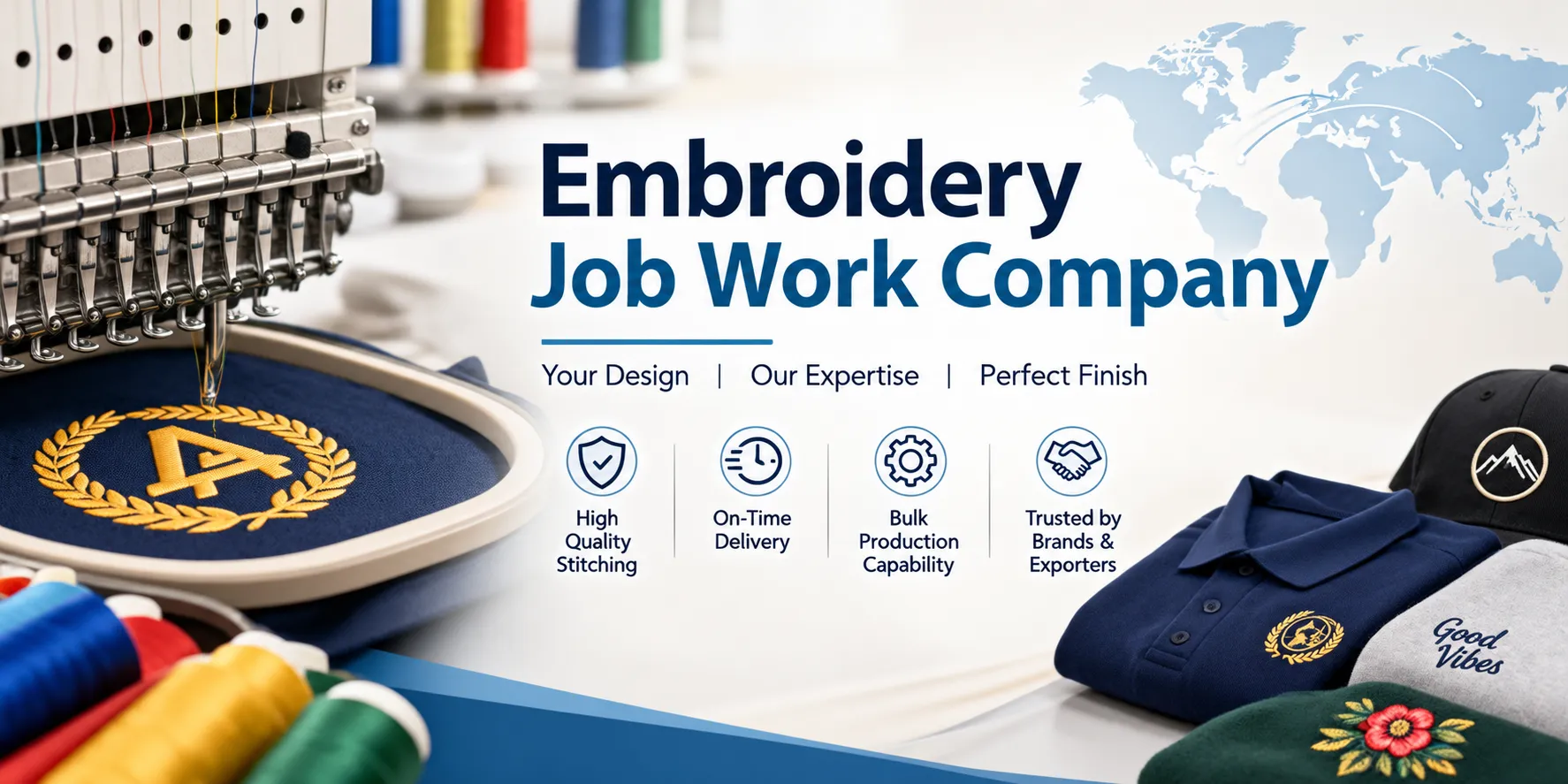
If you run a garment business, a boutique label, or a small manufacturing unit, you've probably reached a point where doing embroidery in-house stopped making sense. Buying machines, hiring operators, and managing digitizing software is a big investment for something that might only be part of your production. This is exactly where an embroidery job work company comes in. You send your fabric or garments, they handle the embroidery, and you get finished pieces back, without owning a single embroidery machine yourself.
This guide covers what an embroidery job work company actually does, how the process and pricing work, and what to check before you hand over your first order.
If you're ready to get a quote for your next batch, contact our team and share your design, fabric, and quantity.
What Is an Embroidery Job Work Company
An embroidery job work company is a manufacturing unit that specializes purely in embroidery, done on fabric or garments supplied by a client, rather than producing and selling finished clothing themselves. You bring the material (or in some cases, they source fabric on your behalf), and the job work company handles digitizing, stitching, and finishing based on your design.
This model is common across India's textile hubs, particularly in cities with strong garment and saree manufacturing bases. Instead of every garment unit, boutique, or exporter maintaining its own embroidery setup, many rely on specialized job work partners who can handle the technical and equipment side while they focus on design, sales, and distribution.
How Embroidery Job Work Actually Works
The process is fairly consistent across most job work companies, though the exact steps can vary slightly based on order size and complexity.
- You share your design and fabric. This could be a finished garment, cut fabric panels, or yardage, along with the design you want embroidered, whether that's a sketch, image, or existing digitized file.
- The design gets digitized. If you don't already have a stitch file, the job work company's digitizer converts your design into a machine-readable format, mapping out stitch type, density, and thread color sequence.
- A sample is stitched. Before committing to a full batch, most reliable job work companies will stitch a sample on your actual fabric so you can check placement, thread color, and stitch quality.
- Production runs on approval. Once you sign off on the sample, the full order goes into production using the approved settings.
- Quality checks and finishing. Finished pieces are inspected, excess threads trimmed, and backing removed before the order is packed and returned to you.
- Delivery. Depending on the company, you either collect the order, arrange pickup, or have it shipped to your location.
Types of Embroidery Job Work Services
Job work companies generally offer a mix of techniques depending on their machine setup and workforce.
Machine Embroidery Job Work
This covers computerized, digitized designs stitched using multi-head embroidery machines. It's the go-to option for consistent, repeatable patterns across bulk orders, whether that's allover fabric embroidery, logo placement, or patch work. If your order needs identical results across hundreds or thousands of pieces, this is usually the most practical route. You can read more about our machine embroidery services if this fits your requirement.
Hand Embroidery Job Work
This includes techniques like zardozi, aari, and sequin or bead work done manually by skilled artisans. It's slower and priced higher per piece, but it's the standard choice for bridal wear, heavily embellished sarees, and premium pieces where texture and depth matter more than speed.
Cording, Sequin, and Specialty Work
Some job work units specialize further in specific techniques like cording, sequin application, or novelty stitches. If your design relies heavily on one of these, it's worth confirming the company has direct, regular experience with that specific technique rather than occasional capability.
Who Uses Embroidery Job Work Companies
Job work isn't limited to any one type of business. It's commonly used by:
- Boutique and small fashion labels who need embroidery on limited runs without the cost of owning equipment
- Saree and lehenga businesses that regularly need embellishment work across large fabric volumes
- Garment manufacturers who want to add embroidered detailing to part of their range without setting up a dedicated department
- Exporters who need embroidery completed to consistent, inspection-ready standards before shipment
- Designers developing new collections who need flexible, small-batch sampling before committing to bulk production
If your business falls into one of these categories, it's worth exploring services built specifically around your segment, such as embroidery services for fashion designers or embroidery services for exporters, depending on your production needs.
Job Work vs Setting Up Your Own Embroidery Unit
This is a common decision point for growing businesses, so it's worth laying out plainly.
Setting up in-house makes sense if embroidery is a core, high-volume part of your business that runs continuously, and you have the capital for machines, digitizing software, skilled operators, and ongoing maintenance. It gives you full control over timelines but ties up significant capital and requires managing production yourself.
Using job work makes more sense if your embroidery needs fluctuate, if it's only part of your product range, or if you're not yet at a volume that justifies owning equipment. It keeps your capital free, lets you scale up or down based on order volume, and gives you access to techniques and machinery you'd otherwise have to invest in separately.
Most small and mid-sized businesses start with job work and only consider setting up in-house once embroidery becomes a consistently large share of their production.
What to Look for When Choosing an Embroidery Job Work Company
Machine Capacity and Technique Range
Ask how many machines and heads the company operates, and whether they handle both machine and hand embroidery if your designs need a mix. A wider technique range means fewer vendors to coordinate across your product line.
Minimum Order Requirements
Some job work companies are set up for large bulk orders only, while others are flexible enough to handle smaller batches for sampling or limited collections. Confirm this upfront if your order size is on the smaller side.
Sampling Process
A trustworthy job work company will always offer to stitch a sample before running your full order, especially for new designs or unfamiliar fabrics. Be cautious of any vendor who wants to skip straight to bulk production without this step.
Turnaround Time
Ask for a realistic timeline based on your specific order, not a generic estimate. Turnaround varies significantly between machine embroidery, which can often be completed within days, and hand embroidery, which can take considerably longer depending on detail level.
Quality Control
Ask how finished pieces are checked before being returned to you. This should include inspection for thread breaks, puckering, color consistency, and correct placement, not just a visual glance at the top of the pile.
Location and Logistics
Working with a job work company near your own production base can simplify logistics, especially if you need to drop off fabric and collect finished pieces regularly. That said, many businesses work successfully with partners in other cities by shipping fabric back and forth, particularly for specialized techniques not available locally.
How Pricing Works for Embroidery Job Work
Job work pricing is usually structured in one of a few ways, depending on the type of work:
- Per piece, common for garment embroidery like logos or placement designs on shirts, jackets, or dresses
- Per meter, typical for allover fabric embroidery on yardage used for sarees, dupattas, or fabric rolls
- Per 1,000 stitches, sometimes used for machine embroidery pricing since stitch count directly affects machine time
- Per design complexity, particularly for hand embroidery, where pricing reflects the technique, detail level, and time required per piece
Rates also shift based on order volume, fabric type, and thread type (standard, metallic, or specialty threads). It's worth asking for a breakdown rather than a single flat number, since two very different designs can carry very different production costs even at the same quantity.
Common Mistakes to Avoid With Job Work Orders
- Skipping the sample stage to save time, and then discovering issues only after the full batch is done
- Not confirming thread type and shade codes in writing, which can lead to mismatches across repeat orders
- Underestimating lead time for hand embroidery, especially for detailed or large-panel designs
- Not checking fabric-specific experience, since delicate or unusual fabrics need different handling than standard cotton or poly blends
- Choosing based on price alone, without checking quality control practices, which often leads to costly rework later
Embroidery Job Work Companies Across India
Job work availability and specialization can vary quite a bit by region, often shaped by the local textile industry. If you're looking for a partner closer to your own base of operations, here's where to start:
- Embroidery job work in Surat, a major hub for fabric and saree embroidery
- Embroidery job work in Tirupur, known for its strong garment manufacturing base
- Embroidery job work in Ahmedabad, Gujarat
- Embroidery job work in Coimbatore
- Embroidery job work in Delhi
- Embroidery job work in Faridabad
- Embroidery job work in Kolkata
- Embroidery job work in Bangalore
Conclusion
A good embroidery job work company should feel like an extension of your own production line, not just a vendor you drop fabric off with. Look for a partner who takes sampling seriously, communicates pricing clearly, and can back up their quality claims with an actual process, not just promises.