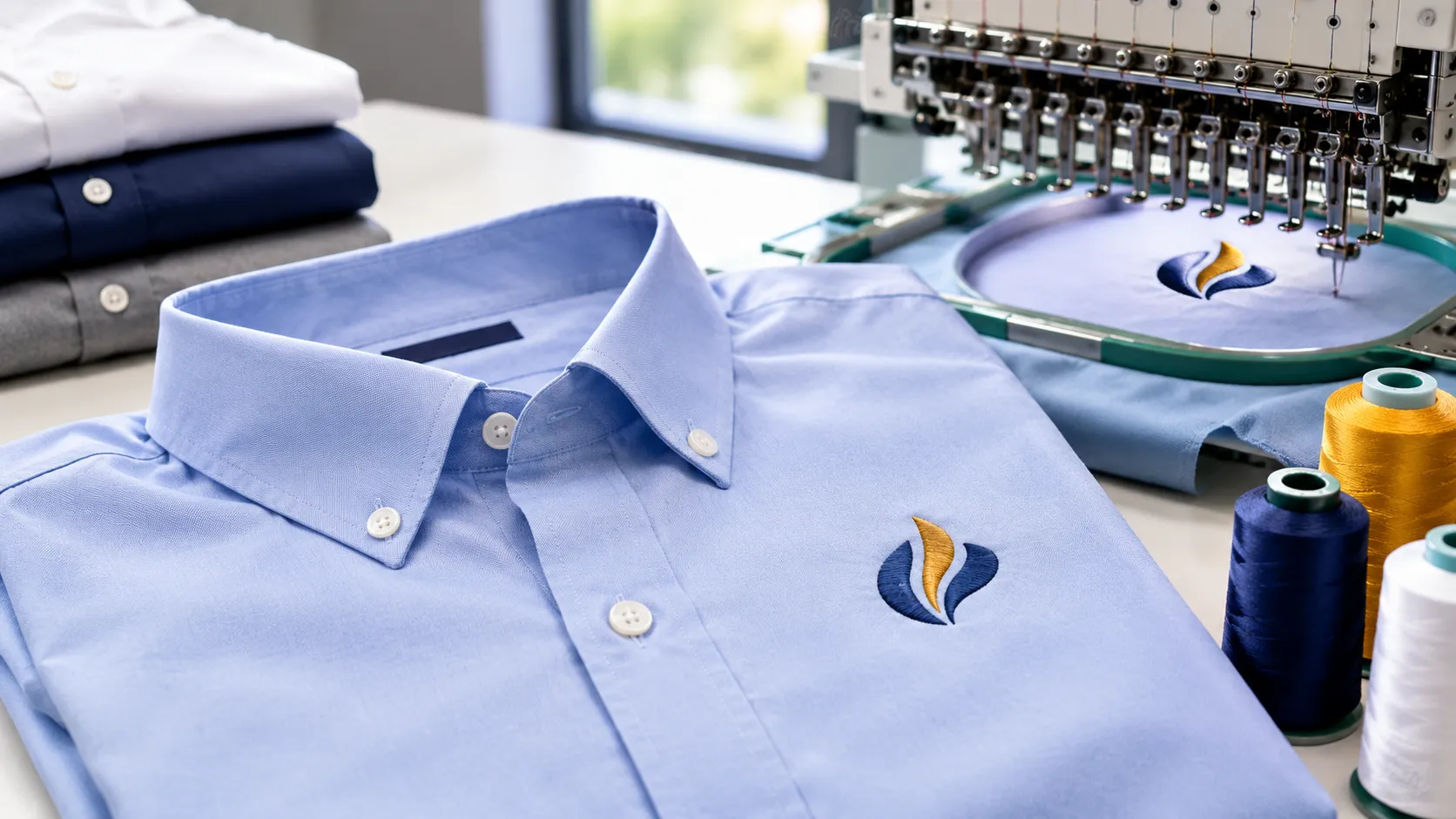
That's why the embroidery of logos onto shirts is a discipline in its own right, not a subset of garment embroidery. How much precision you need to place the motif on the garment, what kind of stitches you use and how you handle the fabric are all different, on a shirt, from what they would be on a t-shirt, a jacket or a sheet of fabric going through a Schiffli machine before being cut up. This page covers what's involved in manufacturing a shirt with a logo on export scale, from the point of view of the manufacturer.
Why Shirt Logo Embroidery Tends To Require Closer Tolerances
A shirt is a structured garment: a collar, placket, cuffs, and often a woven or semi-structured chest panel provide a very different receiving surface to the stretch of a t-shirt or the drape of a dress panel. Consequently, logo embroidery on shirts tends to require closer tolerances than most other categories.
There are three key reasons for this:
The chest panel has little tolerance for placement inaccuracies, since movement and stretch in the woven panel is minimal compared to a knit garment. Whereas a few mm of shift in a t-shirt logo might be disguised by the drape and stretch of the fabric, a woven panel will retain all placement errors visibly across the majority of shirts in a bulk order, particularly when compared to an approved sample.
The weight and weave of shirting fabrics usually allow for less stitch density than fleece or knit. Poplin, oxford and twill shirting are commonly 100-160gsm, with a tighter weave than many sweatshirts or tees, meaning stitching can pucker out.
Shirt logo embroidery is inspected garment by garment far more frequently than length by length. Corporate and export shirt orders are more likely to be checked as individual items against an approved sample, rather than sampling across a width of fabric, meaning tolerances need to be held to a higher standard on every garment that passes through the machine.
Choosing the Right Stitch Type for a Shirt Logo
When we create embroidery samples for a new shirt logo, the first choice is a stitch type and, in this area, many of our buyers learn that there is only one right way to embroider a logo. Actually, there are several and for each logo, the best fit is different
Flat or satin stitch is the most common type used for embroidery logo for shirts as it creates a nicely finished surface and is good with text and simpler shapes. This stitch type is the default for most corporate logos, monogram embroidery and brand wordmarks.
Fill or tatami stitch is better for larger areas of a logo, which use a solid density of colour like in a crest or emblem with broad colour fills. The stitching follows the shape of the design in an ordered way and will keep its shape and density on a firm woven fabric like shirting.
3D or puff embroidery raises the design off the fabric surface using a foam core underneath the stitching. This works well for a bold, dimensional emblem on a polo shirt placket or a premium corporate shirt, though it adds bulk that is not suited to a fine dress shirt collar. If a design calls for this raised effect, our 3D embroidery page covers how the technique is produced in more depth.
Patch embroidery, separate creation and attachment. For more complex multi-colour crest design or for a corporate program using a wide range of shirt styles and weights. Embroidering the logo on a separate piece of fabric and then heat sealing or stitching it onto the garment can often produce better results than trying to embroider the same logo on different material faces. Please see our general Patch Embroidery page for when it is a better option than standard direct embroidery.
Logo stitch type selection is not a matter of personal preference, it is a combination of logo complexity, fabric selection and garment care that will dictate what is the right choice.
Fabric and Backing Behind a Clean Shirt Logo
The weight of the fabric in a shirt determines the potential stitch density for a given garment. A fine 100 GSM dress shirt poplin will not accept as dense a stitching as the 160 GSM twill work shirt, else the logo on the lighter weight fabric will pucker unsightly around the perimeter. That’s a discussion we have before the strike-off, not after the return.
The choice of backing also determines whether a stitched logo will remain flat and stable after multiple launderings. Corporate and uniform tees are more likely to require commercial washing than home washing, which makes a cutaway backing that is permanently hidden behind the logo a more common choice for most shirt logo jobs than the lighter tear-away. Of course, less complex logos on heavier fabric might still use the lighter tear-away.
The placement of a logo also contributes to its potential stability. A logo on the chest has a wider surface area to cling to than one on the collar or cuff, which has far less area to grip and therefore less potential stability. This is why most logos on these smaller surfaces are either less detailed or use alternate stabilization methods.
The type of thread used for a logo impacts both its appearance and its resistance to laundering. Polyester thread holds color better and has greater resistance to abrasion than rayon thread, which makes it a preferred choice for most corporate or uniform programs that require frequent washing, over rayon which offers more sheen for less durability.
Fabric Compatibility for Shirt Logo Embroidery
| Shirting Fabric | Logo Embroidery Behaviour | Adjustment Needed |
|---|---|---|
| Poplin, 100 to 120 GSM | Fine weave, shows puckering easily | Lower density, lightweight cutaway backing |
| Oxford, 130 to 150 GSM | Textured weave, forgiving of moderate density | Standard backing, standard density |
| Twill, 140 to 160 GSM | Sturdy base, handles denser fill stitch well | Standard gauge needle, moderate to high density |
| Polo pique knit | Slight stretch, common for corporate polo shirts | Cutaway backing, placement testing for stretch |
| Denim shirting | Heavy, holds bold logos and patch work well | Heavier needle, higher machine speed |
If a corporate order spans multiple shirt styles, such as a formal dress shirt and a casual polo under the same brand programme, flag that at the brief stage. The same logo file will likely need separate density settings for each fabric base rather than one universal setting applied across all of them.
From Logo File to Finished Shirt: How We Handle Production
A shirt logo order typically follows these steps with us.
Logo file review. Most often corporate clients come to us with a vector logo file already in hand which considerably expedites the process as compared to a from scratch custom design. If the logo requires any adaptation be it for small size legibility or an alternate colourway that will fall under our custom embroidery services.
Digitizing for shirt scale. The same logo that looks sharp on a business card or large banner may require some tweaking to appear legible at two inches as an embroidered chest logo on a shirt placket.
Placement mapping and hoop setup. When it comes to bulk shirt production accurate placement across every garment relies on meticulous set up of the hoop and template prior to first stitch rather than a post stitch adjustment.
Strike off on the fabric intended for bulk production. A strike off is run on the exact fabric and colourway as the bulk order not a swatch in order confirm density and appearance prior to committing the order.
Sample shirt approval. An approved sample shirt not just swatch is produced for evaluation of placement and wearability.
In process checks during bulk production. One production issue we often see during the course of bulk shirt logo production is gradual placement shift as the machine works through a whole production run thus requiring periodic in process checks as opposed to first article and final inspection only.
Final inspection and packaging. Every completed bulk production run goes through a final inspection against the approved sample prior to packaging for either domestic delivery or export with appropriate moisture protection for the voyage ahead into container loading.
Mistakes We See in Shirt Logo Briefs
Uploading the high-resolution logo file without discussing embroidery size. A logo, which looks good on a business card, may turn out to have unnecessary details that need to be removed when downsized for a shirt. Confirming embroidery size during the initial stages allows the digitizer to make the right choices when simplifying lines and removing details.
Assuming that one density setting will work for all the fabrics in the corporate range. A density that looks good on a twill may cause puckering on a finer poplin. Every fabric in a corporate range usually requires separate testing.
Skipping the wash test on an approved sample. Corporate and uniform shirts are washed much more frequently than other garments, so the wash test on an approved sample prior to going into bulk production may reveal some details not obvious on a new shirt.
Not confirming tolerances in writing. A placement instruction to center a logo on the chest may be interpreted differently by different QC teams. Therefor, it is better to agree on the measurement from a specific point on the garment to a logo center during the initial approval of a sample.
Where This Fits Alongside Our Broader Shirt Embroidery Work
Logo embroidery is one element within a broader scope of work covering all manner of shirting, including not just single chest logo placements but also incorporating more complex yoke and placket embroidery. Our embroidery in shirts page has more detail on the full breadth of offerings that go beyond logo embroidery. For buyers looking to build out a dedicated single logo embroidery programme across seasons and fabric constructions our Logo Embroidery Services page explores the production partnership options in more detail.
Why Corporate and Export Buyers Work With Shri Jagdamba Embroidery Pvt. Ltd.
Our production floor is fully equipped with Swiss Lasser AG Schiffli machines, including six MVD 75 units at 21.5 metres in length with CORD attachment capability on two machines, as well as a dedicated MVD 57 sampling machine for proving out placement and density prior to bulk fabric commitment. Operating from Faridabad, Haryana, as part of a larger group that also operates in house dyeing and printing, colour and fabric preparation queries for a shirt programme can be resolved alongside the embroidery brief rather than through a separate vendor.
Our GOTS and GRS certifications appeal to corporate and export buyers that require documented sustainability credentials, and our ERP based order processing ensures that each logo punch file, strike off and placement approval is on record, so that a shirt logo approved this season can be reproduced accurately in a repeat order next year, without the need to rework the development process.
Talk to Our Team
If you have a logo file ready to go, or need a brand mark adapted for shirt scale embroidery, our team can talk you through the digitizing, placement mapping and sample approval process prior to starting bulk production. Get in touch to request samples, discuss design development, request a technical consultation on fabric and stitch type, request MOQ details or an export quotation on your next shirt logo programme.
Contact Shri Jagdamba Embroidery Pvt. Ltd. to send across your logo file and get started on development of your shirt embroidery order.