At Shri Jagdamba Embroidery Pvt. Ltd., we work with garment exporters, fashion brands, and sourcing teams every day to develop embroidered fabrics that meet both design intent and production realities. This guide shares what we have learned from years of hands-on Schiffli embroidery manufacturing so you can make confident fabric decisions for your next collection.
Why Fabric Choice Defines Embroidery Quality
Not every fabric responds to embroidery the same way. A design that looks stunning on cotton poplin may appear flat on a slippery polyester. A chemical lace that works beautifully on a water-soluble base might not hold up on a loosely woven linen.
The density of the weave, the fiber content, the weight of the fabric, and even the finishing treatment all affect how embroidery threads sit, how clearly the design registers, and how the finished fabric drapes on a garment.
In my experience working with garment exporters across India and internationally, I have seen many buyers underestimate this step. They finalise a design first and then search for a fabric that fits it. The smarter approach is the reverse: understand your fabric options first, then design for them.
The Best Fabrics to Embroider for Fashion and Export Use
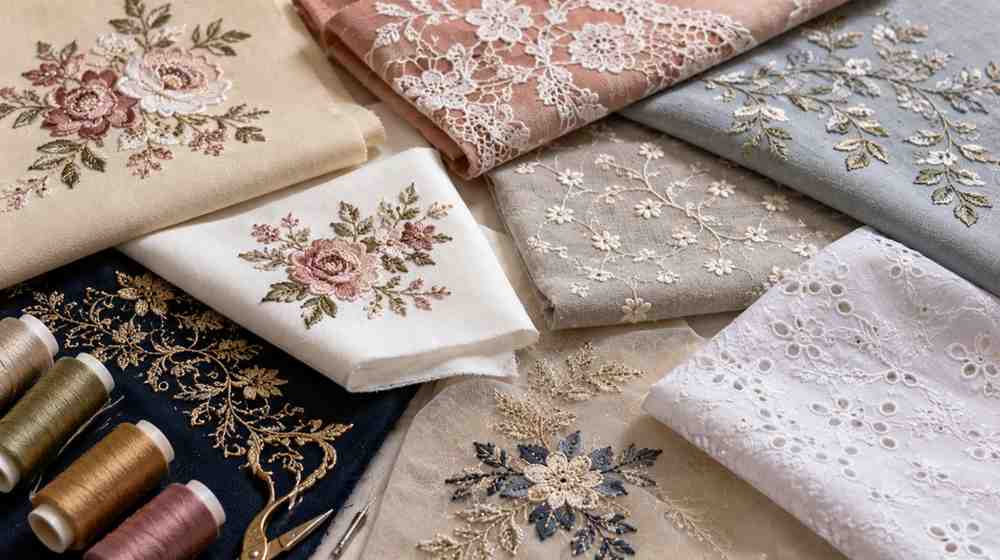
There is no single best fabric to embroider. The right choice depends on the end use, the embroidery technique, and the aesthetic you are targeting. Here is a breakdown of the most widely used and highest-performing options.
Cotton
Cotton is one of the most forgiving and reliable base fabrics for embroidery. Its tight, stable weave holds stitches cleanly and allows for high stitch counts without puckering. It is ideal for all-over Schiffli embroidery, border designs, and heavy density patterns.
Varieties such as cotton poplin, cotton cambric, cotton lawn, and cotton voile each behave slightly differently. Cotton lawn, for instance, is lightweight and breathable, making it popular for kurtas, blouses, and women's ethnic wear. Cotton poplin gives a crisper finish and is preferred for structured garments.
At Shri Jagdamba Embroidery Pvt. Ltd., we work with both greige and dyed cotton fabrics as embroidery bases, giving clients full flexibility over the final color story of their collection.
Viscose
Viscose is a favorite in the premium segment because of its natural drape and silk-like appearance. When embroidered, especially with viscose or dyed yarn, the result has a luminous quality that positions garments at a higher price point.
I have noticed that brands targeting the luxury ethnic and fusion wear market consistently prefer viscose as their embroidery base. It photographs beautifully, which matters a great deal for e-commerce and catalog buyers.
The challenge with viscose is that it can shift slightly during production. Machine precision is essential. Our Lasser AG Schiffli machines, which are Swiss-engineered and among the most accurate in the industry, handle viscose exceptionally well.
Net and Organza
Net fabrics including mono net, soft net, and diamond net are used extensively for bridal, evening wear, and occasion collections. Embroidery on net creates an open, airy aesthetic where the pattern appears to float against skin or inner lining.
Organza offers similar transparency with a crisper hand. Chemical lace embroidery on organza or water-soluble base creates delicate all-over lace that is used extensively in global fashion markets.
These fabrics require very precise stitch tension and machine calibration. A slight variation can cause the net to distort or the stitches to appear uneven. This is an area where manufacturing experience and machinery quality separate good suppliers from great ones.
Polyester and Poly-Blend Fabrics
Polyester is cost-effective and widely used for mass-market garments. It is colorfast, easy to wash, and dimensionally stable. Embroidery on polyester fabrics holds well over time and survives repeated washing cycles without distortion.
Poly-blend fabrics such as poly-cotton offer a balance between cost and quality. For buyers targeting value segments or sportswear, these are practical and commercially sound choices.
Linen and Linen Blends
Linen brings a natural, textured look that is growing in popularity for sustainable and natural fiber collections. Embroidery on linen creates an earthy, artisanal aesthetic that resonates strongly with eco-conscious consumers.
One practical consideration with linen is that its irregular weave requires a slightly adjusted embroidery approach. Using coordinating natural fiber yarns, such as organic cotton dyed yarn, enhances the overall look and keeps the product certification-friendly.
Boski and Georgette
Boski, a lightweight woven fabric, is popular in South Asian fashion markets for its fluid drape. Georgette, known for its crinkle texture, is used in sarees, dupattas, and evening wear. Both fabrics are excellent for light to medium density embroidery and respond well to floral and paisley patterns.
Embroidery Techniques and How They Interact With Fabric
Understanding the best fabric to embroider also means understanding which embroidery technique you are working with. At our facility, we operate multiple Schiffli embroidery approaches.
Greige on Greige Embroidery uses unfinished base fabric with unfinished yarn, and both are processed together after embroidery. This gives excellent color consistency across the full fabric piece.
Dyed on Dyed Embroidery uses a pre-dyed fabric base with matched or contrasting dyed yarn. This is ideal when you need precise color coordination for a specific seasonal palette.
3D Embroidery creates a raised, dimensional effect by layering stitches over a foam or cord base. This technique looks particularly impactful on cotton and poly fabrics and is popular in kidswear, casual wear, and streetwear.
Applique Embroidery combines a separate fabric element stitched onto the base fabric using embroidery thread. The visual depth this creates is striking, and the technique works across a wide range of base fabrics.
Chemical Lace All Over and Border uses a water-soluble base fabric that is washed away after embroidery, leaving behind only the thread structure as a lace. Net Schiffli, Borer Schiffli, Cotton Schiffli, and Boski Schiffli are the common variants. The resulting lace can be used as all-over fabric panels or as borders on garments.
Neck Patches and Panel Embroidery are precision-focused applications where a specific section of a garment is embroidered separately. These require tight dimensional accuracy and strong quality control at every stage.
What Sourcing Managers Should Know Before Placing an Order
When we develop embroidery samples for buyers, the conversation always covers a few non-negotiable topics. These are the things that separate a smooth production run from a painful one.
Sampling and Development: Any new design requires a sampling cycle. At Shri Jagdamba Embroidery Pvt. Ltd., we have a dedicated 5-meter Lasser AG sampling machine specifically for this. This means your designs are developed at full production scale, not on a smaller test machine, so there are no surprises when bulk production begins.
MOQ Flexibility: Minimum order quantities vary by product type and design complexity. We understand that not every buyer is ready for massive volumes in the first order, particularly when testing a new design or entering a new market. We work with buyers to find a practical starting point.
Lead Times: Typical lead times from design confirmation to dispatch range between three to six weeks depending on design complexity, yarn availability, and fabric base. Sampling adds approximately one to two weeks before production begins.
Bulk Production Capacity: Our facility currently produces over two lakh meters per month of embroidered fabric. This capacity ensures that once your design is confirmed, scaling up is not a bottleneck.
Quality Control: Every order goes through in-house mending and shearing to ensure clean finish. Color matching is managed digitally. Our ERP system tracks each order from sampling through dispatch so there is full visibility at every stage.
Design Confidentiality: Buyer designs are treated with complete confidentiality. NDAs can be signed on request.
Why Shri Jagdamba Embroidery Pvt. Ltd. Is a Trusted Embroidery Partner
There are many embroidery manufacturers in India. Here is what genuinely sets Shri Jagdamba Embroidery Pvt. Ltd. apart.
The foundation is machinery. We operate six Lasser AG MVD 75 Schiffli machines, each 21.5 meters in length, with CORD attachments on two machines. Lasser AG is a Swiss manufacturer and represents the gold standard in Schiffli embroidery technology. The stitch precision, repeatability, and speed these machines deliver are unmatched in this segment.
The second differentiator is vertical integration. The Shri Jagdamba group includes in-house dyeing through Shri Jagdamba Dyeing Mills and rotary and digital printing through Shree Jagdamba Knits. This means a buyer can develop a complete collection fabric within one group, with consistent color and quality across all processes.
The third is R&D capability. Unlike most Schiffli units that restrict themselves to standard greige or poly-spun yarns, we actively develop embroidery using cotton dyed yarn, viscose yarn for silk-like shine, organic cotton dyed yarn, multi-color yarns, and CORD yarns of various counts. One collection we developed using these specialty yarns for a leading Indian fashion brand resulted in a complete sell-out and multiple repeat orders.
Fourth is compliance. Our facility has cleared Inditex social, health and safety, and metal detection audits. For buyers supplying to global fast-fashion and mid-market brands, this is a significant advantage that shortens the vendor approval timeline.
Customization Options Available
Every aspect of your embroidered fabric can be customized at Shri Jagdamba Embroidery Pvt. Ltd.
You can choose the base fabric from cotton, viscose, net, organza, georgette, Boski, linen, or polyester. You can specify yarn type including standard polyester, dyed cotton, organic cotton, viscose, multi-color, or CORD. Design width, repeat size, stitch density, pattern motif, and color palette are all adjustable within the capabilities of our machines.
Finishing options include shearing for a clean surface, mending for any stitch repair, and coordination with our dyeing unit for custom background colors. We also support all-over fabric as well as cut panel and border formats depending on your garment construction approach.
Sustainability and Certifications
According to Textile Exchange, demand for certified sustainable textiles continues to grow among global fashion brands, with both organic and recycled fiber certifications becoming baseline requirements for many sourcing teams.
Shri Jagdamba Embroidery Pvt. Ltd. holds both GOTS (Global Organic Textile Standard) and GRS 4.0 (Global Recycled Standard) certifications. This means we can supply embroidery developed on certified organic cotton bases using organic cotton yarn, as well as embroidery incorporating GRS-certified recycled content.
For buyers building sustainable collections or those supplying to European and North American retailers with strict compliance requirements, our certification status removes a significant sourcing barrier.
We are also actively preparing for a transition to solar energy at our facility, which will further reduce the carbon footprint of every meter of fabric we produce.
Ready to Find the Best Fabric to Embroider for Your Next Collection?
If you are a garment exporter, fashion brand, or sourcing professional looking for a reliable, quality-focused, and certified embroidery partner in India, we would be glad to hear from you.
At Shri Jagdamba Embroidery Pvt. Ltd., we combine Swiss-grade machinery, in-house R&D, and integrated dyeing and printing to deliver embroidered fabrics that meet the exacting standards of global buyers.
You can take the next step in any of these ways: request a fabric sample to evaluate quality firsthand, share your design brief to get a custom development quote, speak with our technical team about the right fabric and embroidery approach for your collection, or reach out to discuss your production requirements in bulk.
Contact us at sales@sjepl.in or call 0129-4324141. Our team is available to assist you from sampling through shipment.