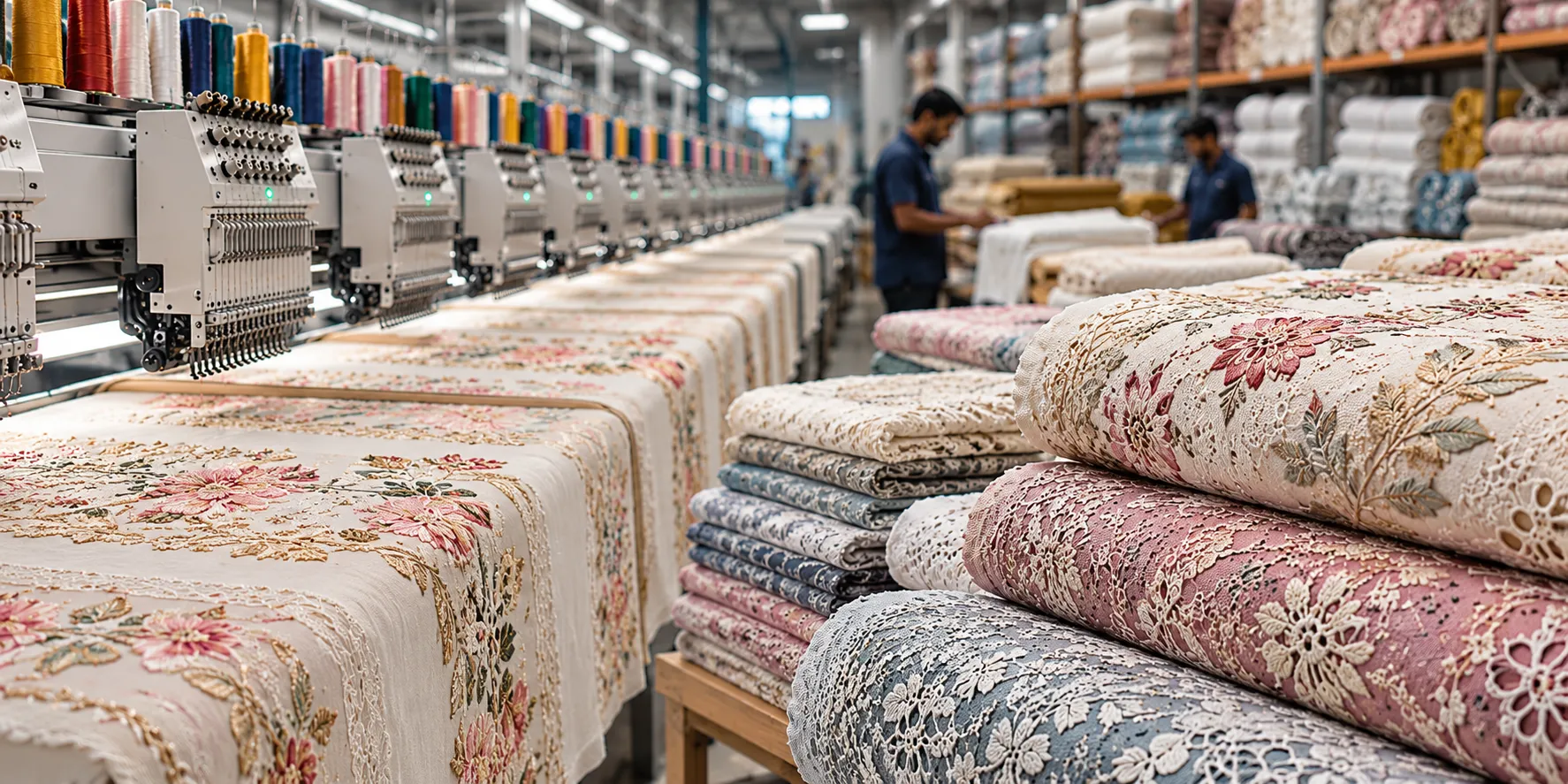
Looking for embroidery job work for textile wholesalers and fabric traders? Shri Jagdamba Embroidery's certified Schiffli unit turns your greige and dyed fabric into bulk embroidered fabric, borders, lace and patches, with consistent shade and stitch quality across the whole lot.
Plain fabric sells on price per metre, and every trader in the market quotes against the same commodity rate. Embroidered fabric sells on design, and design is where a wholesaler can build a margin that competitors cannot copy by lowering a rate. The catch is that the embroidery step usually goes to small units that were never set up for trader-sized lots.
This page explains how our embroidery job work fits a wholesaler's business, what we run on the machines, and how an order moves from your godown to finished rolls.
Why Fabric Traders Outsource Embroidery Instead of Buying Ready Stock
A trader who buys ready embroidered fabric sells what every other trader can also buy. The design, the base and the price are all visible in the same catalogues. Margins in that segment shrink season after season.
Sending your own stock out for job work changes the equation. You buy the base fabric at your own rate, you choose the design, and the finished embroidered fabric carries a price that reflects the design, not just the cloth. A floral all-over, a border or a neck patch that only you stock becomes a reason for a garment manufacturer or boutique buyer to come back to you.
Job work also keeps working capital flexible. You embroider against confirmed orders or a planned collection instead of holding large lots of finished embroidered stock that may not move.
The Problems Traders Face With Small Embroidery Units
Most embroidery job work in India sits with small units that handle sarees, suits and boutique orders well. Supplier listings on B2B directories show minimum orders that commonly run between 30 and 300 metres, which tells you who these units are built for. A wholesaler holding thousands of metres runs into three problems.
First, the lot gets split. When one unit cannot take the whole quantity, the fabric goes to two or three, and the same design comes back in slightly different shades, thread densities and design repeats. Retail buyers notice this when two rolls from one lot are cut for the same garment.
Second, delivery slips. A small unit juggling many clients cannot promise a firm date, and a late embroidered lot means a late sale for you.
Third, paperwork is missing. If your buyers include exporters or large brands, they will ask for compliance documents that a small unit rarely holds. Without them, the lot is harder to sell upstream.
What Our Embroidery Job Work Offers Wholesalers and Traders
Machines built for trader-sized lots
We run brand new Lasser AG (MVD 75) Schiffli embroidery machines, each 21.5 metres long. A large lot can run on our machines without being broken across several units, so the first roll and the last roll match.
A range that covers what traders sell
Our embroidery job work includes:
- Greige on greige embroidery
- Dyed on dyed embroidery
- 3D (puff) embroidery
- Applique embroidery
- Chemical laces, border and all over
- Neck patches embroidery
- Patch or panel embroidery
This mix lets one wholesaler build a full catalogue, from all-over embroidered cotton fabric to borders and lace trims, with a single embroidery partner.
Sampling before bulk
Send a design reference, a swatch, a finished garment or a sketch, and our sampling team develops a sample on your fabric. You approve thread colour, stitch density and placement before bulk production starts, and the approved sample stays the reference for the whole run.
Embroidery on Your Fabric: Greige or Dyed
Most traders hold stock in two forms, and our embroidery job work covers both.
If you hold undyed stock, greige embroidery lets you embroider first and send the fabric for dyeing later, which keeps your colour decisions open until closer to the season. If you hold dyed fabric, dyed embroidery matches thread to the fabric colour you already have.
We also work on customer-supplied fabric, so you do not have to change your mill or your base. A few things on your side help the result:
- Keep roll width and GSM consistent across the lot, because embroidery pulls fabric inward and uneven rolls show up in the finished width.
- Share a swatch from each mill lot if you are mixing lots.
- Tell us the end use, whether kurtis, dresses, home textiles or export garments, so we can set density accordingly.
Because our group has worked across dyeing, knitting and printing, we read the base fabric before we stitch on it. That saves rework on cotton, viscose and blends.
How an Order Moves From Your Godown to Finished Rolls
- Share your brief and a sample of your base fabric.
- We develop and send a sample for your approval, matching thread colour, density and placement.
- You confirm the lot size, and we plan machine time and a dispatch schedule that fits your selling season.
- Bulk production runs with quality checks at each stage, not a single inspection at the end.
- Checked embroidered fabric is dispatched on the agreed schedule.
Because sampling, production and quality control sit together, you deal with one vendor for the whole job instead of coordinating several.
Building a Repeatable Design Library
A wholesaler's strength is the ability to supply the same design again next month. That is hard to do when each lot goes to a different unit.
With one embroidery partner and an approved sample as the reference, reorders can match the original lot far more closely. Over a few seasons you can build a design library of your own, with designs that buyers ask for by name. For fast-moving items, you can also look at our ready range of Schiffli embroidery fabric and keep job work for the designs you want exclusively.
If you want to compare the two routes properly, our blog on job work versus buying ready embroidered fabric walks through landed cost per metre.
Certifications That Help You Sell Upstream
We are GOTS and GRS certified, and our facility is Inditex compliant, having cleared social, health and safety, and metal detection audits. For a trader who sells to garment exporters and brands, that documentation makes your embroidered lots easier to place with buyers who ask for it.
Our founder, Mr. R. K. Sachdeva, started with a small hand dyeing unit in Okhla, Delhi, and the group grew into dyeing, printing, knitting and, from 2024, a dedicated Schiffli embroidery unit in Faridabad. Our full range of services is on our embroidery job work page.
Let's Talk About Your Next Lot
If you trade in fabric and want an embroidery job work partner that can hold a large lot together, we would like to hear from you. Get in touch with our team to share your fabric and design, request a sample or download our brochure.