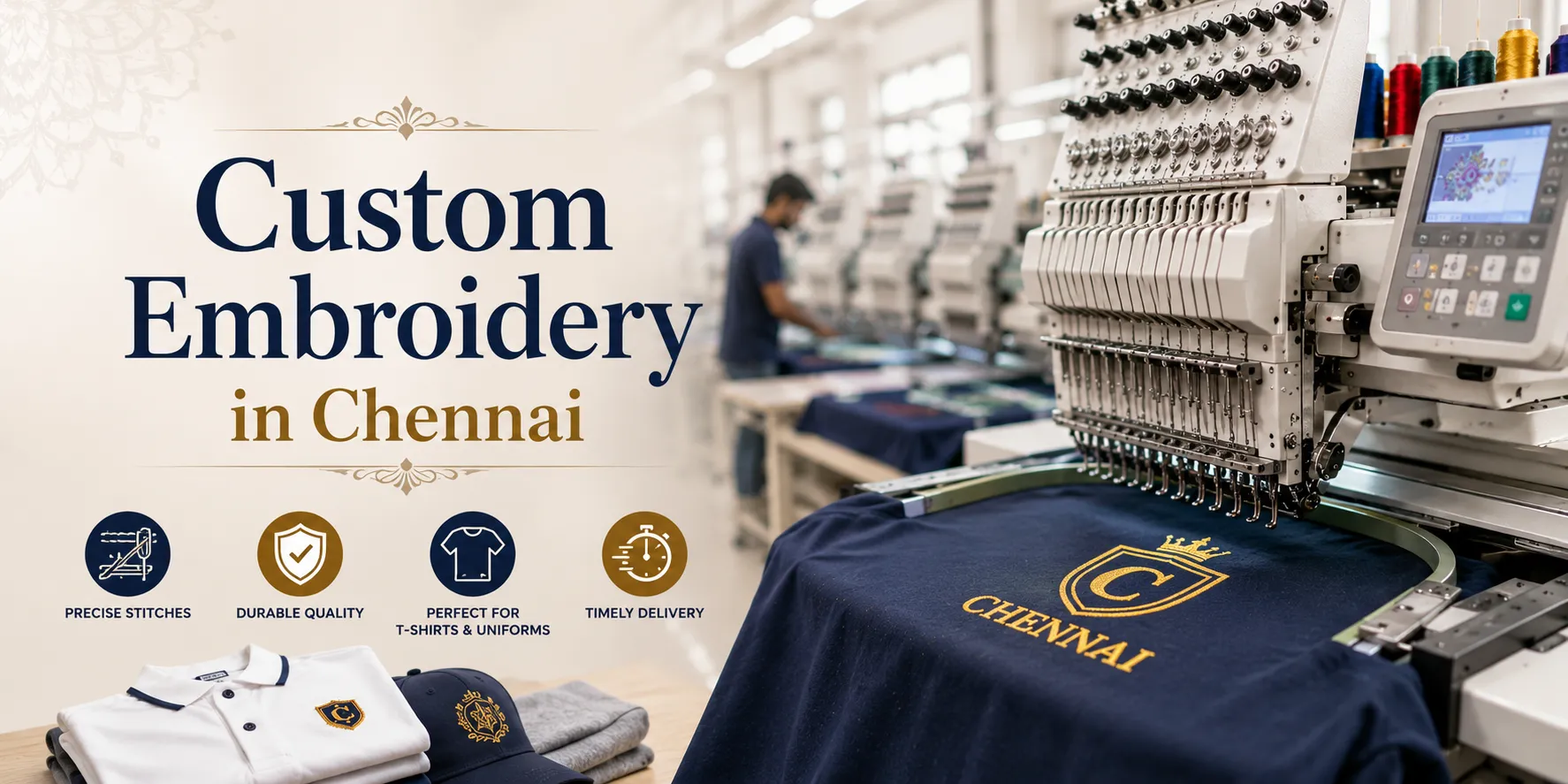
Pick up any decent polo shirt or corporate tee with a stitched logo on the chest and run your thumb over it. That slight raised texture, the way the thread catches the light differently depending on the angle, that is what custom embroidery does that a print simply cannot fake. It is also why so many brands and companies in Chennai keep coming back to embroidery for uniforms, merchandise, and branded apparel even when printing is faster and cheaper.
The problem is, if you actually search for custom embroidery in Chennai right now, most of what shows up is either a directory listing with a phone number or a page so stuffed with the keyword that it stops making sense halfway through. Nobody is really explaining what digitizing actually involves, why t-shirts behave differently under a needle than a stiff cotton shirt does, or what file you are supposed to hand over. So here is the version we wish existed.
Prefer to just talk it through?
Reach out to our team here and we will walk you through samples and pricing based on your actual design.
What Custom Embroidery Actually Means Before You Order
Custom embroidery is not just "stitching a logo on." Before a single needle moves, your design has to be digitized, which means converted from a flat image into a stitch file the embroidery machine can actually read and execute, things like stitch type, stitch direction, density, and the order in which colors and sections get sewn. A lot of pages online mention sending an AI, EPS, or PDF file and stop there, which is only half true. Those formats are fine as source artwork, but the actual machine file that gets produced from digitizing is usually a DST or PES format, and that conversion step is where most of the quality difference between vendors actually happens. A poorly digitized file will pucker, gap, or drift out of place no matter how good the machine is. This is worth knowing before you compare quotes, because two vendors quoting the same price are not necessarily doing the same level of work.
Why T-Shirts Are Trickier Than People Expect
If you have ever gotten a t-shirt back from embroidery with the fabric bunched up around the logo like a tiny mountain range, you already know the issue. Knit fabric, which is what almost every t-shirt is made from, stretches. It moves under the needle in a way that woven fabric like a formal shirt does not. Without the right backing, called a stabilizer, sitting behind the fabric during stitching, the tension from dense embroidery pulls the knit out of shape and you end up with puckering that no amount of ironing fixes afterward.
Good t-shirt embroidery uses the right stabilizer for the job, usually a cut-away backing for stretchy knits since it holds the stitches in place permanently, versus a tear-away backing which works fine on sturdier wovens. Fabric weight matters too. A heavier, tighter-knit cotton tee takes embroidery far more cleanly than a thin, lightweight one, which is exactly why a lot of experienced vendors will actually tell you to prewash and pick a slightly heavier blank before committing to a design, rather than just accepting whatever shirt you send over.
Stitch count is the other piece nobody explains well. More detail in a design means more stitches, and more stitches means a higher price, a heavier feel on the fabric, and a longer production time per piece. A simple text logo might run a few thousand stitches. A dense, multi-color emblem can run well past ten thousand. If your budget or your deadline is tight, simplifying the design before digitizing often makes a bigger difference than negotiating on price per piece.
Chennai's Embroidery Landscape for Businesses
Chennai sits in a genuinely useful spot for this kind of work. It is close to Tiruppur, one of India's largest knitwear and t-shirt manufacturing hubs, which means sourcing quality blank t-shirts before embroidery is rarely a bottleneck here. Within the city itself, computerized embroidery units are spread across areas like Kodambakkam, Choolaimedu, Vadapalani, and Chromepet, mostly small to mid-sized operations doing job work for local boutiques, corporate buyers, and export houses side by side.
That said, most of what you will find by searching locally is job work pricing per piece with very little clarity on capacity, turnaround, or how they actually handle quality checks across a large run. That is fine if you need fifty polo shirts for an office event. It gets riskier once you are placing an order for a few thousand pieces and need every single one to look like the sample you approved. If you have not already, it is worth reading our broader piece on embroidery in Chennai for the wider picture, including bridal and craft embroidery alongside the commercial side covered here.
Embroidery vs Printing on T-Shirts: An Honest Comparison
Since this comes up constantly, here is the straight answer. Embroidery lasts longer, holds its shape through hundreds of washes, and gives a premium, tactile finish that reads as more expensive even on a basic shirt. It costs more per piece though, especially for detailed or multi-color designs, and it is not great for very fine gradients or photographic detail since it is built from stitches, not ink. Printing, whether screen print or DTF, is cheaper for large color-heavy designs and works better for oversized graphics, but it fades and cracks over time in a way embroidery simply does not.
For corporate uniforms, staff polos, and anything meant to be worn and washed repeatedly for a year or more, embroidery usually wins on value even with the higher upfront cost. For one-off event merchandise or giveaways where the shirt might get worn a handful of times, printing is often the more sensible call.
What Realistic Costs and Timelines Look Like
Pricing for custom t-shirt embroidery depends mostly on stitch count, number of thread colors, and order volume, in that order. A simple, low-stitch-count logo on a bulk order of a few hundred pieces sits at the affordable end. A dense, multi-color design with fine detail costs noticeably more per piece, and small orders of a handful of shirts will always carry a higher per-piece rate than a run of a thousand, since digitizing is largely a fixed cost regardless of quantity.
On timelines, expect the digitizing and sample approval stage to take anywhere from a few days to a couple of weeks depending on how complex the design is and how quickly you approve the stitch-out. Bulk production after approval typically moves in weekly batches, and any vendor worth working with should give you a realistic week-by-week estimate once they see your final design and quantity, not a vague promise.
Questions Worth Asking Before You Commit
Ask to see an actual stitch-out sample of your specific design, not just a portfolio of past work. Ask what stabilizer they plan to use on your fabric type, since this alone predicts whether your t-shirts will pucker. Ask about their real weekly capacity and how they handle a defect discovered after delivery. And if you are working with an embroidery company offering professional custom embroidery services for an ongoing brand or uniform program, ask how they maintain color and placement consistency across repeat orders placed months apart, since that consistency is usually where smaller job work units start to slip.
Conculsion
Custom embroidery, especially on t-shirts, looks simple from the outside and turns out to be full of small technical decisions that decide whether your final order looks premium or slightly off. Stabilizer choice, stitch count, fabric weight, and proper digitizing all matter more than most listings let on. Get those right and embroidery pays for itself in how long the garment actually lasts.
If you are planning a bulk or corporate embroidery order and want it done right the first time, get in touch with our team and we will guide you through samples, timelines, and pricing based on your real design and quantity.
