If you have ever walked through T. Nagar on a Sunday evening, past the blouse boutiques with their glass counters full of gold zari samples, you already know Chennai does not do embroidery quietly. It does it loudly, brightly, and with a level of detail that can make you stand there for a full five minutes just staring at one blouse piece. That is the city's relationship with embroidery in a nutshell, and it is a lot bigger than most search results give it credit for.
We looked at what actually shows up when someone searches for embroidery in Chennai right now, and honestly, it is a bit thin. Mostly directory listings with a phone number and an address, a few Facebook pages, and some tuition class aggregators. Nobody is really explaining what you are choosing between, what things cost, or how to avoid getting stuck with a vendor who goes silent after taking your advance. So we decided to write the guide we wished existed when we started sourcing embroidery in this city years ago.
Want to skip the reading and just talk to someone?
Say hello to our team here and we will walk you through samples and pricing directly, no pressure.
Why Chennai Is Its Own Embroidery World
Tamil Nadu's embroidery story is tied closely to its weaving story. Kanchipuram, less than an hour and a half from the city, has been producing silk with zari borders for centuries, and a lot of that zari tradition bled into how Chennai approaches embroidery work today. You will see it in the heavy gold thread on bridal blouses, the temple motifs repeated along a saree border, and the way local karigars treat gold-toned zari almost like a signature rather than just a material choice.
Then there is the aari and maggam work boom. If you ask ten women in Chennai where to get bridal blouse embroidery done, at least seven will mention aari work specifically. It uses a hooked needle instead of a regular one, which lets the artisan pull thread through fabric fast and build up dense, raised patterns of beads, sequins, and stones. It genuinely looks like jewellery once it is done. Areas like Mangadu, Nanganallur, and Choolaimedu have small home-based and boutique units doing exactly this kind of work, often run by women who trained under a senior karigar for years before taking their own orders.
On the other side, Chennai also sits close to Tiruppur, one of India's biggest knitwear and garment export hubs, and Chennai's own port makes it a natural point for apparel businesses that need embroidery finishing before shipment. So the city carries two very different embroidery worlds under one search term: bridal and personal wear on one hand, and commercial or business embroidery for garment brands on the other. Search results rarely separate the two, which is honestly part of why they feel so scattered.
The Types of Embroidery Work People Actually Search For in Chennai
Here is where a real breakdown helps, because "embroidery in Chennai" covers a lot of ground.
Aari or maggam work is the one everyone associates with bridal blouses. It is done using a hook, works fast, and can carry an enormous amount of detail, beads, sequins, cutdana, and stone work layered together. A dense floral aari blouse can easily take two to four days of steady work depending on how heavy the design is.
Zardosi is the older, more traditional gold and silver thread work, often paired with dabka (a coiled wire thread) for a raised, metallic texture. It is heavier, slower, and usually reserved for wedding lehengas, blouses, and formal wear where the client wants something that catches light from across a room.
Thread embroidery, plain and simple, is still the most common request for everyday kurtis, salwar sets, and casual blouses. It is lighter, more affordable, and the fastest to produce.
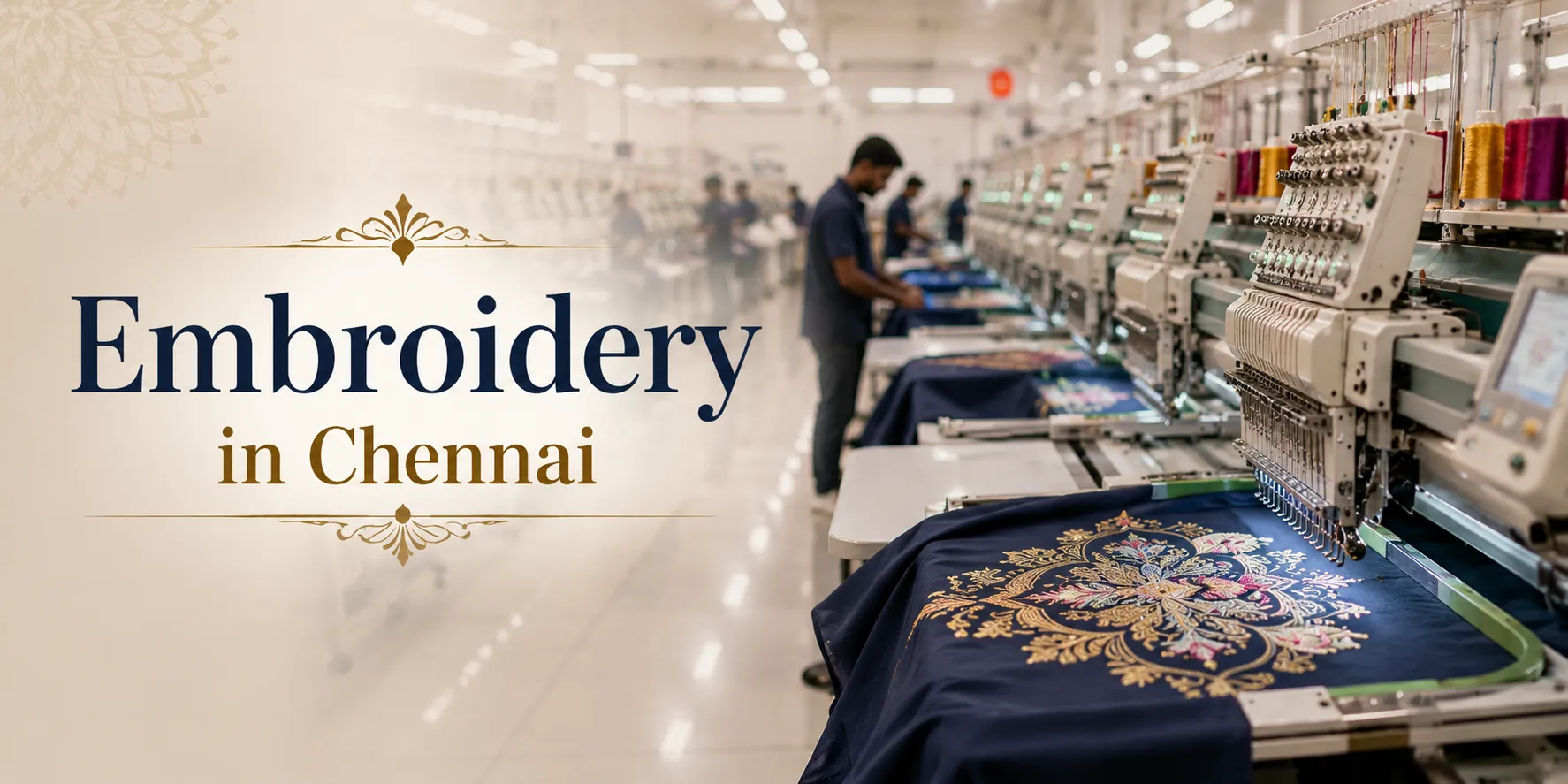
Computerised or machine embroidery is where things shift from craft to production. This is what garment manufacturers, uniform companies, and apparel brands actually need, because it delivers consistent stitch density and placement across hundreds or thousands of pieces, something hand embroidery simply cannot promise at scale. If you are running a fashion label or a garment unit and need this kind of consistency, this is genuinely a different conversation than booking a blouse for a wedding, and it is worth reading up on custom embroidery in Chennai if bulk, repeatable work is what you are after.
What "Embroidery Work in Chennai" Usually Means When People Search It
We noticed something interesting while researching this. People searching "embroidery work" tend to be looking for one of three things: someone to hire for a personal order like a blouse or dupatta, a small business owner looking for job work on a per-piece basis, or a garment brand that needs an ongoing embroidery partner. These are not the same search, even though Google lumps them together.
If you are the first kind, a local aari or zardosi karigar working out of a home studio or small boutique is probably your best bet, and honestly, walking in with a reference photo works better than any written brief.
If you are the second or third kind, running per-piece job work through a directory listing gets risky fast. Consistency across a bulk order is where most small units struggle. A sample piece can look flawless and then piece 400 out of 1,000 has a completely different thread tension because a different operator was running the machine that day. This is exactly the gap that a proper embroidery company offering professional services for apparel brands is built to close, with quality checks happening through the run rather than only at the end.
What It Actually Costs
Nobody in the current search results gives you real numbers, which is frustrating if you are trying to budget. So here is an honest range based on how pricing typically works in this market.
Simple thread embroidery on a kurti or dupatta usually falls somewhere on the lower end, since it is fast to produce and needs minimal material. Aari or maggam blouse work climbs a lot higher once beads, sequins, and stones enter the design, and a heavily worked bridal piece with dense coverage sits well above a simple floral border. Zardosi and dabka work tend to be priced even higher because of the metallic thread cost and the slower pace of the craft. For bulk garment or commercial embroidery, pricing is usually quoted per piece and depends heavily on stitch count, thread type, and order volume, so a 500-piece order will almost always come at a better per-piece rate than a 50-piece one.
Trust us on this one: any vendor who gives you a confident, specific number before seeing your design or fabric is either guessing or quoting on autopilot. The honest answer, every time, is "send us the design and we will tell you exactly."
What Most Listings Get Wrong
Two things stood out while we went through what currently ranks for this topic. First, almost every result is a directory page with zero actual guidance, no explanation of techniques, no pricing context, nothing about how to evaluate a vendor. Second, none of them separate personal bridal embroidery from commercial garment embroidery, even though the buyer journey for each is completely different. A bride looking for a blouse and a brand sourcing embroidery for 3,000 t-shirts are not solving the same problem, and treating them like they are is exactly why so many people end up frustrated with the first vendor they call.
How to Pick the Right Person or Company
For personal orders, ask to see actual finished pieces, not just design catalogs, and ask how long the artisan has been doing aari or zardosi specifically. Craft embroidery is a skill that shows itself in the finishing, whether the knots are hidden, whether the beadwork sits flat, whether the thread tension is even across the whole piece.
For business and bulk orders, ask different questions entirely. What is their actual weekly production capacity, not the optimistic number they lead with. Do they run physical samples before full production starts. How do they handle a defect found after delivery. Do they have experience with your specific technique. A vendor who answers these clearly in the first call and still answers them the same way six months in is one worth sticking with.
Where We Fit Into This
A fair question at this point is where Shri Jagdamba Embroidery fits into a Chennai-focused guide, since our headquarters and main production units are based in Faridabad, not Tamil Nadu. Here is the honest answer. We work pan India, and that includes fashion brands, garment manufacturers, and export houses based in and around Chennai who need embroidery that does not vary from piece one to piece one thousand. Distance stopped being a real barrier a while ago, design files travel in seconds, samples travel overnight, and finished production ships out on a schedule you can actually plan around. What matters more than a local address is whether the embroidery holds up at scale and whether the vendor answers the phone six months into an order, not just during the first quote.
A Quick, Honest Word on Timelines
Personal bridal orders in Chennai typically need anywhere from a few days to a couple of weeks depending on how packed the season is, and wedding season here gets genuinely busy, so booking early is not a bad idea. Bulk garment embroidery timelines depend far more on order size and design complexity, and any serious vendor should be able to give you a realistic week-by-week production estimate once they see your specs, not a vague "soon."
Conclusion
Chennai has one of the richest embroidery traditions in the country, and it deserves a better guide than a stack of directory listings. Whether you are chasing down the perfect aari blouse for a wedding or trying to lock in a reliable embroidery partner for your next apparel collection, the real difference between a good experience and a frustrating one comes down to asking the right questions before you commit, not after.
If you are on the business side of this and need embroidery that holds up across bulk, repeatable orders, reach out to our team and we can walk you through samples, timelines, and pricing based on your actual design, not a generic price list.
