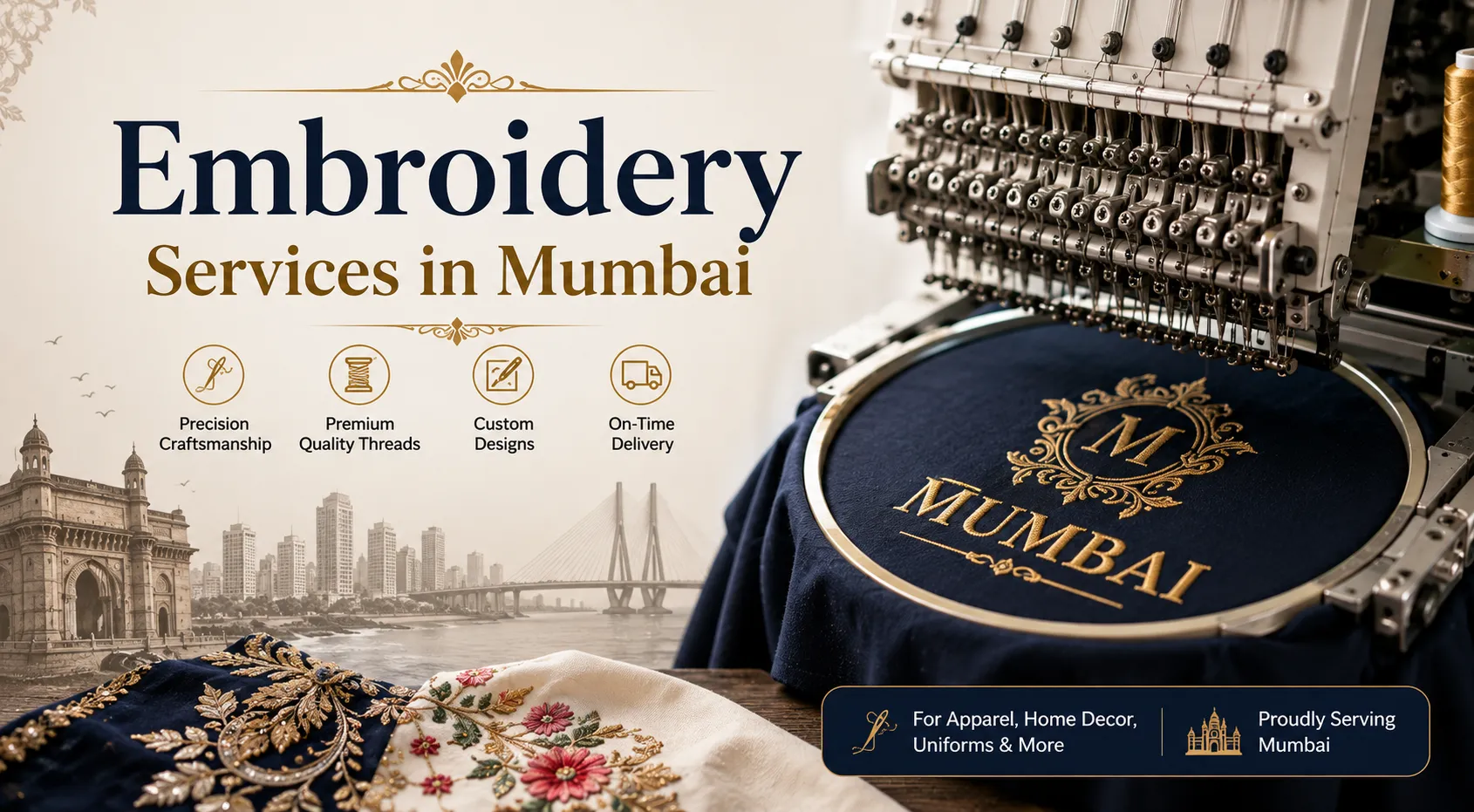
If you've already typed "embroidery services in Mumbai" into Google, you probably know the drill by now. You get a wall of directory listings, a dozen "top 10" pages that all say the same three lines, and maybe one or two company websites with photos of machines. None of it tells you what you actually want to know. How much does this cost. How long will it take. Which part of the city should you even be looking at. Is hand work still a thing here or has everyone gone fully computerized.
We work in this industry every single day, so let's actually answer those questions instead of dancing around them.
Before we get into it, if you'd rather just talk to a real person about your order than read through pricing tables, say hi to our team here and we'll sort it out with you directly.
Mumbai Isn't One Embroidery Hub. It's Three, and They're Not the Same Thing
This is the part most guides skip, and it's honestly the most useful thing to know before you even start calling anyone.
Mumbai's embroidery work isn't concentrated in one neighbourhood with one style. It's spread across three very different clusters, and each one has its own specialty, its own price band, and its own way of doing business.
Dharavi is where a huge chunk of the city's hand embroidery actually happens, and it's been that way for decades. Small workshops, often just one room, run by a master artisan (called an ustad) with five or six embroiderers working under him on a wooden frame called an addaa. This is where most of the zardozi work in Mumbai comes from, the gold and silver thread embroidery you see on bridal lehengas and heavy dupattas. Researchers who've studied the cluster describe exactly this setup, a master artisan and a small team, often working out of tight, informal spaces. It's not glamorous. But the skill level in these rooms, honestly, is something else. A single heavily worked bridal piece can take a team over a week of pure hand labour.
Bhiwandi and Mira Road are more machine focused. This is where you'll find the bigger karkhanas running multi head computerised machines, doing higher volume work for exporters, garment manufacturers, and fashion labels who need consistency across hundreds or thousands of pieces rather than one showstopper piece.
South and Central Mumbai (think Malabar Hill, Dadar, and areas closer to the fashion and export offices) is where you'll find the design houses and boutique studios. These are less about production volume and more about couture level bridal and fashion embroidery, often serving international clients. Firms here are known for supplying serious luxury and bridal fashion houses.
So when you search for embroidery services in Mumbai, the honest first question to ask yourself is: do you want hand craftsmanship for a special piece, or reliable machine output for bulk production? Those are two different parts of the city, two different pricing structures, and honestly, two different conversations.
The Techniques You'll Actually Be Choosing Between
Mumbai workshops offer a genuinely wide spread of embroidery styles, and knowing the right term saves you a lot of back and forth with a vendor.
Aari embroidery uses a hooked needle and creates fast, flowing chain stitch work, great for florals and dense coverage. Zardozi is the metallic thread and thread-wrapped wire work, heavy, ornate, and the go to for bridal wear. It actually traces back to Persia, and picked up serious royal patronage under the Mughals before falling out of favour and later being revived after independence. Dabka and mukaish are finer metallic thread and wire techniques, often used for a more delicate shimmer than full zardozi. Cutdana and sequin work add sparkle and texture with cut glass beads and sequins. Then there's resham (silk thread) work, moti (pearl) work, mirror work, and gota patti, each suited to a different fabric weight and occasion.
If you're a fashion brand or export house rather than an individual buyer, you're more likely dealing with computerised multi head machines that can replicate a digitised design across large runs with barely any variation piece to piece, which is honestly the whole point when you're producing at scale. A serious embroidery company in Mumbai will usually run both hand and machine capability side by side, so a single order (say, a hoodie run with a machine embroidered logo plus one hero piece with hand detailing) doesn't need two separate vendors.
What Does Embroidery Actually Cost in Mumbai?
Nobody wants to talk numbers, but let's try anyway, because "contact us for pricing" on every single page is not helpful.
For simple machine embroidered logo work on shirts or t-shirts, small workshops and karkhanas typically price per piece, and it comes down heavily to stitch count, thread colours, and quantity. A basic single colour chest logo on a bulk order will always be cheaper per piece than a multi colour, high stitch density design run in small quantities, because setup and digitising costs get spread across more units.
Hand embroidery is a completely different pricing world. A heavily worked zardozi lehenga can genuinely take a team of artisans anywhere from a week to a month depending on how dense the work is, and pricing reflects labour hours far more than material cost. This is one thing a lot of buyers don't realise going in, and honestly, it's why comparing a hand embroidered bridal piece to a machine embroidered t-shirt logo on price is comparing two completely different products.
If you're placing a bulk commercial order, ask for pricing tiers based on quantity brackets. Most serious commercial embroidery services providers will have a clear MOQ (minimum order quantity) and a per piece rate that drops as your quantity climbs. If a vendor can't give you a straight answer on this within a day or two, that's usually a sign to keep looking.
Turnaround Time, Realistically
Here's the honest version, not the marketing version.
Simple single colour logo embroidery on a moderate bulk order usually takes one to two weeks from final artwork approval. That's assuming your design is ready to digitise and you're not still deciding on colours halfway through production, which, trust us on this one, happens more often than you'd think.
Multi colour or heavily detailed designs need extra time upfront for digitising and sampling, so build in a few extra days before you even hit the machines. Hand embroidery timelines stretch much further. A detailed bridal piece is realistically a multi week job, sometimes longer during wedding season when every karkhana in Dharavi is booked solid.
If someone promises you a heavily detailed hand embroidered piece in three days flat, be a little skeptical. Good embroidery takes the time it takes.
Things Most "Top 10" Lists Get Wrong
Two things stood out to us while going through what's currently ranking for embroidery services in Mumbai, and they're worth calling out directly.
First, almost every page treats Mumbai's embroidery scene as one uniform thing, a flat list of company names and phone numbers with no context on where these workshops actually sit or what they specialise in. As we covered above, Dharavi hand work and Bhiwandi machine production are genuinely different businesses. Lumping them together does buyers a disservice.
Second, barely anyone talks about the human side of it, the actual artisans, the addaa frames, the fact that this craft has survived Mughal patronage, colonial decline, and now a very modern export boom, all within the same few square kilometres of the city. That history matters because it explains why hand embroidery from Mumbai's clusters still commands respect internationally, even in an age of instant digital printing.
Choosing the Right Partner
A few practical things to check before you commit to any vendor offering embroidery services in Mumbai:
Ask to see actual samples of past work, not just a catalogue photo. Fabric behaves differently under the needle depending on weight and stretch, so a sample on similar material tells you far more than a portfolio shot ever will. Ask about their digitising process if it's a logo or custom design, since a poorly digitised file leads to puckering and thread breaks no matter how good the machine is. Get a straight answer on MOQ and pricing tiers upfront. And ask who actually handles quality control between stages, thread tension, alignment, and fabric condition should all be checked, not just glanced at once the piece comes off the machine.
If a provider can walk you through all of this without dodging questions, that's usually a good sign you're dealing with people who actually know the craft, not just a broker taking a cut between you and someone else's workshop.
