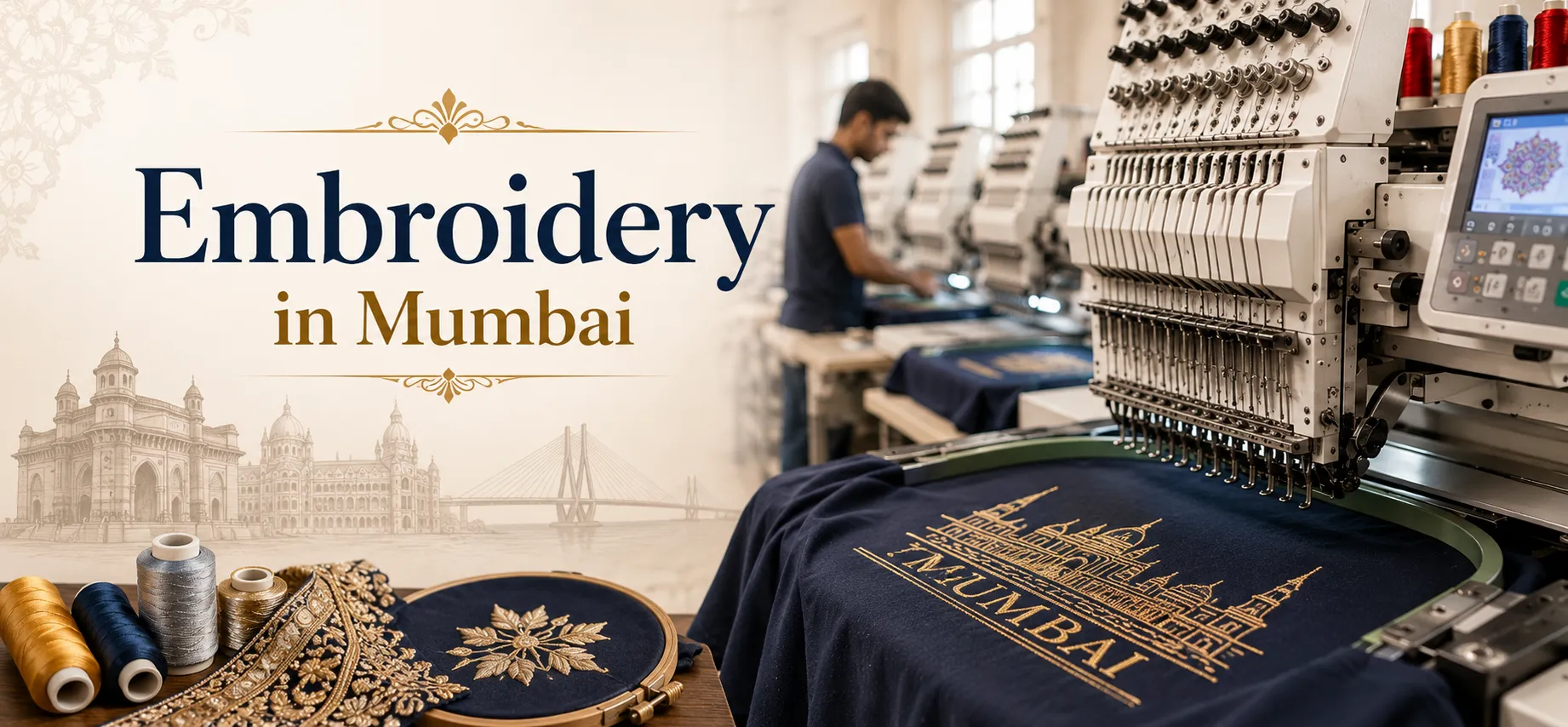
Search "embroidery in Mumbai" and you'll land on page after page of directory listings. IndiaMART, JustDial, TradeIndia, all of them showing you the same thing: a wall of names, a few phone numbers, maybe a photo of a sequin sample if you're lucky. Nobody actually tells you how this industry works, what you should expect to pay, or why the same search term can mean five completely different things depending on who's typing it.
So let's actually fix that. Whether you're a designer looking for hand embroidery work in Mumbai for a bridal order, a small brand trying to find someone who does clean machine work on a budget, or a manufacturer sourcing for bulk production, this guide walks through the real landscape, not just a list of names.
Want to skip the research and just talk to someone?
Say hello to our team here and we'll point you in the right direction, even if it turns out we're not the right fit for your specific job.
Why "embroidery in Mumbai" means so many different things
Here's the thing almost every listicle gets wrong. They treat "embroidery in Mumbai" as one category, when it's really at least three separate worlds that happen to share a search term.
There's the karigar-led hand embroidery world, small units and individual artisans doing zardozi, aari, cutdana, and sequin work by hand, often for bridal wear or couture houses. There's the job work world, small computerized embroidery units scattered across areas like Bhandup, Govandi, and Dharavi, taking in piece-rate orders from garment traders and boutique owners. And then there's the manufacturing side, larger facilities set up to handle bulk, export-ready production for fashion brands and garment exporters who need thousands of identical pieces done right.
Honestly, most people searching for "embroidery work in Mumbai" are looking for the second category, a job work unit that can take a batch of kurtis or dupattas and get it done at a fair per-piece rate. But the directories lump all three together, which is exactly why so many people end up calling five numbers before finding someone who actually does what they need.
What Mumbai's embroidery clusters actually look like
If you've ever tried to source embroidery in this city, you already know it's not centralized in one neighborhood. Job work units are spread across places like Bhandup West, Govandi, Kandivali East, and Dharavi, often tucked into gullies you'd never find without a local pointing you there. Dharavi in particular has a dense concentration of small embroidery and garment finishing units, part of the informal manufacturing economy that quietly supports a huge chunk of the city's fashion and export trade.
On the other end, you've got more design-forward studios based in areas like Malabar Hill and central Mumbai, doing bespoke hand embroidery for bridal and couture clients, the kind of work that involves sitting with a designer over swatches rather than dropping off fabric at a counter. Trust us on this one, the vibe of these two worlds is completely different, one is fast-paced piece-rate production, the other is slow, deliberate, artisan-led craft. Knowing which one you actually need saves a lot of wasted calls.
What embroidery work actually costs in Mumbai
This is the part almost nobody explains clearly, and it matters a lot if you're budgeting for a project. Job work pricing in Mumbai is usually quoted per piece for simple computerized designs, and per thousand stitches for more custom or digitized work. Basic thread embroidery on a plain garment might run somewhere in the low single digits of rupees per piece for very simple motifs, while detailed work involving sequins, cutdana, or dense zari can run well over a hundred rupees per piece depending on complexity and the fabric it's going onto.
For international clients or larger digitized jobs, some Mumbai units also quote in dollars per thousand stitches, a pricing model that's more standard globally and makes it easier to compare quotes across cities. Either way, the real cost driver isn't the garment itself, it's the stitch density and technique. A simple outline motif and a dense, multi-layered zardozi panel are not the same job, even if they're going on the same size of fabric, and any unit that quotes you a flat price without asking about design complexity is probably going to surprise you later.
The techniques you'll actually run into
Mumbai's embroidery scene covers a genuinely wide range of techniques, and this is one place where the city still holds an edge over a lot of other manufacturing hubs. Zardozi, the metallic thread and wirework technique associated with bridal and festive wear, has deep roots here. Aari work, done with a hooked needle for fine chain stitching, is common for both bridal detailing and everyday kurti embroidery. Sequin and cutdana work, computerized thread embroidery, and applique are all readily available too, often within the same cluster of units.
What this means practically is that if your design needs more than one technique, say a base of machine embroidery with hand-finished sequin detailing layered on top, Mumbai is one of the few places where you can realistically get both done without shipping work between cities. That combination of skills in one place is genuinely rare, and it's a big part of why the city hasn't lost its pull despite manufacturing shifting to other regions over the years.
Job work vs. a full embroidery company, and why the difference matters
If your order is small, a handful of garments or a one-off design, a local job work unit is exactly right. Quick, flexible, priced fairly. But if you're a brand or manufacturer planning to run the same design across a few thousand pieces, season after season, that setup starts showing its limits. Job work units are built for flexibility, not for holding a design's exact tension, color, and density consistent across a huge run.
This is really where an established embroidery company in Mumbai earns its place. A company built for bulk production locks in machine settings and quality checks before a full run starts, so piece 3,000 looks the same as piece 3. If you want a deeper look at how these two models compare and where the line sits, our breakdown of embroidery services in mumbai goes into it in more detail.
And if Mumbai is just one of a few cities you're weighing for a sourcing decision, it's worth zooming out. Our wider guide to embroidery companies in India breaks down how different clusters across the country compare, useful if you're not fully committed to sourcing locally yet.
What to actually check before you commit to someone
Every directory listing looks the same on the surface, a name, a rating, a "verified" badge. None of that tells you whether the unit can actually deliver your specific job well. Before handing over a design, it's worth asking a few direct questions.
Ask to see finished samples in the exact technique you need, not just their general portfolio. Ask about realistic turnaround, and be specific, a hand embroidery order of a hundred detailed pieces can easily take ten days or more, while a simple machine job on fifty pieces might be done in two or three. Ask how they handle rework if something comes back wrong, since this is where a lot of job work relationships quietly fall apart. And if your order is going to scale up later, ask upfront whether they can actually handle that volume, rather than finding out the hard way mid-season.
Conclusion
Embroidery in Mumbai isn't one thing, it's an entire ecosystem, from karigars doing hand zardozi in small units to large-scale facilities running bulk, export-ready production. The trick is figuring out honestly which world your project actually belongs to before you start calling numbers off a directory listing.
If you're leaning toward the bulk or export side of that spectrum, we'd be glad to talk through your design, technique, and volume directly. Get in touch with our team here and we'll give you a straight answer on timelines and pricing, no generic quote, just real numbers for your actual order.
